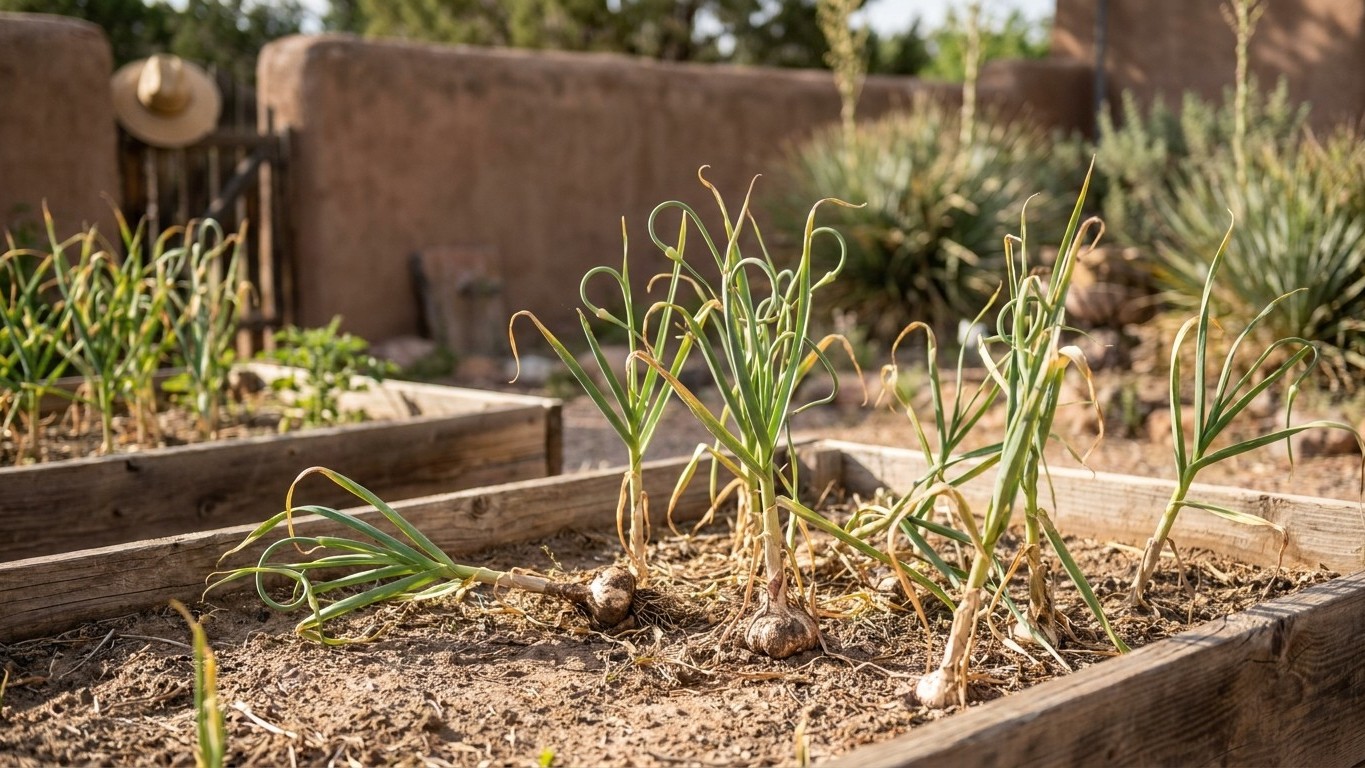

A round, undivided bulb instead of a head full of cloves — that’s what a New Mexico gardener finds at harvest when hardneck garlic goes into ground that never gets cold enough, long enough. The clove split needs weeks of soil chill to trigger it, and skip that window and the plant just lifts as one solid round the following summer, wasted effort from October to July. Most of the state, sitting up on high desert elevation, clears that bar without trying. The low southern deserts don’t.
Will garlic get the cold it needs in New Mexico

Garlic does not divide into cloves on its own. It needs a stretch of genuinely cold soil after planting to trigger that split, and skip the chill and the plant lifts as one round, undivided bulb the following summer instead of a head. University of Georgia Extension publication C854 sets that requirement at six to eight weeks with temperatures below 40°F, and that number is the one to hold against your own winter before you commit to a hardneck type.
Most of New Mexico clears it without much drama. This is high desert country, and at the elevations where the bulk of the state’s garlic goes into the ground, winter delivers months of cold, not just weeks of it. NOAA’s 1991-2020 normals put the first fall freeze at Albuquerque’s official station somewhere between October 29 and November 9, which tells you cold arrives on schedule through the middle of the state and holds through winter. A garden in New York clears the same threshold even more easily, as described in Growing Garlic in New York: Planting Dates, Varieties and Winter Cold, but New Mexico’s advantage comes from elevation rather than latitude, and that advantage thins out fast as you drop toward the low deserts.
The low, warm pockets of the south, and any garden sitting well below the elevation of Albuquerque’s reference station, run closer to the edge in a mild winter. A grower there should not assume the chill is automatic just because the calendar says winter. Two real options cover that gap. Refrigerate seed cloves near 40°F for several weeks before planting, broken apart from the bulb and kept dry so they don’t sprout or rot in the crisper drawer. Or plant a softneck type, which needs less chilling to divide reliably and shrugs off a lax winter far better than any hardneck will; for a full rundown of which cultivars fit each region, see Garlic Varieties That Suit New Mexico Winters. Neither is a consolation prize. Never treat a marginal winter as a reason to skip garlic. It only changes which type belongs in your ground and whether the cloves need a head start in the refrigerator before they ever touch soil.
When to put the cloves in
Anchor this decision on the first fall frost, not on a page-of-the-calendar date, because what garlic actually needs is time to root before the ground locks up, without so much warmth left that it pushes tall top growth going into winter. This guide to When to Plant Garlic in New Mexico builds directly off this frost anchor. NOAA’s 1991-2020 normals put that first freeze at Albuquerque’s reference station between October 29 and November 9. Count backward three to four weeks from the middle of that range, in the neighborhood of November 3, and you land in early to mid October, which is exactly why every cultivar listed further down calls for setting cloves out from early October through mid October.
What moves that date around the state
New Mexico has no coastline and no large lake to soften its air, so elevation is the dominant factor that shifts this window from one county to the next. High mountain valleys in the north often see their first freeze weeks earlier than Albuquerque’s station reports, and a grower there should plant on the early edge of the window or even before it. The low desert along the southern border runs weeks later and warmer, and cloves can go in on the late edge of the window, sometimes past it, without any harm.
Treat the October 29 to November 9 figure as a midpoint for counting backward, never as a safe planting date in its own right. It comes from one station near Albuquerque, and NOAA is explicit that suburban and rural gardens typically see their first fall frost earlier than an airport reading, sometimes by a week or two, more at elevation. If your county sits high or sits in a cold pocket, plant early and let the extra time work in your favor. Rooting without much leaf growth is the goal, not a race to plant on the latest possible day.
Which types suit New Mexico
Hardneck or softneck is not a matter of taste in this state. It is a matter of what your winter actually does. Hardneck garlic wants a real cold season to divide well and produce the scape gardeners prize; softneck garlic tolerates a milder or less predictable winter and, in exchange, stores for months longer in a pantry or root cellar.
Given how much of New Mexico sits at elevation with a genuine cold season, hardneck varieties do well across the northern and mountain counties, where winter reliably clears the chilling threshold discussed above. Gardeners just across the state line face the same climate logic in reverse in the low desert, and the same softneck-first approach applies there too, covered in Growing Garlic in Arizona: Planting Dates, Varieties and Winter Cold. In New Mexico’s own low, warm pockets, softneck is the safer default, and the longer storage life is a real advantage against a hot, dry summer pantry.
| Variety | Neck type | Fits best where |
|---|---|---|
| Inchelium Red | Softneck | Warmer, lower-elevation gardens; long storage |
| Lorz Italian | Softneck | Mild winters, southern counties |
| German White | Hardneck | Cold, high-elevation counties |
| Chesnok Red | Hardneck | Northern mountain gardens |
| Duganski | Hardneck | Cold winters, shorter storage |
| German Red | Hardneck | High desert with a real winter |
| Georgian Crystal | Hardneck | Cold winters |
| Blue Music | Hardneck | Cold winters, large cloves |
Beyond that shortlist, Chesnok Red and German Red are common choices for a grower who wants the flavor spread a hardneck offers, while Early Red Italian and Italian Late round out the softneck side for anyone gardening in the warmer valleys. Fall Festival and Ivan, both hardneck, and Georgian Fire and Bavarian Purple all want the same cold-winter counties as the rest of the hardneck list above.
Soil and bed preparation
Garlic sits in the same patch of ground from fall planting through the following summer’s harvest, which means whatever is wrong with that soil in October is still wrong with it in March. Drainage comes first. A clove that sits in standing water through a wet spell of winter rots long before any disease organism gets involved, and that failure looks identical to cold damage unless you already know your bed drains fast.
Steps to take in the weeks before planting
- Work several inches of finished compost or aged manure into the bed to loosen New Mexico’s often heavy or caliche-laced soils.
- Raise the bed a few inches above grade if water has ever pooled there after a hard rain.
- Pull the previous crop’s roots and debris, since old onion or garlic residue can carry disease straight into new cloves.
- Test soil pH and fertility rather than guessing, especially in alkaline high-desert soils that often run higher than garlic prefers.
- Water the bed a day or two before planting so cloves go into moist, not bone-dry or waterlogged, ground.
Break bulbs into cloves right before planting, not weeks ahead, and set only the biggest, firmest cloves aside for the garden. A cracked or bruised clove is an open door for rot over a long winter in the ground, and it is far cheaper to eat a marginal clove now than to lose the plant it would have grown into.
What the climate here favours, and what it does not
UC IPM’s Pest Management Guidelines for onion and garlic (UC ANR Publication 3453) publish the soil temperature ranges where several major garlic diseases are active, and cross-referencing those ranges against New Mexico’s growing-season air temperatures gives a rough sense of which threats have more months of opportunity here and which have fewer. Those published thresholds are soil temperatures, and the figures below are air temperatures, so this is a tendency worth watching, not a diagnosis or a forecast of infection.
| Disease | Pathogen | Months in range, Sept-July | Level |
|---|---|---|---|
| White rot | Sclerotium cepivorum | 5: September, October, April, May, June | Critical |
| Fusarium basal rot | Fusarium oxysporum f. sp. cepae | 4: September, May, June, July (1 at optimum) | Critical |
| Pink root | Setophoma terrestris | 1 at optimum: July | High |
| Southern blight | Sclerotium rolfsii | 0 months at optimum | High |
White rot has the widest window here, with New Mexico’s mean air temperatures falling inside its published 50 to 75°F range across five months of the growing season. Fusarium basal rot follows with four months in range, including one squarely at its published optimum near the height of summer. Pink root only lines up with New Mexico’s climate for a single month, July, and that is also its optimum, worth noting if bulbs show pink-tinged roots at harvest.
Southern blight is the one piece of real reassurance in this table. No month of New Mexico’s growing season reaches its 86 to 95°F optimum on average, which means the disease is less active here than in a genuinely hot, humid climate, not that it cannot show up. Infected seed stock or a warm microclimate can still bring any of these four in regardless of what the monthly averages say, and starting with clean, disease-free cloves from a reputable source matters more than any temperature table.
Getting it through the winter
Mulch is what stands between a planted clove and a New Mexico winter that swings hard between freezing nights and sunny, wind-dried days. Lay a generous, even layer of straw or shredded leaves over the bed shortly after planting, once the soil has cooled but before the first hard freeze locks it up. That timing matters. Mulch put down too early traps warmth the clove doesn’t need and can encourage the kind of early top growth you’re trying to avoid, while mulch laid too late does nothing for a bed that’s already frozen solid.
Depth matters more here than in a milder, wetter climate, because New Mexico’s dry, often windy winters pull moisture out of exposed soil fast and expose shallow-planted cloves to frost heaving, the freeze-thaw cycling that pushes a clove partway out of the ground and leaves it sitting on the surface to dry out or freeze outright. A clove planted at proper depth and covered well is far less likely to heave than one set shallow in loose soil.
Leave the mulch in place through winter and into early spring, then pull most of it back once new green shoots push through and the hardest freezes have passed, since NOAA’s data on the state’s last spring frost is not part of this article but any grower should check their own county’s spring freeze risk before uncovering too early. A thin layer left in place through the growing season still helps New Mexico’s dry summer soil hold moisture around the developing bulb.
Harvest and curing here
Pull garlic by reading the plant, not the calendar. Lift the bulbs once the lower third to half of the leaves have browned and dried while the upper leaves are still green, since each green leaf corresponds to a papery wrapper layer around the bulb, and waiting too long past that point costs you those protective wrappers and shortens how long the bulb will keep.
New Mexico’s dry summer heat is an advantage for curing, not a complication, as long as you manage it rather than trust it blindly. Direct sun on freshly pulled bulbs can scorch or partially cook cloves within hours in the kind of heat the state sees at harvest time, so move bulbs into shade with good airflow immediately, rather than leaving them lying in the row to dry.
Curing in dry heat
Hang or lay bulbs in a single layer somewhere shaded, dry, and ventilated, a carport, covered porch, or open shed all work. In New Mexico’s low humidity, curing generally moves faster than the multi-week timelines quoted for humid climates, but rushing it still costs flavor and storage life. Wait until the outer wrapper is fully papery and the neck is tight and dry before trimming roots and tops, and resist the urge to call it finished just because the outside looks dry after a few days. The center of a bulb cures more slowly than its surface, and cutting that process short is one of the most common ways growers lose a crop they’d already safely harvested.
Local help
County-level frost dates, soil test results, and disease pressure all vary enough across a state this large and this varied in elevation that a single article can only get you close. New Mexico State University’s Cooperative Extension Service, at aces.nmsu.edu, publishes county-specific planting guidance and offers soil testing through its county offices. Check with your county’s extension office before finalizing a planting date, especially if your garden sits well above or below Albuquerque’s elevation.
Common questions
Can I Plant Garlic in spring in New Mexico instead of fall?
You can, but expect smaller bulbs with fewer, less-defined cloves, since spring planting skips most or all of the cold period garlic needs to divide well. Fall planting, timed to the first frost window discussed above, is the standard approach here and gives noticeably better results.
My garlic sent up a tall flower stalk. Should I let it bloom?
That stalk is a scape, not a flower stem in the fruiting sense, and it should be cut once it curls, not left to mature. Cutting it redirects the plant’s energy into the bulb instead of the top growth, and the scape itself is edible.
Is it too late to plant if I miss the early-to-mid October window?
Not necessarily, particularly in the state’s warmer, lower-elevation counties where the first frost lands later than at Albuquerque’s reference station. Planting into November still works there. In colder, high-elevation gardens, get cloves in the ground as soon as possible and mulch heavily to make up for lost rooting time.
Why did I only get one round bulb instead of a head of cloves?
That’s the classic sign of insufficient chilling, discussed above under the six to eight week threshold from University of Georgia Extension. It happens most often to hardneck varieties planted too late, planted in too warm a spot, or grown from cloves that were never refrigerated to make up for a mild winter.
Do I need to water garlic through the winter in New Mexico?
Established garlic mostly goes dormant through the coldest stretch and needs little water then, but New Mexico’s dry winters mean beds can dry out completely if there’s no snow cover or rain for weeks. Check soil moisture under the mulch occasionally and water lightly during dry spells so the bed doesn’t go bone-dry going into spring growth.