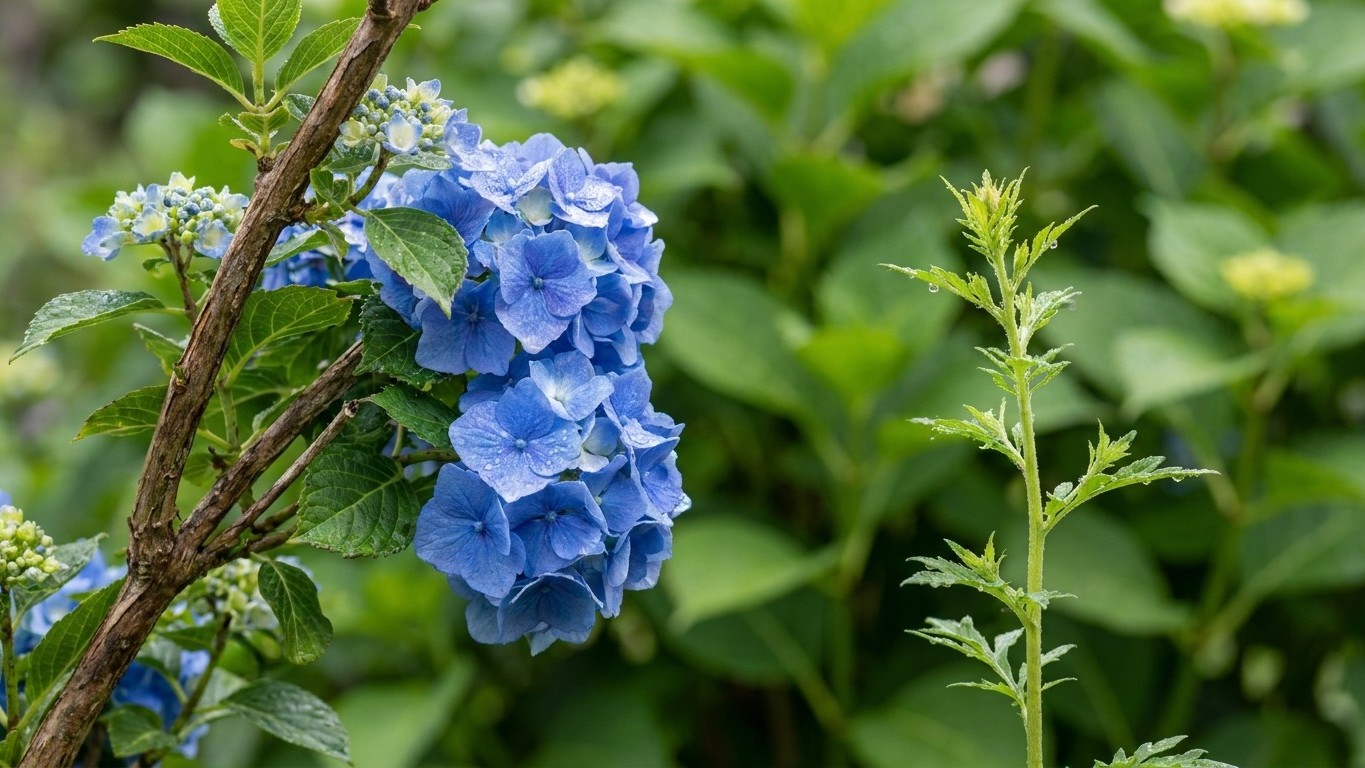

Hydrangeas bloom pink in New Mexico because the soil and the irrigation water are alkaline. At a high pH, the aluminum in the ground stays locked in minerals, and a bigleaf hydrangea can’t absorb it. Without aluminum moving through the plant, the flowers turn pink. Lower the pH around the roots and supply aluminum, and the same plant can bloom blue. Expect a season or two of work, then regular upkeep.
What this comes down to in New Mexico

Hydrangeas are pink here because alkaline soil blocks aluminum, and turning them blue means acidifying the root zone during the growing season, which at Albuquerque (the reference city for these frost figures) runs from the last spring frost, March 31 to April 12, to the first fall frost, October 29 to November 9. Those dates come from the NOAA NCEI U.S. Climate Normals, and they describe the airport weather station only. A suburban, rural or higher-elevation garden can freeze later in spring and earlier in fall, sometimes by a week or two or more.
Between those two frost windows there is a long growing season. That is the stretch when flower buds form and when acidifying treatments can reach the roots. Flower color is decided by what the plant takes up while those buds develop, so a soil drench in late fall does little for next summer’s blooms.
How does soil pH change hydrangea color?
The pigment in the flower is the same in pink and blue plants. When aluminum is available, it binds to the pigment and shifts it toward blue. Aluminum dissolves into a form roots can use when the soil is acidic, and it becomes largely unavailable as the soil becomes less acidic.
Many New Mexico soils are alkaline. Caliche, the whitish layer of calcium carbonate under much of the desert and its edges, keeps pushing pH upward. So does hard tap or well water, which carries bicarbonates that neutralize any acid you add. A pink hydrangea here is behaving normally for the ground it grows in.
Which hydrangeas can actually turn blue?
Bigleaf hydrangeas (Hydrangea macrophylla, both mopheads and lacecaps) and mountain hydrangeas (Hydrangea serrata) respond to soil chemistry. Classic mopheads such as ‘Nikko Blue’ and the reblooming Endless Summer series fall in this group. White-flowered types such as smooth hydrangea (‘Annabelle’) and panicle hydrangeas (‘Limelight’ is a common one) ignore pH entirely. Panicle blooms fade to pink as they age no matter what is in the soil, so that color change is no sign of alkalinity. White bigleaf cultivars stay white too, because they lack the pigment.
Working it out for your own garden
Start with a number. Guessing at soil acidity wastes a season, and a pH test costs little. Take samples from several spots under the dripline, mix them, and use a home kit or send a sample to a lab through your county extension office.
| Soil pH | Typical bloom color | What to do |
|---|---|---|
| 5.2 to 5.5 | Blue | Maintain with acidic mulch and periodic aluminum sulfate |
| 5.5 to 6.0 | Purple or mixed blue and pink | Lower a little more for clear blue |
| 6.0 and above | Pink to red | Acidify, or move the plant to a container |
How much aluminum sulfate does a pink hydrangea need?
A common home method is to dissolve aluminum sulfate in water and pour it around the base of a plant whose soil is already damp. Repeat from the time new growth appears through early summer. Label rates differ by product, so follow yours. Dry soil plus strong solution can burn roots.
Here is the reasoning behind it. If your test reads high and blue needs an acidic soil, you are asking for a large drop in pH. The scale is logarithmic, so that is a large change, and alkaline soil with free lime will push back on every application. In a garden bed with caliche or limestone-rich native soil, the pH often drifts back within weeks.
What does a worked example look like?
Take a mophead like ‘Nikko Blue’ planted straight into native soil with a pH near 8. Expect pink to purplish blooms, whatever you pour on. Put that same cultivar in a large container of peat-based or pine bark potting mix, which starts in the acidic range, water it with the aluminum sulfate solution on schedule, and blue is realistic. A raised bed filled with acidic mix works the same way, as long as it is lined from the native soil below.
Frost can still ruin the show. Old-wood bloomers set their flower buds the previous summer. If a warm March wakes the buds and a freeze lands in the early-April window, the flowers are gone and color never gets a chance. Reblooming types flower on new wood as well, so they recover with a later flush. A panicle hydrangea will never turn blue, no matter how perfect the pH.
Skip high-phosphorus fertilizer on plants you want blue. A low-phosphorus feed is the usual choice. For the broader basics of siting and care, the state guide on growing hydrangeas in New Mexico covers them.
What changes across the state
New Mexico spans many USDA hardiness zones, from cold mountain zones in the north to mild zones in the southern deserts (USDA Plant Hardiness Zone Map, based on the average annual extreme minimum temperature). That range tells you the state is several climates at once, and the Albuquerque frost dates are one reference point among many.
Elevation moves the frost window a great deal. High-country gardens in the north and in the mountains see spring freezes well after the reference-city range and fall freezes well before it. The growing season shrinks, and old-wood bigleaf buds face a longer stretch of risk. Lower, warmer valleys in the south sit closer to or earlier than the reference range, with more heat stress on leaves in summer.
Soil and water shift too. Desert basins and river valleys tend toward alkaline soil and mineral-rich water. Soils under mountain forests, especially where conifer needles build up, are often less alkaline, so blue comes more easily there. That does not mean they are acidic. Test every site, because one lot can differ from the next one over.
Your water matters as much as your dirt. A garden on a private well may pull in very hard water, while a garden on municipal supply gets whatever the utility delivers. Rainwater or collected snowmelt is gentler and closer to neutral. If you can collect it, it keeps your amendments from being neutralized so fast.
The mistakes this state punishes

Adding aluminum sulfate without testing is the first one. Gardeners with soil already near 8 sometimes pour on strong solutions, burn the roots, and still get pink flowers. Test first, apply to moist soil, and retest after a few applications.
Planting into the ground and expecting blue is the second. Native soil with caliche will fight you. Containers and raised beds with acidic mix give you control over pH, and they are easier to correct when something goes wrong.
Third, concrete edging, stucco walls, adobe, and gravel mulches made from limestone can affect nearby soil pH. Keep hydrangeas away from them, or use a bark-based mulch and a liner.
Fourth, pruning in spring. Old-wood bigleaf varieties carry next season’s flowers on last year’s stems. Cutting them back after a warm spell removes the buds before the frost window has even closed, so prune right after bloom if needed.
Fifth, trusting a warm spell. Soil that warms in March is no promise of frost-free weather. At the reference city, the last spring frost falls after April 12 in roughly one year in three and as late as about April 23 in one year in ten, and later in many gardens. Hold off on removing winter protection until the window has clearly passed in your county.
Checking this against your county
The frost dates here describe one weather station, and the soil numbers describe typical conditions, not your yard. Your county office of New Mexico State University’s Cooperative Extension Service can tell you your local frost range, run or recommend a soil test, and explain the water chemistry in your area. For the full picture of care, siting and choices, return to the state guide on growing hydrangeas. The frost figures come from the NOAA NCEI U.S. Climate Normals.
Common questions
Can I turn hydrangeas blue in New Mexico without containers?
It is possible but hard to hold. Native alkaline soil and hard water raise the pH back after every treatment, so in-ground plants need repeated aluminum sulfate applications, acidic mulch, and retesting. Most gardeners get better results from a large pot or a lined raised bed filled with acidic mix.
How long does it take for blooms to change color?
Plan on a gradual shift, such as purple or mixed blooms, and often longer for clear blue. Flower color follows what the plant absorbs while buds form, so the change shows up in new blooms rather than flowers that are already open.
Will my white or panicle hydrangea turn blue if I acidify the soil?
No. Smooth hydrangeas such as ‘Annabelle’ and panicle types do not respond to aluminum. Their flowers may age to pink or green, which has nothing to do with soil. Only bigleaf and mountain hydrangeas with the right pigment can change.
Is pink a sign my hydrangea is unhealthy?
Pink flowers are normal for a bigleaf hydrangea in alkaline soil. Leaf color tells you more about health. Yellowing leaves with green veins point to iron chlorosis, which is also common in high-pH soil and is a separate problem from flower color. Ask your county extension office how to treat it.