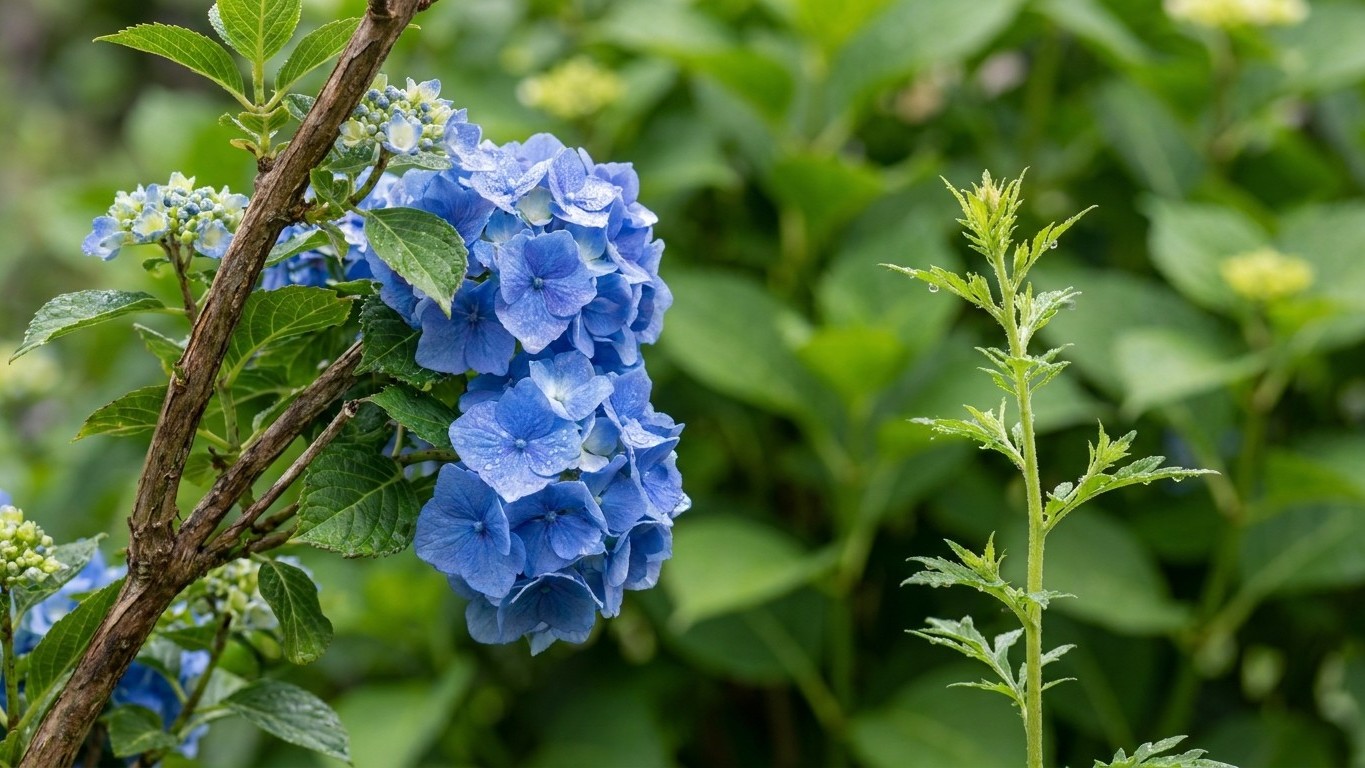

Hydrangeas can work in New Mexico, but only when the type, the planting date and the site all line up. Panicle and smooth hydrangeas take the state’s temperature swings best, afternoon shade protects the leaves, and the alkaline soil common across much of the state pushes bigleaf flowers toward pink instead of blue. In Albuquerque, the reference city here, planting opens in mid-April. Colder or higher ground runs later.
When to plant Hydrangeas in New Mexico

The frost numbers come from the NOAA NCEI U.S. Climate Normals for 1991-2020, based on 32°F freeze probabilities in the 30-70% band at the Albuquerque airport weather station. The last spring frost falls between March 31 and April 12. The first fall frost arrives between October 29 and November 9. Those are ranges, not deadlines. Inside them, the odds of another freeze are sliding from likely to unlikely.
An airport sits in the warm, paved middle of a metro area. Suburban and rural gardens usually get their last spring frost one to two weeks later and their first fall frost one to two weeks earlier, and the gap widens with elevation. Northern New Mexico and any mountain-facing lot run later in spring and end sooner in fall. Treat the Albuquerque dates as a starting point and check your own county before you commit.
Nursery plants, cuttings or seed
Most New Mexico gardeners will buy hydrangeas in containers. Growing from seed is possible but slow, the seedlings vary, and flowering can take years. Cuttings rooted indoors are a better do-it-yourself route, and once they have roots they follow the same schedule as a nursery plant.
The count-back from your planting date
Pick the planting date first, then work backward. Take April 12, the late end of the Albuquerque range, and add a day: April 13. Container plants that spent weeks in a greenhouse or inside need 7 to 10 days of hardening off, so they should start going outdoors by April 3, first in shade for a few hours, then longer, then in morning sun. A suburban garden that frosts one to two weeks later shifts everything to roughly April 20 through 26, with hardening off starting about April 10 to 16.
Dormant, bare-root or just-bought nursery plants that are already outside can go straight in once the freeze risk has passed. Bigleaf hydrangeas set their new leaves early, and one late freeze can blacken them and take the season’s flower buds with them.
Fall planting works too, mainly in milder lower-elevation areas. A common rule of thumb is to get roots in at least six weeks before the first frost. Counting back from October 29 lands on September 17.
Soil and site preparation
Light matters more here than almost anywhere else in the country. New Mexico’s high elevation means intense sun and low humidity, which leaves hydrangea leaves scorched and flopping by late afternoon. An east-facing bed that gets morning sun and afternoon shade is the best case. A spot against a south or west wall is the worst, especially next to gravel or bare rock mulch, which radiate heat back into the plant.
Texture comes next. Hydrangeas want soil that holds moisture and still drains. Heavy clay and caliche layers both fail that test in opposite ways: clay stays soggy around the crown, while a hardpan layer turns the planting hole into a bathtub. Dig the hole two to three times as wide as the root ball and no deeper, so the crown sits level with the surrounding soil. Check that water drains from the hole within a few hours. If it doesn’t, move the plant or build a raised bed.
Start the prep weeks ahead, not on planting day. Four to six weeks before the plant goes in, work 2 to 3 inches of compost into the top 8 to 12 inches of the bed. That gives the organic matter time to settle and the soil life time to wake up. A soil test at the same time tells you the pH, which matters for flower color and for iron availability. Sulfur to lower pH works slowly, over months, so apply it only if a test says you need it, and do it well ahead of planting. This article carries no local soil survey numbers, so test your own soil.
Spacing follows mature size. Compact bigleaf and smooth types need about 3 to 4 feet between plants, while large panicle types can want 6 feet or more. The plant tag has the number. Set up drip irrigation or a soaker line before planting, because retrofitting it around a young shrub is a nuisance.
Varieties that suit New Mexico
Season length matters less for hydrangeas than for vegetables, since you are not racing to a harvest. The traits that count are what wood the flowers form on, how well the plant takes cold snaps, and how much sun and heat it tolerates. A shrub that blooms on new growth shrugs off a late freeze. One that blooms on last year’s wood can lose the whole show.
| Type | Blooms on | Heat and sun | Cold and late frost | Widely sold examples |
|---|---|---|---|---|
| Panicle (H. paniculata) | New wood | Best of the group, tolerates more sun | Very hardy, reliable after a freeze | ‘Limelight’, ‘Little Lime’, ‘Quick Fire’ |
| Smooth (H. arborescens) | New wood | Needs afternoon shade | Hardy, resprouts after damage | ‘Annabelle’, ‘Incrediball’ |
| Bigleaf (H. macrophylla) | Old wood, some rebloomers also on new | Needs shade and steady water | Buds vulnerable to late frost | ‘Endless Summer’ series |
| Oakleaf (H. quercifolia) | Old wood | Handles heat better than bigleaf | Moderately hardy | ‘Snow Queen’ |
For most New Mexico yards, panicle types are the safest bet. They tolerate the most sun, bloom on new wood and keep going through variable springs. Compact selections such as ‘Little Lime’ suit small beds and containers. Smooth hydrangeas like ‘Annabelle’ do well in shade, though the big heads can flop. ‘Incrediball’ was bred for sturdier stems.
Bigleaf hydrangeas are the ones everybody pictures, and they are the hardest here. Rebloomers such as the ‘Endless Summer’ series flower on both old and new wood, which hedges against a lost bud set. With alkaline soil, expect pink or purple, not the vivid blue on the plant tag. Oakleaf hydrangeas offer peeling bark and red fall color, and they are worth a try in a sheltered, shaded spot.
What to plant alongside
The best neighbors share a hydrangea’s tastes: part shade, moisture and rich soil. Hostas, ferns, heuchera and Japanese forest grass all fit that bill, and they also shade the soil and slow evaporation around the shrub’s roots. Low groundcovers such as sweet woodruff do the same job. Spring bulbs planted underneath finish their show before the hydrangea leafs out fully.
Pollinators are a mixed story. Panicle and smooth hydrangeas bear small fertile flowers that bees visit. The big mophead types are mostly sterile showpieces with little to offer. If bees matter to you, plant a panicle and add a few nectar plants nearby that tolerate the same watering.
Keep drought-tolerant plants out of the same bed. Lavender, Russian sage, many penstemons and most native xeric plantings hate the frequent water hydrangeas need, and they rot or sulk if you give it. Rock gardens and gravel borders are the wrong neighbors for the same reason. Large trees compete too, since cottonwood and poplar roots are thirsty and aggressive. Acid-lovers like azaleas and rhododendrons share hydrangea’s preferences in theory, but alkaline soil makes them hard to keep alive without a lot of effort.
Some pairings have little evidence behind them. Marigolds repelling pests and garlic or chives confusing aphids are popular claims, but there is little solid support for either protecting a hydrangea. Coffee grounds do not reliably turn flowers blue. Treat those as optional garnish, not a pest plan.
Watering, feeding and support
Water deep and less often. A slow soak that wets the top foot of soil beats a daily sprinkle, because it pushes roots down where the soil stays cooler. New plants may need water two or three times a week in the first summer, tapering as roots establish. Established shrubs in high-desert heat still want a weekly deep soak at minimum, and more in a hot spell. The finger test is more accurate than a calendar. Push a finger 2 inches into the soil beside the plant, and water if it feels dry.
Mulch is the cheapest insurance you can buy. Spread 3 to 4 inches of wood chips or shredded bark over the root zone, keeping it a couple of inches off the stems. It cuts evaporation, evens out soil temperature and slowly feeds the soil as it breaks down. Pick organic mulch, since rock radiates heat onto the shrub.
Feed lightly. One application of a balanced slow-release fertilizer in spring as growth starts is enough for most plants. Heavy nitrogen buys you leaves and fewer flowers. If new leaves come in yellow with green veins, the likely culprit is iron chlorosis, common in alkaline soil, and a chelated iron product plus mulch helps more than extra fertilizer.
Pruning depends on the type. Panicle and smooth hydrangeas bloom on new wood, so cut them back in late winter or early spring, before growth starts. Bigleaf and oakleaf types bloom on old wood, so prune right after flowering and not later, or you remove next year’s buds. Cut spent flowers and dead canes the rest of the time, and leave the live stems alone.
Support helps the heavy-headed types. Panicles and ‘Annabelle’ bend in rain and wind. A peony ring or a few stakes set early in spring, before the plant fills out, hides the hardware as leaves come in.
Common problems

Afternoon wilting on a hot day is normal, and the plant should perk up by evening. If the leaves are still limp in the morning, the soil is either too dry or, less often, too wet, and the finger test tells you which. Crispy brown leaf edges point to sun scorch or salts building up from irrigation water. A deep flush now and then, plus more shade, usually fixes it.
Yellow leaves with green veins mean iron chlorosis, as covered above. Plain yellowing across the whole leaf points more toward overwatering or poor drainage. Check the soil before you reach for fertilizer.
No flowers is the complaint that sends most people looking for answers. Bigleaf hydrangeas pruned in fall or winter lose their buds. A late freeze after leaf-out can kill buds on old-wood types even if the plant lives. A site that is too shady, or too much nitrogen, can also leave you with a lush green shrub and no blooms. Switching to a panicle or a rebloomer is often the practical answer.
Flower color surprises people. Blue needs acidic soil and available aluminum, and alkaline soil locks that aluminum up. Planting in a large container with acidic mix is the only dependable route to blue in much of New Mexico. White types such as ‘Annabelle’ and most panicles are not affected by pH.
Fungal issues like powdery mildew and leaf spots show up where air is stagnant or leaves stay wet. New Mexico’s dry air makes them less common than in humid states, but overhead watering in the evening invites them. Water at the base in the morning, and thin crowded stems if airflow is poor.
Pests that actually show up in New Mexico
New Mexico State University Extension’s Guide H-176 on garden insect pests lists the insects that matter for home gardens: bagrada bug, beet leafhopper, squash bug, aphids, thrips, corn earworm, spotted and striped cucumber beetles, grasshoppers and lygus bugs. It is not an exhaustive list, and pressure varies across the state. Several of those, such as squash bugs, cucumber beetles and corn earworm, are vegetable pests. Four are the ones to watch around hydrangeas.
Aphids come first. You see clusters of soft insects on new shoots and under leaves, curled or sticky foliage, and sometimes ants farming them. They hit in spring when growth is tender. A strong spray of water knocks most off, and insecticidal soap handles the rest if you repeat it.
Thrips are tiny, so what you notice is the damage: silvery streaks or stippling on leaves, and flowers that open flecked or deformed. Look at the flower heads in summer. Remove spent blooms, and use insecticidal soap on the plant. Thrips are hard to eradicate, so aim to keep numbers down.
Grasshoppers leave ragged holes and chewed leaf edges. The guide notes one generation a year, which makes timing the key. Young nymphs in spring and early summer are the target. A fine netting over small plants keeps them off, and bait products labeled for grasshoppers work best early.
Lygus bugs have three to four overlapping generations, so they are present for much of the season. The sign is distorted buds and flowers, or dimpled, discolored spots on new growth. They move in from nearby weeds, so clearing weeds around the bed reduces the pressure. Take unfamiliar damage to your county extension office for identification.
Harvest and end of season
Hydrangeas are cut flowers, and the harvest is the bloom. For fresh bouquets, cut in the cool of morning once the flower head is fully open, with a long stem, and put it straight into water. Cut hydrangeas wilt fast. Recutting the stem and an inch of water in the vase help.
For drying, wait. Late in summer, when the blooms turn papery and shift to muted greens, rose and burgundy tones, cut them and hang them upside down in a dry, dark spot with good airflow. They keep for months indoors. Panicle flower heads also hold well on the plant and dry there, giving winter interest.
As fall approaches, the reference-city range for the first frost is October 29 to November 9, and garden sites often see it one to two weeks sooner. In the last weeks before that, stop feeding so the plant can harden, and water deeply before the ground freezes. After the first hard frosts, add a fresh 3 to 4 inch layer of mulch over the roots. For bigleaf hydrangeas, which carry next year’s buds on old wood, leave stems unpruned. A ring of chicken wire stuffed with leaves, or a burlap wrap, shields the buds in colder areas.
Local help
Frost dates, soil pH and pest pressure shift from county to county. New Mexico State University Extension can connect you with your county office for local planting dates, soil testing and insect identification. For more state-specific advice, browse the New Mexico guides, or compare with Growing Hydrangeas in Arizona: Types, Colour and Winter and Growing Hydrangeas in North Carolina: Types, Colour and Winter. The full basics are in How to Grow Hydrangeas: The Complete Guide.
Common questions
When is the safest time to plant hydrangeas in New Mexico?
In Albuquerque, after the March 31 to April 12 last-frost range, so mid-April onward. Suburban and rural sites run one to two weeks later, and higher elevations later still. Fall planting works in milder areas if roots are in about six weeks before the first frost.
Which hydrangea is easiest to grow in New Mexico?
Panicle hydrangeas, such as ‘Limelight’ or ‘Little Lime’. They bloom on new wood, tolerate more sun than other types and recover from late frosts better than bigleaf types.
Can I get blue hydrangeas in alkaline soil?
Not reliably in the ground. Blue needs acidic soil, and alkaline soil keeps aluminum unavailable. A container with acidic potting mix is the realistic route, and a soil test tells you where your bed stands.
Why are my hydrangea leaves turning yellow with green veins?
That pattern is usually iron chlorosis, common where soil is alkaline. Chelated iron and organic mulch help. Yellowing across the whole leaf points more to overwatering or poor drainage.
Do hydrangeas need winter protection in New Mexico?
Panicle and smooth types rarely do. Bigleaf and oakleaf hydrangeas benefit from a thick mulch layer after the first hard frosts, plus a burlap or leaf-filled wire cage in colder areas to protect old-wood buds.