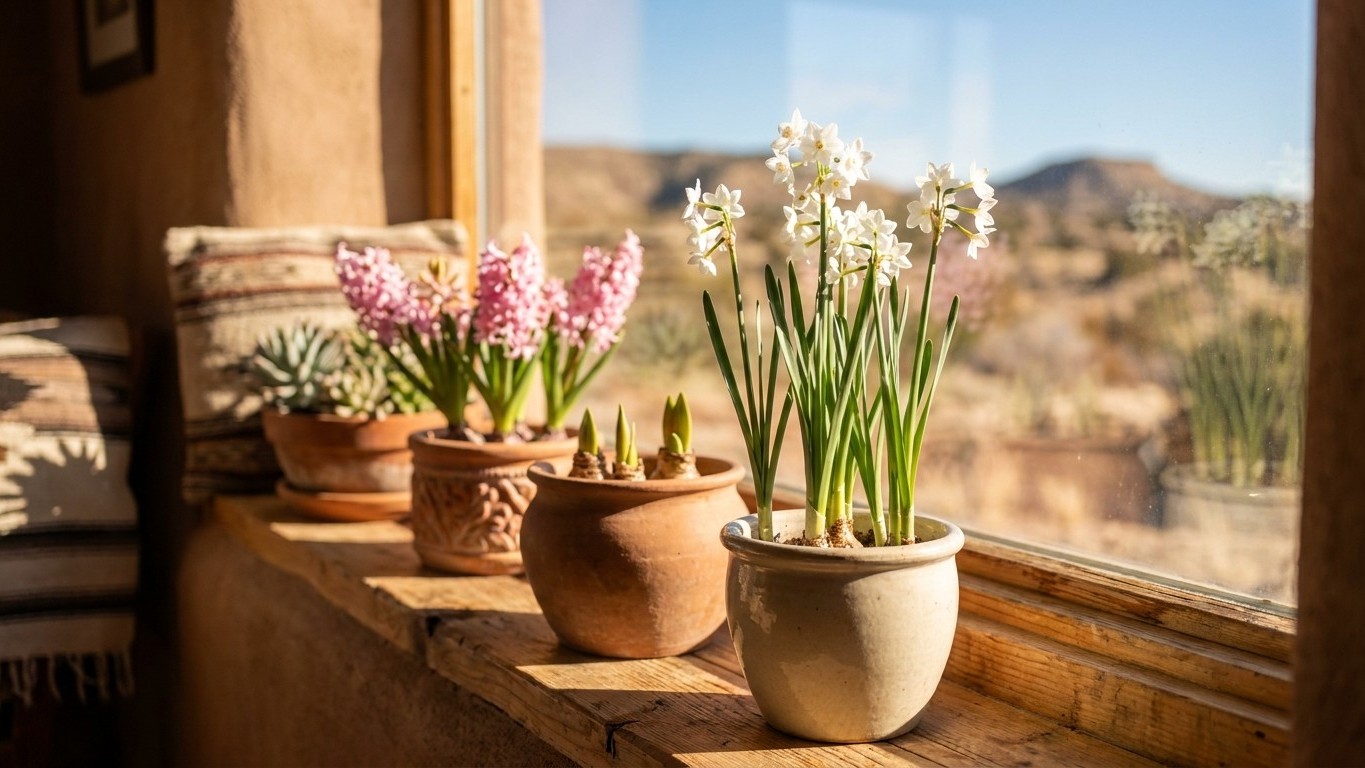

Forcing spring bulbs indoors works the same way in New Mexico as anywhere else: pot the bulb, give it weeks of cold below 45°F, then bring it into warmth and light so it blooms ahead of the outdoor garden. What changes here isn’t the technique. It’s why a gardener bothers at all, since the ground itself already delivers plenty of natural chill across most of the state, and the real risk shifts to containers left outside rather than to bulbs planted in a bed.
Why this matters in New Mexico

Albuquerque’s coldest month averages a daily minimum of 26.4°F, according to NOAA NCEI Climate Normals for 1991-2020. That’s well under the 45°F ceiling a tulip, hyacinth or daffodil needs to satisfy its chilling requirement, and it stays under that ceiling for months, not weeks. A bulb planted in the ground here gets its twelve to fourteen weeks of cold whether the gardener does anything or not. So forcing indoors in this state isn’t compensating for a winter that’s too mild, the way it might in a warm-winter coastal city. The soil is doing that job for free.
Where forcing actually earns its keep here is indoors, in a heated house, where a bulb never touches that outdoor cold at all. A gift amaryllis on a windowsill, a bowl of paperwhites on the kitchen table, a pot of hyacinths meant to bloom in January rather than April, none of those bulbs experience the 26.4°F nights doing the work outside. The gardener has to fake that winter in a refrigerator or an unheated space, because the house itself never gets cold enough to trigger the bulb’s internal clock.
Containers left outdoors raise a separate problem, and it’s the one that actually bites in New Mexico. The USDA Plant Hardiness Zone Map (2023, based on 1991-2020 normals) places the state across a 4b-9a range, one of the widest spans of any state, reflecting elevation swings from the low Rio Grande valley to mountain towns above 8,000 feet. Albuquerque itself sits in the middle of that range, but a reader in Taos or Silver City is gardening under a different number entirely. A pot has none of the insulating mass of open ground: it freezes solid, roots and all, in conditions where an in-ground planting a few feet away would sail through the winter untouched. That mismatch, not a shortage of regional cold, is the practical hazard for anyone forcing bulbs in containers left outside to chill.
So the state falls squarely into the container category, not the missing-cold category. The chilling itself is abundant. The danger is choosing a pot as the chilling chamber and leaving it exposed to a cold that a bed would have buffered.
How to do it here
The steps don’t change from one region to the next, but where a New Mexico gardener finds the cold, and what threatens the pot, does.
- Choose a bulb suited to forcing. Small, quick-chilling types (crocus, muscari, dwarf daffodils, hyacinths) tolerate the process better than tall, late tulips.
- Pot it shallow, with drainage. Set the bulb with its nose just above the soil line in a container that actually drains; a pot without a hole is the single most common cause of rot later.
- Find a spot that holds steady under 45°F for the required weeks. An unheated garage works in much of New Mexico as long as it doesn’t dip well below freezing on the coldest nights of the year, since Albuquerque’s coldest-month minimum already averages 26.4°F, an attached garage can track close to that. Check it with a thermometer rather than assuming.
- Or use a refrigerator drawer, away from fruit. Ripening apples and pears give off ethylene gas, and ethylene damages the flower bud forming inside a chilling bulb. Keep the pot in a produce-free drawer.
- If the pot chills outdoors, treat it as two zones colder than a bed. A container offers none of the ground’s insulation, so match the bulb to a hardiness zone at least two steps hardier than the one on the tag, or move the pot into an unheated but sheltered space and mulch it heavily.
- After the full chill period, move the pot somewhere cool and bright first. A sudden jump straight to a warm, sunlit room pushes the flower before the stem has elongated, producing the stunted stem described later in this article.
- Shift to full warmth and light only once shoots are a few inches tall. That’s the cue the bulb is ready to finish growing and open.
Which bulbs are worth it
Some bulbs force with almost no fuss. Others sulk no matter how carefully the steps are followed, usually because of something built into the plant itself, a short chilling requirement forces fast and evenly, while a tall stem and heavy flower head make a pot top-heavy long before the process is done.
Where the bulb was never going to survive a New Mexico winter outdoors anyway, especially in the state’s warmer, lower-elevation pockets near the 9a end of the range, forcing costs nothing in the long run. The bulb was a one-season purchase either way.
- Paperwhite narcissus (needs no chilling at all, blooms in weeks from a bowl of pebbles and water)
- Hyacinths (short chill requirement, sturdy stem, reliable in a shallow pot)
- Crocus (quick to chill, low growth habit, well suited to a small container)
- Grape hyacinth, muscari (compact, forgiving of an imperfect chill period)
- Dwarf daffodil varieties (shorter stem than standard trumpet types, less prone to toppling)
- Tall, single late tulips (long stems bend or snap in an indoor pot without garden support)
- Large trumpet daffodils (heavy flower head on a stem the container can’t anchor)
- Fritillaria (long, uneven chilling needs that are hard to replicate in a home refrigerator)
- Amaryllis (a different plant biologically, it doesn’t need cold dormancy, and treating it like a chilled bulb wastes the effort)
What goes wrong, and when you can still fix it
Leaves but no flower
Green growth appears right on schedule, but no bud ever forms. The chilling period was cut short, the bulb produced foliage because that requires less stored energy than flowering, but it never built the flower inside the bud. There’s no fix this season. The bulb can be planted out in the garden bed once the ground is workable, where it may recover over a year or two, but the indoor display is over.
A flower on a stem too short to see
The bud opens practically at soil level, barely clearing the pot’s rim. The chilling was likely adequate, but the pot was moved into full warmth and bright light too abruptly afterward, so the flower matured faster than the stem could elongate to lift it. Caught early, before the bud fully opens, moving the pot back to a cooler, dimmer spot for a few more days can still let the stem catch up somewhat. Once the flower is fully open, the stem won’t lengthen any further.
Rot in the pot
The bulb turns soft, sometimes with a sour smell, before it ever sends up a shoot. Water sat around the base of the bulb with nowhere to drain, whether from a pot with no hole or soil packed too dense to let excess moisture escape. This bulb won’t recover; discard it. The fix applies to the next attempt: a container with real drainage, and soil loose enough to let water pass through rather than pool.