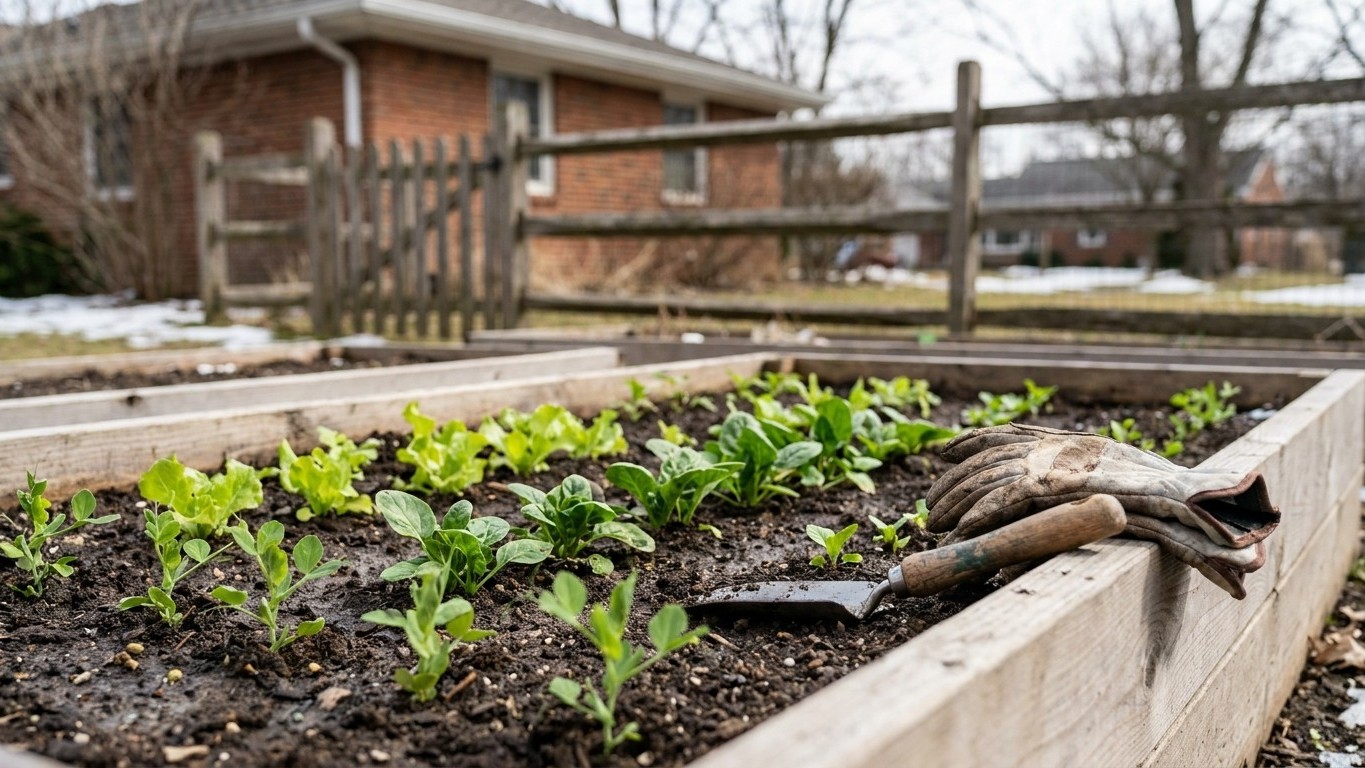

March in New Mexico sits almost entirely before the state’s last frost window, so the honest answer is: plant cold-hardy greens, alliums and root crops directly outdoors now, start tomatoes and peppers indoors for later transplant, and hold off on anything tender until well into April. What decides the difference is soil temperature and frost risk, not the date on the calendar.
What goes in the ground in March

The last spring frost at the reference station runs from March 31 to April 12, based on NOAA’s 1991-2020 climate normals for the Albuquerque area. That means most of March falls squarely inside the frost-risk period, not after it. Anything that can’t shrug off a freeze has no business in open ground yet.
What can go in is the short list of crops that actually shrug off a freeze. Peas germinate fine in soil as cool as 40°F and tolerate light frost once up. Spinach, lettuce, arugula and mustard greens do the same, and kale seedlings will sit through a hard freeze with barely a shrug. Onion sets and shallots go in now too, since both need a long cool stretch before bulbing starts. If garlic wasn’t planted in fall, it’s too late for a full-size harvest, but a spring planting of softneck varieties can still produce green garlic.
Root crops are the middle ground. Carrots, beets and turnips can go in toward the back half of the month if the soil is workable and not waterlogged, but germination slows to a crawl below about 45°F, so a cold snap just stalls them rather than killing them.
| Crop | Direct sow in March? | Frost tolerance |
|---|---|---|
| Peas | Yes | Handles light freeze |
| Spinach, lettuce, kale | Yes | Handles hard frost |
| Onion sets, shallots | Yes | High |
| Carrots, beets, turnips | Late March, weather permitting | Moderate |
| Tomatoes, peppers, beans, squash | No | None, killed by frost |
Everything in that last row waits. Warm-season crops sown into ground that hasn’t cleared the frost window don’t just risk a setback, they die outright, and there’s no recovering a dead seedling.
What to start under cover
Seed-starting math runs backward from the frost window, not forward from today. Tomatoes and peppers need roughly six to eight weeks indoors before they’re ready to go outside as sturdy transplants. Counted back from the April 12 end of the frost window, that puts the ideal start somewhere in mid-to-late February for the latest safe transplant date, which means March is still workable for gardeners who plan to set plants out closer to late April or into May, once soil has warmed further.
Cole crops like broccoli, cabbage and cauliflower need less lead time, closer to four to six weeks, so starting them indoors now lines up well with transplanting once the frost window has passed. Same goes for a second round of lettuce and greens meant for cold-frame or under-cover planting while the ground outside is still too cold for direct seeding of anything tender.
The two ways this goes wrong are predictable. Start too early and tomato seedlings sit in small pots for weeks, turning leggy and rootbound while they wait for warm ground that hasn’t arrived yet. Start too late and there isn’t enough season left before summer heat stresses young plants or fall frost cuts the harvest short. Working backward from the frost window, rather than a fixed date, is what keeps a gardener out of both traps.
A cold frame or unheated hoop house buys extra room here. Seedlings hardened off under cover for a week or two before transplanting adjust to outdoor light and wind without the shock of a bare transition straight from a windowsill.
What is ready to pick
Outdoors, March offers little that wasn’t already growing before winter. Overwintered kale, leeks and collards that made it through the cold season are usually still standing and often taste better after a freeze, since cold triggers sugars in the leaves. Anything protected under a cold frame or row cover, spinach and mesclun mixes especially, should be ready to cut steadily through the month.
Indoors, sprouts and microgreens fill the gap when nothing outside is producing much. A tray of pea shoots or radish microgreens is ready in seven to ten days from seed, which makes it one of the few crops with a harvest date that doesn’t depend on the weather at all.
Storage crops need a check-in now too. Winter squash, potatoes and onions held since fall should get pulled out and inspected, since March is often when the ones that are going to fail start showing it. A soft spot on a squash, a potato gone soft and dark, or an onion with a rotten smell at the neck means it needs to be used or tossed before it spreads to the rest of the bin. Rhubarb crowns can also be forced indoors in a dark, warm spot for an early harvest of pale, tender stalks weeks before the outdoor crop is anywhere close to ready.
The jobs that matter this month
Dormant pruning of fruit trees and berry canes needs to wrap up before buds swell and sap starts moving, and in most of New Mexico that window closes as March progresses. Prune apple, pear and stone fruit trees while they’re still fully dormant; pruning after growth starts costs the tree energy it needed for the coming season and opens fresh wounds right when disease pressure rises.
Seed ordering has a deadline too, even if it doesn’t feel like one. Popular varieties of tomatoes, peppers and squash sell out from suppliers well before planting season, so placing an order now beats discovering in May that the variety a gardener wanted is gone.
Soil work pays off disproportionately this month. Testing pH and nutrient levels before the growing season gives enough lead time to correct deficiencies with amendments that need weeks to break down and become available to roots. Turning finished compost into beds now, rather than at planting time, lets it integrate into the soil structure instead of sitting as a raw layer that roots have to grow around.
A few smaller tasks round out the list: sharpening and oiling pruning tools before the pruning rush, checking drip irrigation lines and emitters for winter damage before the system gets switched back on for the season, and repairing raised beds, trellises or fencing while beds are still empty and easy to work around. In an arid state where every growing season runs on irrigation, a cracked line found in March is a five-minute fix; the same crack found in June, under a full bed of plants, is a much bigger job.
What not to do in March
The classic mistake is treating a warm afternoon as proof that the season has turned. Air temperature swings fast in New Mexico’s dry climate, but soil temperature lags well behind it, so a 75°F day doesn’t mean the ground is warm enough for beans or squash. Direct-sown warm-season seed into cold soil either rots before it germinates or comes up so weak it never catches up to seed planted a few weeks later into properly warmed ground.
Pulling row covers or cold frames off too early after a mild stretch is the second common error. The frost window at the reference station runs to April 12, and a string of warm days in early or mid-March doesn’t cancel that risk, it just sets up a harder fall when the next cold front rolls through unprotected plants.
Nitrogen timing trips people up too. Feeding a heavy dose of nitrogen to seedlings or transplants before they’re actively growing pushes soft, leafy growth that has poor frost tolerance right when frost is still a live threat. It’s better to hold off on nitrogen-heavy feeding until plants are established and the frost window has closed, then feed to support the growth spurt that follows.
Overwatering cold soil causes its own quiet damage. Wet, cold soil around dormant roots or new transplants is a setup for root rot, and it’s easy to overwater out of habit from a warmer season without noticing the soil hasn’t warmed up enough to use that moisture.
Checking this against your own county
A state-wide frost window is a starting point, not a guarantee for any single garden. New Mexico’s elevation swings from below 4,000 feet near the southern border to over 7,000 feet around Santa Fe and higher still in the northern mountains, and that difference alone can shift the last frost date by weeks in either direction. Rural and higher-elevation gardens typically see frost linger later in spring and arrive earlier in fall than the reference-station dates suggest.
For a planting calendar tuned to a specific county, the New Mexico State University Cooperative Extension Service publishes local guidance worth checking before finalizing a planting date.
Common questions
Can I plant tomatoes in New Mexico in March?
Not outdoors as seedlings or seed. The reference station’s frost window runs to April 12, and tomatoes are killed outright by frost. March is the month to start tomato seed indoors for transplanting after that window closes, not to put plants in open ground.
What vegetables are frost-tolerant enough for March planting in New Mexico?
Peas, spinach, lettuce, kale, arugula, mustard greens, onion sets and shallots all tolerate the freezes that are still likely through March. Carrots, beets and turnips can go in toward the end of the month if soil is workable, though cold soil slows their germination.
When is the last frost date in New Mexico?
At the reference weather station, NOAA’s 1991-2020 climate normals put the last spring frost between March 31 and April 12. Higher-elevation and rural gardens often see frost linger later than that range, so it’s worth checking local extension data for a specific county.
Should I start seeds indoors in March in New Mexico?
Yes, for warm-season crops like tomatoes and peppers meant for transplanting after the frost window closes, and for cole crops that need a shorter head start. Counting backward from the local last-frost range, rather than guessing, keeps seedlings from getting leggy or missing the transplant window entirely.