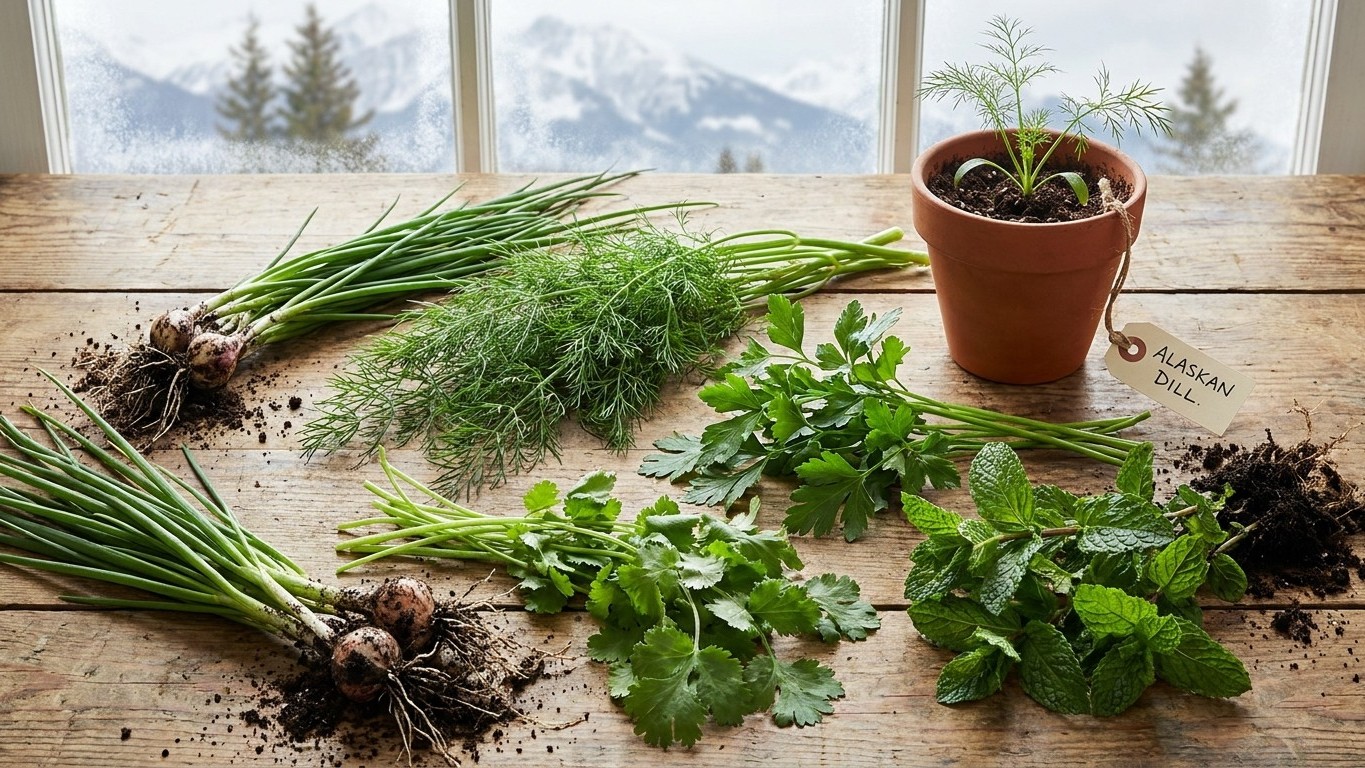

New York’s herb list splits cleanly by hardiness and season length: annual herbs like basil, dill, and cilantro do well almost anywhere in the state given a frost-free stretch, hardy perennials like thyme, chives, sage, and oregano survive winter in most counties, and tender Mediterranean perennials like rosemary and bay need to come indoors or get treated as annuals everywhere in New York.
The short answer for New York
Start with what the state’s frost data actually says, because it’s the backbone of every herb decision here. In New York City, the last spring frost falls between March 23 and April 3, and the first fall frost arrives between November 14 and November 27. That’s a frost-free window stretching roughly seven and a half months, which is generous by Northeast standards. But that figure comes from a single dense urban weather station in Central Park. Upstate counties and the Adirondacks lose weeks off both ends of that window, sometimes closing the season a full month earlier in fall and opening it a month later in spring.
That gap changes which herb types make sense by region, not just by preference. Warm-season annuals, basil, dill, cilantro, need that long frost-free stretch to produce multiple harvests or successive sowings. In New York City and the Hudson Valley’s milder pockets, the season length supports that easily. Further north, gardeners are working with a compressed window, so fast-maturing varieties and a head start indoors matter more than they would downstate.
Hardy perennial herbs tell a different story, and this is where the state’s USDA hardiness zone range of 3b to 7b does the real work. That’s an enormous spread for one state, built entirely on the average annual extreme minimum temperature. Chives, thyme, oregano, and sage are bred to survive winters at the colder end of that range, so they come back reliably in most New York counties once established, provided they’re not in the harshest zone 3b pockets without mulch protection.
Tender perennials are the clearest no across the entire state. The coldest month’s average daily minimum in New York City, the mildest reference point available, sits at 27.9°F. Rosemary and bay laurel are rated for winters far milder than that. If a plant can’t survive New York City’s winter minimum, it has no chance upstate, where the same month runs colder still. Grow them in containers you can bring inside, or treat them as annuals.
What will not work here

The state’s own numbers rule out a few common habits before a single seed goes in the ground. Leaving rosemary or bay laurel outdoors year-round is the most obvious failure. Their hardiness needs sit well above New York’s 27.9°F coldest-month minimum, and that figure comes from the state’s mildest urban station. Anywhere colder, and the outcome is the same plant, dead by February.
Slow-to-mature herbs run into trouble at the state’s short-season end. New York’s hardiness zones bottom out at 3b, typically found in the Adirondacks and high elevations of the Tug Hill Plateau. Those areas see frost arrive earlier and linger later than the New York City dates, sometimes by weeks on each side. A long-season herb that needs a full frost-free stretch to bulk up, or a second or third succession of basil, simply runs out of runway there. The fix isn’t a different herb list; it’s starting indoors earlier and choosing quicker-maturing selections within the same herb.
Tight spacing is the other quiet failure point, and it has nothing to do with cold. New York’s summers, especially downstate and in the Hudson Valley, run humid. Basil packed in close rows with poor airflow is a textbook setup for fungal trouble, powdery mildew and downy mildew both move fast through crowded, humid plantings. The plants don’t die from cold there; they die from moisture sitting on leaves overnight with nowhere to evaporate. Wider spacing and morning watering do more for a humid-summer herb bed than any fertilizer schedule.
None of this means New York is a hard place to grow herbs. It means the failures are specific: tender perennials left outside, slow herbs planted where the season won’t finish them, and dense plantings in a humid climate. Match the herb to the actual number, not the general reputation of “cold state,” and most of the common mistakes disappear on their own.
What changes across New York
A hardiness range of 3b to 7b means New York isn’t one growing region wearing a single state name; it’s several. Zone 7b, the milder end, sits around New York City and parts of Long Island, where the coldest month’s average minimum hovers near 27.9°F. Zone 3b, the coldest end, belongs to the Adirondack interior and the highest elevations upstate, places where winter lows run dramatically colder and the frost-free season shrinks accordingly. That’s not a small variation. It’s the difference between a garden that can push a hardy perennial through winter unprotected and one where the same plant needs a thick mulch layer or a cold frame just to have a chance.
Elevation adds its own twist on top of latitude. Two counties at similar north-south position can still land in different zones if one sits in a valley and the other on a ridge or plateau. Cold air pools in low spots on clear, calm nights, so a garden tucked into a valley bottom can run colder than a hillside garden a few miles away at the same latitude. This is exactly why the frost dates drawn from a New York City station describe New York City and nowhere else with certainty.
For a reader north of the city or at higher elevation, the practical shift is straightforward even without knowing an exact zone number. Push perennial herb planting toward late spring rather than early, since soil there warms later. Lean on mulch for anything marketed as hardy to zone 5 or colder, since the coldest pockets of the state sit right at that edge. And treat every date as a New York City baseline to adjust backward, not a fixed calendar for the whole state. The right move isn’t guessing which zone applies; it’s checking the map directly.
Where to check this for your own county
A state description is exactly the wrong scale for a planting decision. The right scale is the county, and Cornell Cooperative Extension is the source built for that. Their directory lists offices, and every county in New York has a local office feeding into it.
Two things are worth pulling from the county office specifically, rather than trusting anything state-level. First, the local planting calendar. Cornell Cooperative Extension offices tailor sowing and transplant windows to their own county’s frost data, not New York City’s, which matters enormously given how far upstate and mountain frost dates drift from the figures cited here. Second, the herb and vegetable varieties that have actually been trialled in that county’s conditions. Extension programs run variety trials specific to their region’s soil, humidity, and season length, and a variety that performed well in a Hudson Valley trial isn’t automatically the right pick for a St. Lawrence County garden.
A county recommendation will outperform a state one every time, because it’s built from local data rather than averaged across zones 3b through 7b. A state-level view can show what generally holds true across New York and where the biggest regional splits fall. It can’t tell an individual gardener their own frost date, their own soil warm-up timing, or which basil variety a neighboring farm found most reliable last season. That’s the extension office’s job, and it’s free to ask.
Checking this against your own garden
Every date is a probability built from thirty years of station records, not a guarantee for a specific yard. The garden itself has better information, and it doesn’t require any equipment to read.
Soil warmth by feel is the first check. Push a hand a few inches into the bed where herbs will go. If it still feels cold and slightly damp like early spring rather than workable, warm-season herbs like basil will sit and sulk even if the calendar says the frost date has passed. Waiting for that soil to feel closer to room temperature is a better guide than any printed date.
The second sign is how established perennial herbs are behaving nearby. Chives pushing new green shoots from the base, or thyme showing fresh growth at its woody stems, means the ground has warmed enough to support root activity. That’s a strong local signal that the immediate microclimate, not the county average, is ready for more tender plantings too.
The third is the appearance of first true leaves on anything already direct-sown. The initial seed leaves that emerge first don’t tell much; they run on stored energy from the seed itself. The first true leaves, the ones that actually look like the herb’s mature foliage, show the plant is drawing real nutrition from the soil and the microclimate is supporting active growth. Seeing that happen faster or slower than a neighbor a few miles away is the clearest evidence of how a specific yard’s exposure, drainage, and air movement differ from the county average, and it’s worth more than any single number.