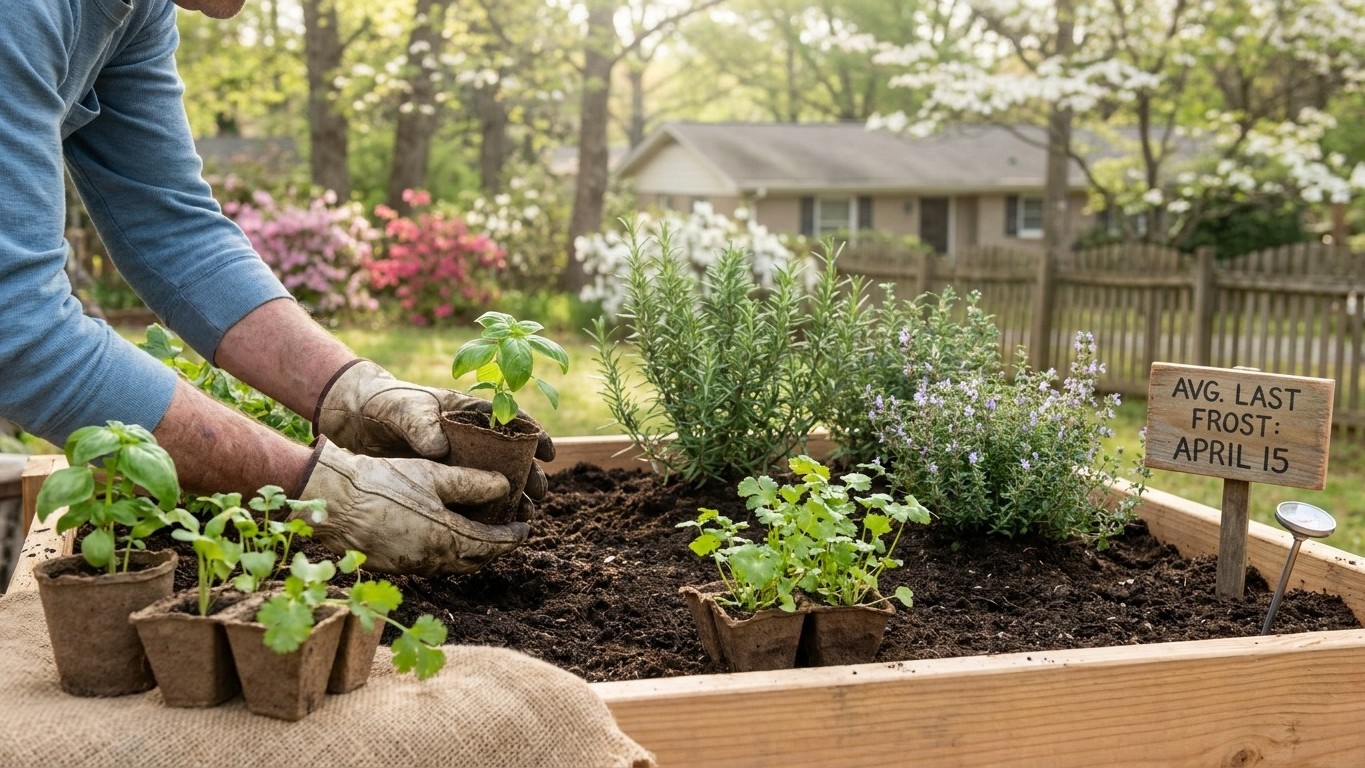

New York’s tender herbs like basil and cilantro go in the ground after the last spring frost risk window closes, typically after April 3 near New York City and later upstate. Hardy herbs like parsley, chives, and dill tolerate a few weeks earlier. But “after frost” here is a probability, not a guarantee, and that changes everything about how you plan.
The short answer for New York
Near New York City, the last spring freeze at 32°F falls somewhere between March 23 and April 3, based on NOAA’s 1991-2020 climate normals for the region. That window marks a 30 to 70 percent chance of a freeze on any given day within it, not a hard cutoff. So a gardener who sets out basil on March 25 is playing decent odds, not a sure thing. Waiting until after April 3 pushes the odds solidly in the plant’s favor, though nothing outdoors is risk-free until closer to late April in most seasons.
Fall works the same way in reverse. First freeze in the same NYC-area dataset lands between November 14 and November 27. That’s your outer boundary for tender annual herbs still producing outdoors, basil especially, which turns to black mush at the first real frost. Hardier herbs like sage, thyme, and rosemary shrug off a light frost and can stay in the ground weeks longer.
Winter survival is a separate question from frost dates, and it hinges on a different number: the mean daily minimum of the coldest month, which sits at 27.9°F for the New York City reference station. That’s not the record low, and it’s not an average temperature, it’s the typical overnight low during the coldest stretch of winter. Herbs rated hardy well below that figure, like chives, mint, oregano, and established thyme, generally winter over fine in the ground. Herbs that struggle once nights regularly dip near freezing, rosemary being the classic example, need a container, a sheltered spot, or a trip indoors for winter in most of the state.
All of this comes with a caveat baked into the data itself: these frost and cold-month figures are drawn from the Central Park weather station, a dense urban site that runs warmer than almost anywhere else in New York. They describe conditions in New York City, not the state as a whole. Upstate counties and the Adirondacks freeze earlier in fall, thaw later in spring, and see colder winter lows than these numbers suggest. Treat this section as the NYC-area answer and read on before assuming it applies to your county.
What will not work here
The state’s USDA hardiness zone range runs from 3b to 7b, an enormous spread built on one variable: average annual extreme minimum temperature. That range alone tells you a plan built around New York City’s mild coastal figures will fail badly further north. A rosemary plant that survives winter outdoors in a sheltered Brooklyn yard has no chance in a Zone 4 garden in the North Country, where extreme lows run far below anything the coldest-month figure for the city implies.
Short growing seasons defeat slow herbs before humidity or heat ever get involved. Herbs that need a long, uninterrupted warm stretch to fully mature, some basil varieties, certain long-season parsley types, run into trouble in any part of the state where the gap between the spring and fall frost windows narrows. Near the city, that gap runs from early April to mid-to-late November, a workable stretch. Upstate, where spring frost lingers and fall frost arrives early, the same herb can run out of season before it ever produces well.
Humidity, not drought, is the more common killer here. New York summers bring sticky, still air punctuated by heavy rain, conditions that favor fungal diseases on herbs planted too close together. Basil crowded into tight rows develops downy mildew and fusarium wilt readily in these conditions. Lavender and rosemary, both native to dry Mediterranean hillsides, resent the state’s humid summers and heavy clay soils even more than they resent the cold. Poor drainage rots their roots long before winter cold becomes the issue. A raised bed or a container with real drainage holes solves more problems here than any frost date ever will.
Watering on a fixed weekly schedule, a habit that works in drier climates, tends to backfire in New York’s wetter pattern. Add irrigation on top of a rainy stretch and shallow-rooted herbs like cilantro sit in soggy soil, inviting rot rather than drought stress. The fix isn’t a stricter schedule, it’s watching the soil rather than the calendar, a theme that comes back later in this piece.
What changes across New York
A hardiness range of 3b to 7b is not a small variation, it’s close to the full span the USDA scale covers in the eastern United States. That gap means there is no single planting date that works for the entire state, full stop. A date that’s safe in New York City can be six or more weeks premature two hundred miles north or a few thousand feet higher in elevation.
The practical shift for a gardener outside the city runs in two directions. Spring planting for tender herbs should move later, sometimes considerably later, the further north or higher the garden sits, since both the last frost date and the soil’s own warm-up lag behind the coastal figures cited above. Fall harvest, meanwhile, needs to happen earlier, because the first freeze arrives well before the November 14-27 window that applies to the city. A basil crop timed to New York City’s fall frost date could be killed weeks ahead of schedule in a colder county.
Altitude compounds the latitude effect. Two gardens at the same latitude can differ by a full hardiness zone if one sits in a valley that collects cold air and the other sits on a breezy hillside. Valley gardens tend to frost earlier in fall and later in spring than the surrounding area, a pattern known locally to anyone who has watched frost settle into low ground first on a clear autumn morning.
None of this is something to guess at from a state-level article. The USDA Plant Hardiness Zone Map, built from the same 1991-2020 climate normals, lets a reader look up their own zone by ZIP code rather than estimating it from a range. That’s the right next step before committing to a planting date based on anything written here.
Where to check this for your own county
Cornell Cooperative Extension, reachable at cals.cornell.edu/cornell-cooperative-extension, runs county-level offices across New York, and that’s where a planting date stops being a state-wide estimate and becomes a local recommendation. Every county office works from the same land-grant research base but adjusts its guidance for local frost patterns, soil types, and the varieties that actually perform well in that specific area.
Two things are worth pulling from a county office before finalizing any planting decision. First, the local planting calendar, which will reflect the actual frost pattern for that county rather than the New York City figures used as the baseline. A county two hours north of the city might publish a last-frost guideline three weeks later than the dates cited here, and that difference matters more than anything else. Second, the list of herb varieties the extension office has trialed locally. Cornell’s network runs variety trials across different regions of the state, and a basil or parsley cultivar that performs well in the Hudson Valley isn’t automatically the same one that thrives in the Southern Tier or on Long Island.
A county recommendation beats a state one every time, and that’s not a minor caveat, it’s the whole point of checking further. New York City reference data is the most complete public dataset available at the state level, but it was never meant to substitute for local knowledge. Think of it as the starting estimate, useful for understanding the mechanics of frost probability and winter cold, but not the final word for a specific garden in a specific county.
Some gardeners also time this by the Moon: when to plant herbs by the moon, as almanac tradition rather than fact.
Checking this against your own garden
Every date here is an average built from thirty years of weather records. Your own garden runs on its own clock, shaped by sun exposure, soil type, and whatever microclimate sits around your particular yard, and that clock usually tells you more than any calendar entry.
Soil warmth is the first and most useful signal, and it doesn’t require a thermometer. Dig down two or three inches and feel the soil with bare hands in the morning. Cold, clammy soil means seeds like basil or cilantro will sit and rot rather than germinate, regardless of what the frost calendar says about the date. Soil that feels merely cool but not cold, closer to the temperature of a cellar than a refrigerator, is usually ready for the more cold-tolerant herb seeds even if the calendar suggests waiting.
Volunteer seedlings offer a second signal worth watching. Herbs like dill and cilantro often self-seed from the previous year’s plants, and their first true leaves, the second set to appear after the initial rounded seed leaves, tend to show up right when conditions have turned reliably favorable in that exact spot. If nature’s own seedlings are pushing up true leaves in a corner of the yard, that corner is ready for a fresh round of sowing.
Perennial herbs give a third, slower signal. Watch for the first flush of new green growth on established chives, mint, or oregano coming back from the roots each spring. That flush marks the point where the soil in that specific bed has crossed into active growing temperature, a more honest measure for that location than any regional frost date, since it reflects the sun exposure and drainage of that exact spot rather than an average drawn from a weather station miles away.