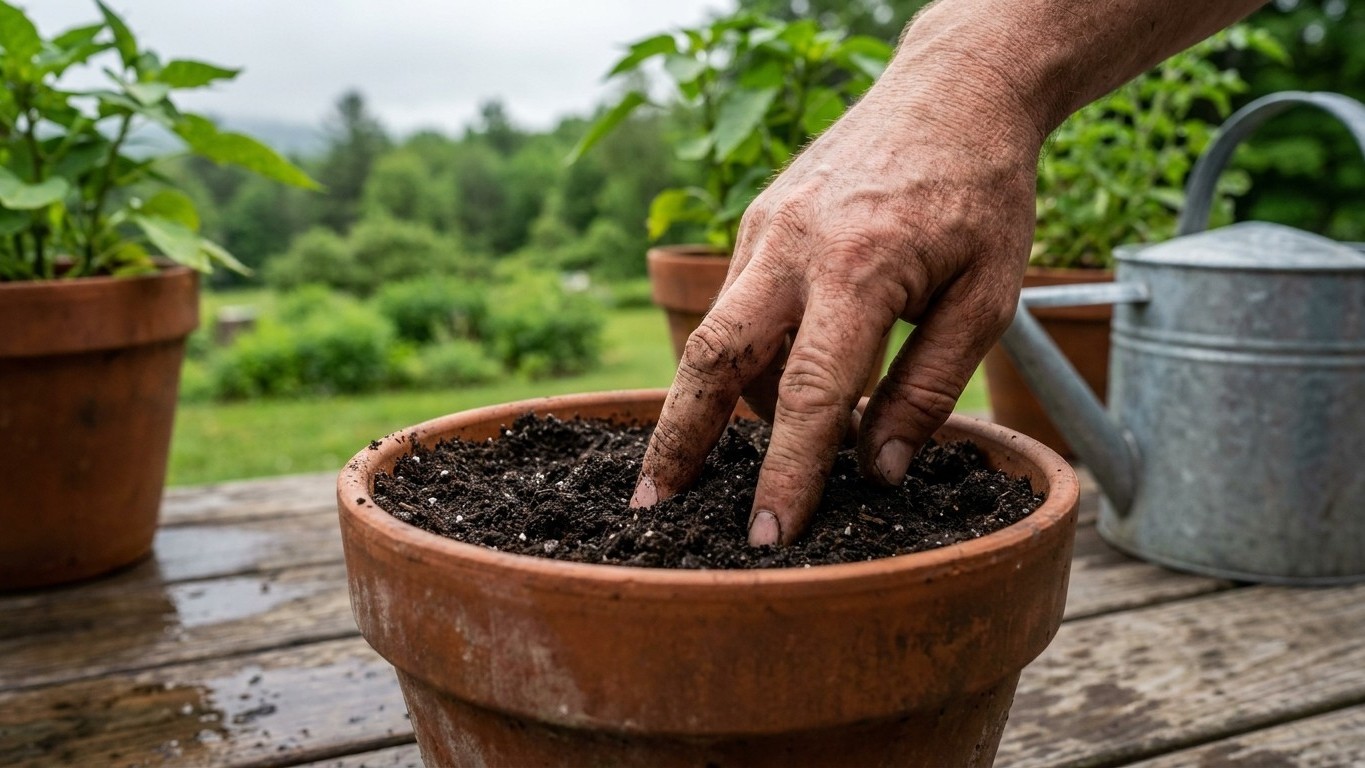

Vermont gardeners get more rain than most of the country during summer, but pots and containers still dry out fast because they hold a fraction of the soil volume a garden bed does. The short answer: check the potting mix two inches down before you water, water deeply at the base rather than a light daily splash, and expect containers to need water more often than the ground even in a wet Vermont summer.
What changes here

Two numbers set the baseline for watering decisions in Vermont: August, the driest summer month, still delivers 3.54 inches of rain, and the state averages only 5.4 days a year at or above 90F. Put together, that’s a climate where the sky does a lot of the work and heat stress is the exception rather than the rule, so the biggest risk for containers isn’t drought, it’s soggy roots sitting in mix that never had a chance to dry.
Do the arithmetic and the picture gets sharper. A vegetable bed or a container garden generally wants around an inch of water a week. Spread August’s 3.54 inches over roughly 4.4 weeks in the month, and an average week brings close to 0.8 inch of rainfall from the sky alone. That leaves a gap of only about 0.2 inch a week for the gardener to fill by hand, roughly a fifth of what the bed asks for. For a garden bed, that’s a small top-up, not a full watering routine.
Containers don’t get that break. A pot has no reservoir of surrounding soil to draw from, and its mix drains faster than open ground, so rain that comfortably covers a garden bed’s needs often isn’t enough for a hanging basket or a patio planter. The same rainfall numbers that make Vermont’s garden beds low-maintenance in summer can still leave a container bone-dry within a day or two of sun, especially in a south-facing spot or a plastic pot that heats up in the afternoon.
Soil and potting mix texture change how far that inch goes, too. A sandy or fast-draining mix lets water pass through within hours, so the moisture from an 0.8-inch week is gone almost as fast as it falls. A heavier, moisture-retentive mix holds water closer to a week, which is good for stretching between waterings but risky if it’s watered again before it’s dried, since roots sitting in saturated mix simply suffocate. Vermont’s wetter, cooler profile makes that second scenario the one to watch.
How to water when it matters
The method that works with Vermont’s climate rather than against it comes down to three habits: water deeply and infrequently rather than a little every day, aim the water at the base of the plant rather than over the foliage, and do it in the morning. Deep watering pushes moisture down to where the roots actually are, training them to grow downward and outward instead of clustering near the surface where they’re first to dry out and first to cook in a heat spike. Morning watering gives leaves and the surface of the mix time to dry before evening, cutting down the damp, still conditions fungal disease needs to take hold overnight.
Checking moisture at root depth matters more than checking the surface, because the top half-inch of potting mix can look and feel dry while the root zone underneath is still soaked, or the reverse. A finger pushed two inches into the mix, or a small trowel for garden beds, tells the real story. If it comes out cool and moist, hold off. If it’s dry and crumbly, it’s time to water.
Here’s a starting sequence to work from, then adjust based on what you find when you check:
- Push a finger two inches into the potting mix or soil before watering anything; only proceed if it comes out dry.
- Water slowly at the base until it runs from the container’s drainage holes, or until a garden bed is soaked to a few inches deep.
- For containers in full sun during Vermont’s warmer stretches, check again daily since small pots can dry out within 24 hours even without a 90F day.
- For garden beds, start with about one inch of water a week total, counting whatever rain has already fallen, and adjust after checking the finger test two or three days later.
- On sandy or fast-draining mixes, shorten the interval and water in smaller amounts more often; on heavier, moisture-retentive mixes, lengthen the interval and let it dry between waterings.
That one-inch-a-week figure is a starting point, not a rule. A container on a shaded porch behaves nothing like one on a sunbaked deck, and the only way to know for certain is the finger test on your own plants, not a number from a chart.
What goes wrong
A little water every day
Daily light watering wets only the top inch or so of soil, which keeps roots shallow because that’s where the moisture is. Shallow roots dry out fast and struggle the moment there’s a gap in watering, which is exactly the opposite of the resilience deep watering builds.
Watering the leaves at night
Wetting foliage in the evening leaves it damp all night, and damp leaves in still, cool night air are an open invitation to fungal problems like powdery mildew and blight. Watering the base of the plant, and doing it early enough for any splashed leaves to dry before dark, avoids the setup entirely.
Trusting a passing shower
A quick summer thunderstorm can look like it solved the watering problem, but a lot of that rain runs off a container’s surface or a garden bed’s crust before it soaks in. Checking with a finger two inches down after a storm, rather than assuming the sky handled it, is the only way to know if the rain actually reached the roots.
Skipping mulch or letting containers sit exposed
Bare soil and bare potting mix lose moisture to the sun and air far faster than mulched or shaded surfaces. In Vermont’s case, though, given how much rain arrives even in the driest summer month and how few days push past 90F, the costlier mistake tends to run the other way: watering on a fixed daily schedule regardless of what the mix or soil is actually doing, and drowning roots that never had the chance to dry out between waterings. Containers without drainage holes make this worse, since excess water has nowhere to go.
Local help
The University of Vermont Extension is the state’s land-grant resource for gardening questions specific to Vermont’s soils and climate, and it’s worth checking directly at uvm.edu/extension for current guidance. Watering restrictions vary by town and water provider and change through the season, so confirm any local rules with your own water utility before setting a routine.
Common questions
Do container plants need more water than garden beds in Vermont?
Yes. Containers hold far less soil volume and drain faster, so even with Vermont’s relatively high summer rainfall, pots can dry out within a day or two while garden beds go longer between waterings.
How often should I water outdoor pots during a Vermont summer?
There’s no fixed schedule that works everywhere. Check two inches into the mix with a finger; if it’s dry, water until it drains from the bottom, and expect that to mean daily checks during warm, sunny stretches.
Does Vermont’s rainfall mean I can skip watering containers entirely?
No. Even in August, the driest summer month, rain that wets a garden bed adequately often isn’t enough for a container, since pots don’t have surrounding soil to draw moisture from.
What’s the biggest watering mistake in Vermont specifically?
Overwatering on a fixed schedule tends to cost more here than drought does, since the state’s relatively wet, cool summers mean containers and beds can stay soggy if watered before they’ve had a chance to dry.