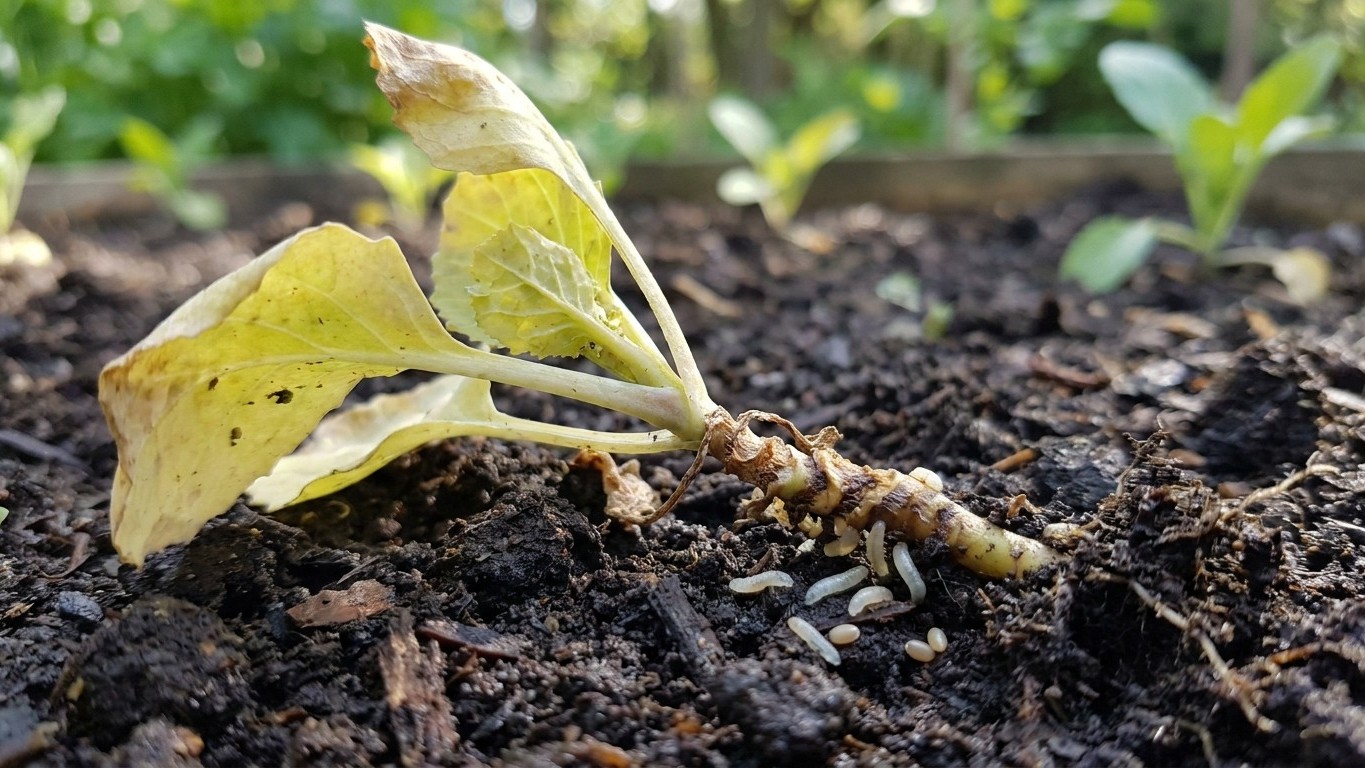

Cabbage maggot (Delia radicum) shows up in New York gardens twice a year, sometimes three times in warmer pockets of the state: once when soil temperatures climb into the mid-40s in spring, usually mid-April through May, and again in late summer into fall as the weather cools back down. The first generation is the one that catches most home growers off guard, because it attacks transplants and seedlings before anyone’s looking for trouble. Stopping it means timing your plantings around soil temperature, protecting the base of each stem with row cover or collars, and rotating brassica beds so the flies can’t find last year’s crop by scent alone.
What Cabbage Maggot Actually Does to a Plant

The adult looks like an ordinary gray housefly, about a quarter-inch long, and most gardeners never notice it landing near their seedlings. The damage comes from what she leaves behind. Females lay clusters of tiny white eggs right at the soil line, tucked against the stem of cabbage, broccoli, cauliflower, radish, turnip, or rutabaga plants. Within a week, the eggs hatch into small white larvae that tunnel straight down into the roots.
For a radish or turnip, that tunneling ruins the harvest outright. Brown scarring and soft rot spread through the root, and the plant tastes bitter even if it survives to pull. For cabbage and broccoli transplants, the damage is often fatal before the head ever forms. A seedling with a chewed-up root system wilts on a sunny afternoon, looks fine the next morning, then collapses for good within a few days. Growers who pull a dying transplant and find the roots stripped down to threads, with maybe a grayish-brown pupal case nearby, are looking at a textbook maggot kill.
Why New York’s Climate Suits This Pest
Cabbage maggot is a cool-season insect. It thrives in the 50 to 70 degree range and struggles once soil temperatures push past 75, which is exactly the pattern New York’s spring and fall deliver. Downstate counties around the Hudson Valley and Long Island tend to see earlier spring activity, sometimes by two or three weeks, compared to the North Country or the Adirondack foothills, where soil stays cold longer into April. That regional lag matters for timing transplants: a grower in Plattsburgh has more breathing room than one in Poughkeepsie.
Cornell Cooperative Extension has tracked this pest for decades using a degree-day model, tallying accumulated heat units above a 43-degree base starting around March 1. Peak fly emergence in most of the state lands somewhere between 200 and 360 degree-days, which typically translates to late April or early May for the first flight. A second, usually smaller flight follows in late July through September as temperatures drop back into the pest’s comfort zone.
When Cabbage Maggot Shows Up Across New York
Three windows matter for anyone growing brassicas in this state:
- Mid-April to late May: the first and usually heaviest flight, coinciding with early transplanting of cabbage and broccoli
- Late July to early September: a second generation that targets fall brassicas and root crops like turnips and rutabagas
- A possible partial third generation in unusually warm, extended autumns, mostly reported in downstate counties
The overwintering population survives as pupae in the top few inches of soil, so a field or garden bed that hosted brassicas the previous fall carries a built-in head start for spring flies. That’s the single biggest reason rotation works as well as it does. Move the crop, and the emerging adults have to fly further to find a host, which cuts egg-laying success significantly.
Cultural Controls That Actually Change the Outcome
Timing the transplant date is the cheapest and often the most effective tool available. Pushing cabbage and broccoli transplants out past the peak of the first spring flight, even by ten days to two weeks, avoids the window when females are most aggressively searching for stem tissue to lay on. In practice, that means watching soil temperature rather than the calendar. Waiting until soil hits the upper 50s before setting out transplants sidesteps a chunk of the early damage.
Rotation matters just as much, and the distance counts. Moving brassicas at least 200 feet from where they grew the prior two seasons meaningfully reduces the odds that overwintering adults find the new planting on their first flight. A four-year rotation cycle, keeping any member of the cabbage family out of a given bed for that stretch, is the standard recommendation from extension programs across the Northeast.
Physical exclusion is where home gardeners get the best return for the least effort. Floating row cover, laid over the bed immediately after transplanting or seeding and sealed tight at the edges with soil or sandbags, keeps the adult flies from ever reaching the stem to lay eggs. It has to go on before the flies arrive and stay sealed, because a single gap is enough for a female to slip through. Cabbage collars, simple cardboard or tar-paper disks fitted snugly around the stem at soil level, work as a lower-cost backup where full row cover isn’t practical, blocking the fly’s direct route to the stem base.
Soil and Timing Adjustments Worth Trying
Some growers delay direct-seeding radishes and turnips until after the first spring flight has passed, accepting a slightly shorter growing window in exchange for far less root damage. Others start brassica transplants indoors and hold them until they’re larger and more established before setting them out, since bigger, tougher stem tissue survives light infestations better than a fresh, thin-stemmed seedling.
Diatomaceous earth, worked into the soil surface around the stem base, can deter egg-laying females by irritating their bodies on contact, though it needs reapplication after rain. It’s a supplemental tactic, not a standalone fix.
Biological and Targeted Options
Beneficial nematodes, specifically species in the Steinernema genus, have shown real promise against cabbage maggot larvae in university trials, including work out of Cornell’s entomology program. Applied as a soil drench around transplant time, these microscopic parasites seek out and infect the larvae underground before they can do significant root damage. They work best in moist, warmer soil, which lines up conveniently with the pest’s own preferred conditions.
Natural predators help too, though they rarely provide complete control on their own. Ground beetles and certain parasitic wasps prey on cabbage maggot eggs and pupae in undisturbed soil, which is one more argument for reducing tillage in beds that have a history of infestation. Chemical insecticides labeled for cabbage maggot exist and are used in some commercial settings, but for home gardens the combination of timing, rotation, and row cover generally handles the problem without needing to reach for a spray at all.
Spotting Trouble Before It Spreads
Yellowing outer leaves on a young cabbage or broccoli plant, especially paired with wilting on a warm afternoon that doesn’t recover overnight, is the earliest visible warning sign. Gently digging around the base of a suspect plant, without pulling it entirely, lets a grower check for the telltale tunneling and soft, water-soaked root tissue before the whole planting is at risk. Catching one damaged plant early is worth pulling and destroying it, rather than leaving it in the ground as a breeding site for the next generation.
Yellow sticky traps placed at soil level near brassica beds can also flag the start of adult activity, giving growers a few days’ warning before egg-laying ramps up. It’s a low-tech signal, but paired with Cornell’s degree-day tracking, it gives New York gardeners a reasonably accurate window for when protective measures need to already be in place rather than applied after the damage shows.