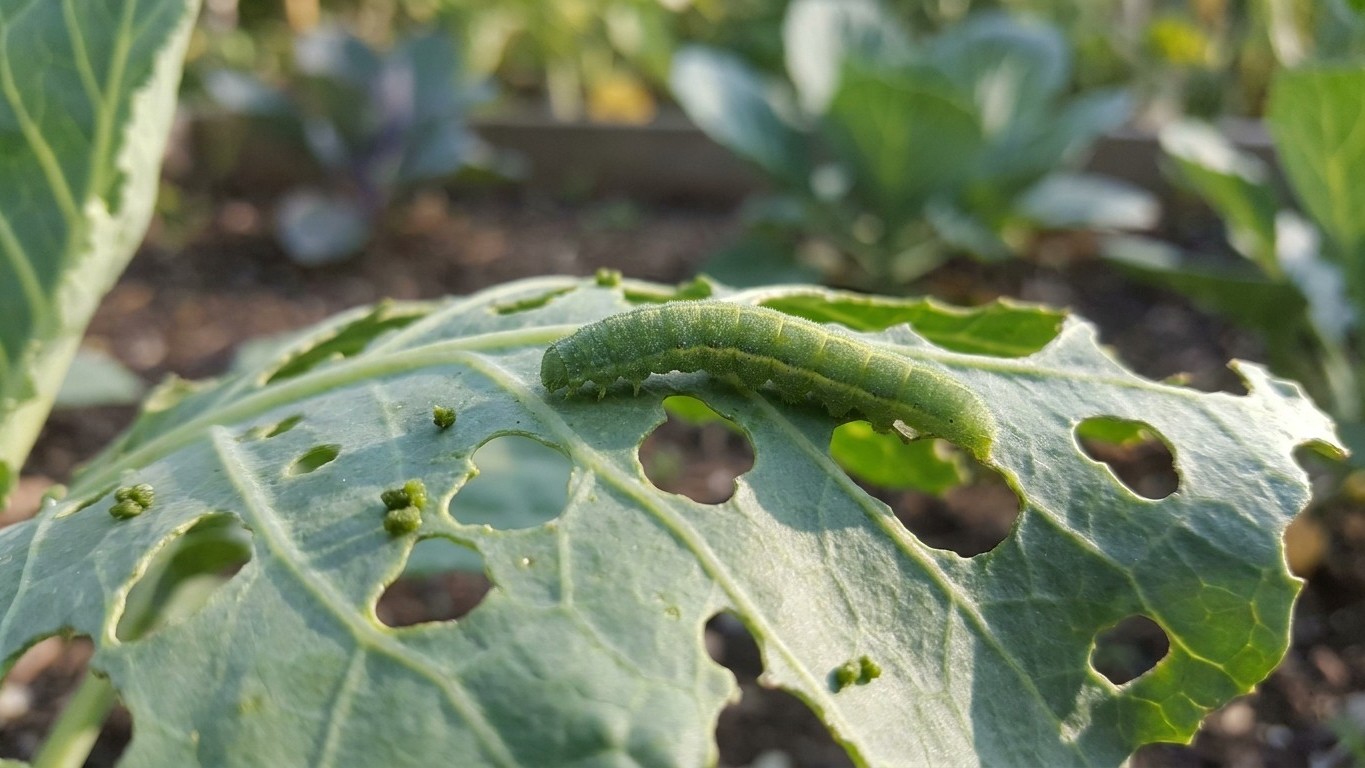

Imported cabbageworm shows up in New York gardens as soon as the first cool-season brassicas go in the ground, usually by early May in the Hudson Valley and Long Island, a few weeks later in the North Country. The velvety green caterpillars chew ragged holes through cabbage, broccoli, and kale leaves straight through October, running three to four overlapping generations a season. Floating row cover installed before the white butterflies arrive blocks egg-laying almost entirely, and it remains the single most reliable fix for home growers who don’t want to spray anything.
That’s the short version. The longer story involves knowing exactly what you’re looking at, because New York brassica beds host at least two look-alike pests that get lumped together and treated wrong.
What Imported Cabbageworm Actually Looks Like

The adult is the small white butterfly you’ve probably watched flutter across a vegetable patch a hundred times without giving it a second thought. Wingspan runs about an inch and a half, with one or two black spots on the forewings depending on sex. This is Pieris rapae, sometimes called the cabbage white, and it’s not native to North America. It arrived in Quebec in the 1860s and spread through the Northeast within a few decades, which means New York growers have been dealing with this insect for well over 150 years.
The larva is what does the damage, and it’s a velvety, unmarked green caterpillar that grows to about an inch long, with a faint yellow stripe down its back that’s easy to miss. It moves slowly and tends to sit tight along leaf veins or tucked into the head of a developing cabbage, which is exactly why infested heads sometimes get harvested, sliced open at the kitchen counter, and reveal a very unwelcome surprise. Frass, the small green fecal pellets caterpillars leave behind, is often the first clue something’s feeding before you spot the worm itself.
Cabbageworm vs. Cabbage Looper: The Mix-Up That Costs Growers Time
Gardeners frequently confuse imported cabbageworm with the cabbage looper, and the distinction matters because control timing differs slightly between the two. The looper caterpillar is pale green with thin white stripes and moves in a distinctive arching, inchworm-style hump because it lacks a full set of prolegs in the middle of its body. Imported cabbageworm has a complete set of legs and crawls in a straight line. Loopers also tend to show up a bit later in the season and favor the undersides of outer leaves, while cabbageworms will bore straight into the head. Both respond to the same biological control, which simplifies things for anyone who’d rather not become an amateur entomologist just to grow broccoli.
When Imported Cabbageworm Shows Up in New York
Overwintering happens as a pupa, tucked into plant debris, fence posts, or nearby structures, so first-generation adults emerge as soon as daytime temperatures hold consistently above the mid-60s. In most of New York that translates to late April through mid-May. Downstate and Long Island, with their milder microclimates, tend to see activity a week or two earlier than the Adirondacks or the Tug Hill Plateau, where a late frost can push the first flight into early June.
Because the life cycle from egg to adult takes roughly three to four weeks in warm weather, the state typically sees three to four generations before frost shuts things down in October. That’s the part that trips people up: a garden that looked clean in June can be crawling with caterpillars by August, because each successive generation builds on the population left behind by the last one. Populations generally peak in mid to late summer, right when fall brassica transplants for broccoli and cabbage are going into the ground, which is unfortunate timing for anyone hoping to get a second crop through to harvest.
Cornell Cooperative Extension offices across the state track regional emergence through their integrated pest management outreach, and local county offices are a solid resource if you want emergence estimates tailored to your specific growing zone rather than a statewide average.
What Actually Stops Imported Cabbageworm
Control options split into three categories that work best layered together rather than relied on individually: physical exclusion, biological controls, and targeted insecticide use as a last resort.
Row Covers: The Low-Effort, High-Reward Option
Lightweight floating row cover, the spun polyester fabric sold at nearly every garden center in the state, physically prevents the adult butterfly from reaching the plant to lay eggs in the first place. It needs to go on at transplanting or seeding, before the first flight arrives, and stay secured at the edges with soil, sod staples, or rocks so butterflies can’t slip underneath. The fabric lets in light, air, and water, so plants keep growing normally underneath. The one catch: row cover has to come off before flowering if you’re growing anything that needs pollinator access, which isn’t usually an issue for cabbage or broccoli grown for the head, but matters for crops like broccoli raab left to bolt for seed.
Bacillus thuringiensis: The Standard Biological Treatment
For gardens where cabbageworms have already gotten past the cover, or where covering isn’t practical, Bacillus thuringiensis subspecies kurstaki, commonly sold as Bt or Bt-kurstaki, is the go-to biological insecticide. It’s a naturally occurring soil bacterium that produces a protein toxic specifically to caterpillars when they ingest treated leaf tissue. It doesn’t harm bees, birds, pets, or beneficial insects like ladybugs, which is why it’s approved for organic production and widely recommended by extension programs across the Northeast.
Timing and coverage matter more than the product itself. Bt needs to be reapplied after rain since it washes off, and it needs to reach the undersides of leaves where eggs are laid and young larvae first feed, since it works only when eaten, not on contact. Spraying in the evening also helps, since the active ingredient breaks down in direct UV light and lasts longer once the sun goes down.
Natural Enemies Already Working in Your Favor
New York gardens already host a parasitic wasp, Cotesia glomerata, that was intentionally introduced generations ago specifically to knock down imported cabbageworm populations, and it’s now well established throughout the Northeast. The wasp lays its eggs inside a cabbageworm caterpillar, and the developing larvae eventually emerge and spin small yellow silk cocoons clustered on the caterpillar’s back, a sight that looks alarming but signals the pest is already dying. Avoiding broad-spectrum insecticides preserves this wasp population along with other predators like lacewings and ground beetles that feed on cabbageworm eggs and young larvae.
Hand-picking remains a legitimate option for small backyard plots. A quick daily check of the undersides of leaves, especially along the midrib and inside developing heads, catches caterpillars before they do serious damage. It’s tedious, but for a dozen cabbage plants it takes less time than most people assume, and it requires zero product cost.
Cultural Practices That Reduce Pressure Over Time
Crop rotation limits how easily overwintering pupae find next year’s brassica bed close by, since adults emerging from soil or debris will fly toward the nearest host plants first. Clearing brassica debris at the end of the season removes overwintering sites, cutting down on the population that emerges the following spring. Interplanting with strongly scented herbs like dill, thyme, or sage doesn’t eliminate cabbageworm, but some New York growers report it makes host plants somewhat harder for egg-laying females to locate, likely by masking the plant’s chemical signals that attract them in the first place.
Timing plantings to avoid peak flight periods helps too. Getting spring brassicas in early enough to mature before the first generation builds up steam, or delaying fall transplants until late-summer populations start declining with cooler weather, sidesteps a portion of the pressure without any additional labor or product.
Growers dealing with heavier infestations sometimes reach for broader-spectrum insecticides, but that approach tends to backfire over a full season, since it also wipes out the parasitic wasps and other predators that would otherwise keep populations in check on their own. A single untreated generation of cabbageworm rarely destroys a healthy crop; unchecked biological controls plus one well-timed round of Bt usually gets a New York garden through to harvest with leaves intact.