
Imported cabbageworm shows up in North Carolina as soon as brassicas go in the ground, and it never really leaves. In the coastal plain, adults start flying in March. In the mountains, expect a few weeks’ delay, sometimes into April. The pest cranks out four to six generations before frost, which means collards, kale, and cabbage face pressure from planting through late fall. The fix that actually works combines timing your plantings around the worst flights, using floating row cover before eggs land, and reaching for Bacillus thuringiensis (Bt) when caterpillars are small.
What Imported Cabbageworm Looks Like at Each Stage

The adult is a white butterfly with one or two black spots on each forewing, roughly two inches across. Gardeners often mistake it for a cabbage moth, but it’s active during the day, fluttering low over brassica beds looking for a place to lay eggs. Those eggs are pale yellow, bullet-shaped, and stuck singly to the underside of leaves. You need a hand lens to spot them reliably.
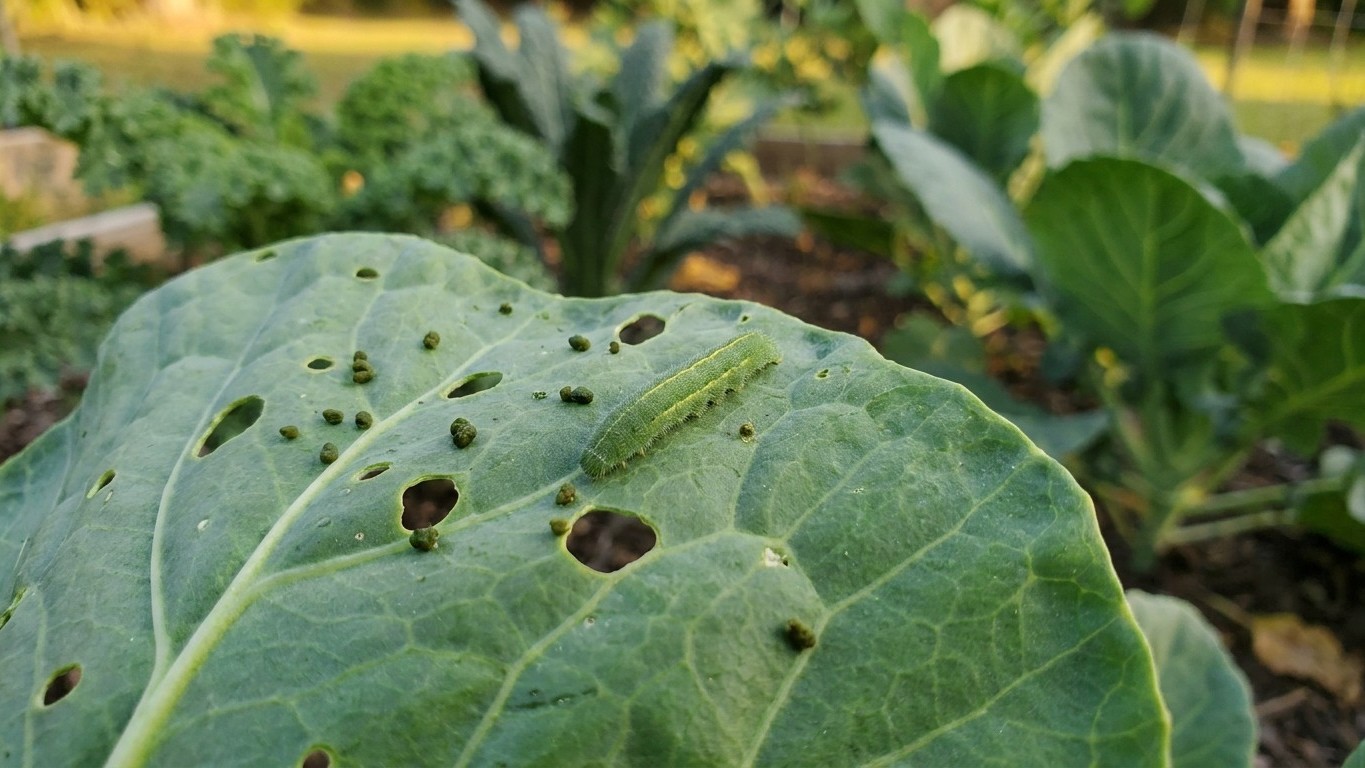
The larva is the stage that does the damage: a velvety green caterpillar with a faint yellow stripe down its back, growing to about an inch long. Unlike cabbage looper, it doesn’t arch its back when it crawls. That single detail separates the two pests in the field, and it matters because loopers respond to slightly different Bt strains and timing.
Frass, the small green pellets caterpillars leave behind, is often the first sign a grower notices, usually before the actual holes in the leaves get obvious.
When Imported Cabbageworm Shows Up in North Carolina
North Carolina spans three distinct growing regions, and cabbageworm timing shifts across all of them. The coastal plain around Wilmington and Greenville warms fastest, so the first adult flights and egg-laying often begin in March, sometimes overlapping with the tail end of collard harvest. The piedmont, including Raleigh and Charlotte, typically sees the first generation established by mid-April. The mountains, around Asheville and Boone, run two to three weeks behind the piedmont because of cooler spring soil temperatures.
What matters more than the calendar date is heat accumulation. Imported cabbageworm development tracks growing degree days, and populations build fastest during the stretch from late May through August when daytime highs sit consistently in the 80s. That’s also peak season for fall brassica transplants across the state, which creates the worst timing collision of the year: gardeners setting out broccoli and cabbage starts in July and August run straight into the pest’s most active generations.
Fall Crops Face the Heaviest Pressure
Fall brassicas planted for a September or October harvest are more exposed than spring crops. By late summer, cabbageworm populations have had all season to build, parasitoid wasp numbers haven’t yet caught up, and young transplants offer tender growth that’s easy to chew through. Growers who scout twice a week during the first three weeks after transplanting catch infestations before they spread past a handful of plants.
Which Crops Take the Hit
Imported cabbageworm feeds almost exclusively on brassicas, which happens to be one of North Carolina’s most planted vegetable families. Collard greens, a genuine staple crop across the eastern part of the state, take heavy damage because they’re often left in the ground for months, giving multiple generations time to build up on the same plants. Cabbage, broccoli, kale, mustard greens, and turnip greens are all regular targets. Cauliflower gets hit too, though the tight head structure means damage is often hidden until harvest.
Ornamental relatives matter as well. Nasturtiums, often planted as a trap crop, and flowering kale used in fall landscaping both attract egg-laying females. That’s worth knowing if you’re gardening near a neighbor who grows either one, since adult butterflies range widely and don’t respect property lines.
How to Spot Damage Before It Spreads
Cabbageworm larvae feed from the outside in, chewing large, ragged holes between leaf veins. Young larvae stick to the undersides of outer leaves, which is exactly where most gardeners fail to look. By the time damage is visible from a standing position, larvae have often already moved toward the growing point or, on cabbage and broccoli, into the developing head.
Frass accumulation on lower leaves is often the more reliable early warning. On collards and kale, damage tends to look like scattered shot holes at first, then widens into large missing sections as larvae mature. On broccoli and cauliflower, larvae will tunnel directly into florets, which is the damage that actually ruins a harvest since the head itself becomes unmarketable, not just cosmetically damaged leaves.
Cultural Controls That Reduce Pressure
Floating row cover, put down at transplant and sealed at the edges with soil or landscape staples, blocks adult butterflies from reaching plants to lay eggs in the first place. It’s the single most effective non-chemical tool available, and it works whether you’re growing four plants in a raised bed or forty in a market garden row. The catch: brassicas don’t need pollinators, so row cover can stay on for the entire crop cycle without cutting yield.
Crop rotation helps less than gardeners expect, since adult butterflies fly readily between beds and don’t rely on overwintering in the same soil. What does help is breaking up large blocks of brassicas with strips of unrelated crops, which disrupts the visual and scent cues butterflies use to find host plants. Removing crop debris after harvest also matters, since it eliminates a source of late-season larvae that would otherwise finish development and add to the following generation’s numbers.
Encouraging parasitic wasps, particularly Cotesia glomerata, gives a real assist. These tiny wasps lay eggs inside cabbageworm larvae, and infested caterpillars stop feeding well before they’d otherwise finish their damage. Planting small-flowered plants like dill, cilantro left to bolt, or sweet alyssum near brassica beds gives adult wasps a nectar source and keeps them working the area.
Bt and Other Treatments That Actually Work
Bacillus thuringiensis subspecies kurstaki, sold under several brand names as a biological insecticide, remains the standard treatment for imported cabbageworm and works only after larvae ingest treated leaf tissue. Timing is everything: Bt breaks down within a few days of application, especially with rain, and it only affects larvae, not eggs or adults. Applying it every seven to ten days during active feeding periods, and always after scouting confirms larvae are present, gets the best results without wasting product.
Spinosad is another option with a similar mode of action, useful in rotation with Bt to reduce the odds of resistance building up, though resistance to either product remains uncommon in home garden settings. Both products carry organic certification in most formulations, which matters to gardeners avoiding broad-spectrum synthetic insecticides that also wipe out the parasitic wasps and predatory insects doing free pest control.
Hand-picking works fine on a small scale, particularly on collards and kale where large leaves make larvae easy to spot once you know where to look. Checking the undersides of the three or four outermost leaves on each plant, twice a week, catches most of the population before it does serious damage. It’s slow work, but for a dozen plants in a backyard bed, it’s often faster than mixing and applying a spray.
Natural Predators Already Working in Your Favor
Beyond parasitic wasps, several predators already present in most North Carolina gardens keep cabbageworm numbers in check without any intervention. Paper wasps hunt caterpillars actively and will carry them off to feed their own larvae, making them a genuine ally despite their sting risk. Lacewing larvae and lady beetle larvae both feed on cabbageworm eggs, though they take a smaller bite out of overall populations than the wasps do.
Birds, particularly Carolina wrens and chickadees, pick caterpillars off open brassica beds regularly, especially where nearby shrubs or trees give them cover to work from. Gardeners who avoid broad-spectrum insecticides tend to see these natural controls do more of the work over a season, cutting down how often Bt or spinosad applications are even necessary.
Related guides
- Imported cabbageworm in Virginia: When It Shows Up and What Stops It
- Imported cabbageworm in Tennessee: When It Shows Up and What Stops It
- Imported cabbageworm in Ontario: When It Shows Up and What Stops It
- Imported cabbageworm in Oregon: When It Shows Up and What Stops It
- Imported cabbageworm in Alabama: When It Shows Up and What Stops It