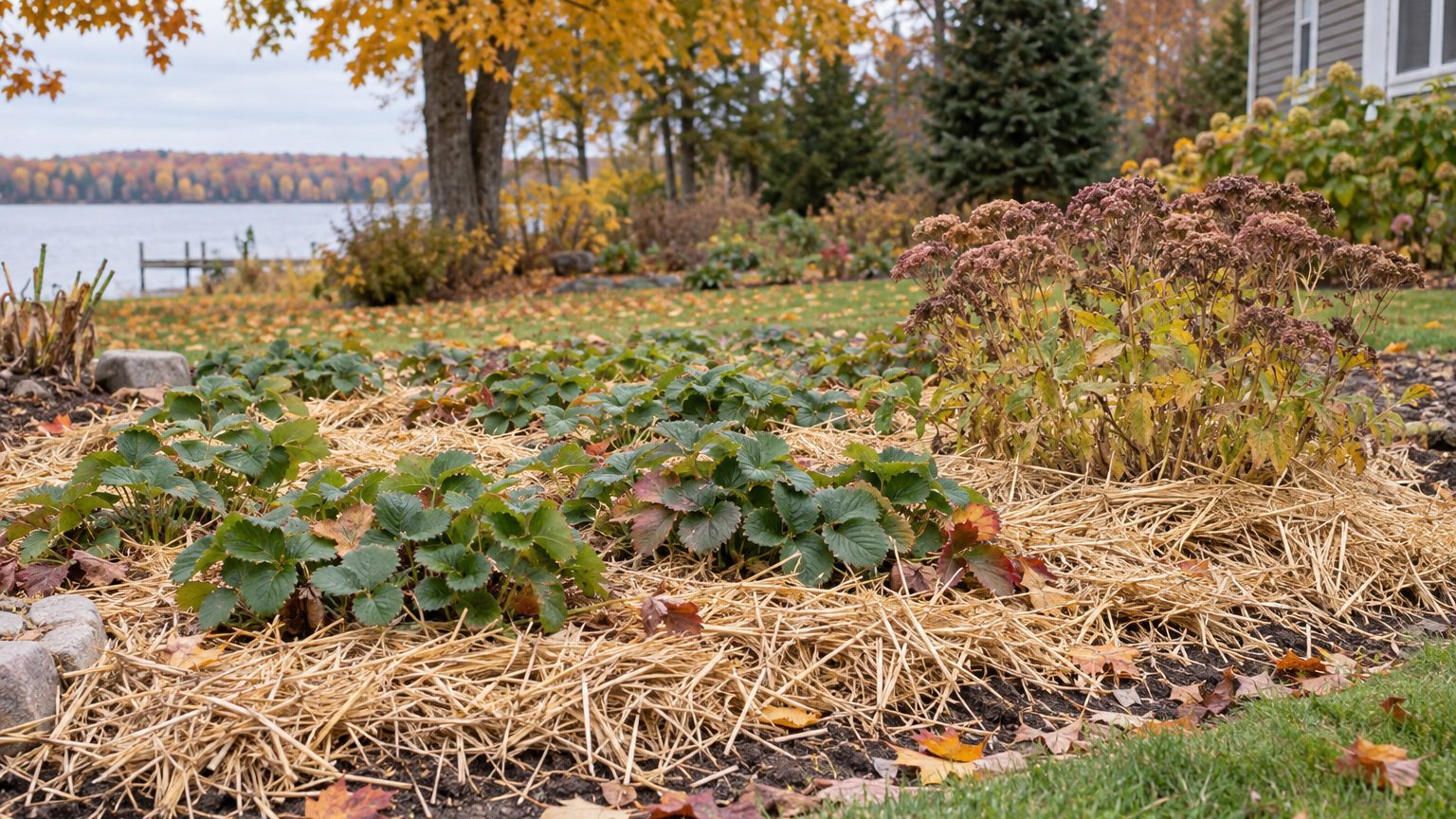

In Charlotte, winter mulch for strawberries and perennials goes down after the first frost window of October 30 to November 8 has passed and the ground has begun to chill and freeze, not before. Mulch applied in a warm October holds heat, invites rot, and shelters rodents. Apply it once nights run reliably at or below freezing, in a layer 2 to 3 inches deep, and plan to pull it back as growth resumes in spring.
When to put winter mulch down in North Carolina
Why the timing runs backward
Most gardeners assume mulch is a blanket that keeps plants warm. It isn’t. Its real job in winter is to keep the soil at a steady temperature, ideally cold and stable, so roots and crowns don’t suffer through repeated freezing and thawing. Spread it in early October and you trap the last of the summer’s warmth in the soil. Crowns stay soft and active when they should be going dormant, and the damp, sheltered layer makes a fine home for fungus and mice.
The Piedmont makes the timing tricky. According to NOAA’s 1991-2020 Climate Normals for Charlotte, the average daily minimum in the coldest month is 31.8°F, a hair under freezing. The soil there doesn’t lock up solid for months. It freezes on a clear night and softens by afternoon, over and over. That swing is the problem mulch solves, because each cycle can push shallow-rooted plants up out of the ground.
NOAA’s freeze-probability data for the same station puts the first fall frost between October 30 and November 8. That is the range at which a 32°F freeze becomes a 30 to 70 percent chance (NOAA NCEI U.S. Climate Normals). It is the starting gun, not the finish line. A single frosty morning means little. Wait until that window has passed and cold nights have become the pattern, then spread your mulch. Your personal date will shift from year to year. Watch the forecast, and the soil, rather than the calendar. The First and Last Frost Dates in North Carolina page gives the broader picture.
Mountains, Piedmont, and coast
Charlotte sits in the Piedmont, and the figures above belong to that station. The rest of the state shifts around them. The Blue Ridge mountains see frost earlier in fall, so mulching moves earlier there, and so does everything else on the fall list. The coastal plain gets its first frost later and has milder winters, so the heaving problem fades and mulch becomes more about moisture, weed control, and a cover for the occasional hard night.
| Region | First fall frost compared with Charlotte | What winter mulch mainly does |
|---|---|---|
| Blue Ridge mountains | Earlier | Evens out freeze and thaw; protects crowns |
| Piedmont (Charlotte) | October 30 to November 8 (NOAA) | Cuts down on heaving; holds moisture |
| Coastal plain | Later | Moisture, weeds, frost-night cover |
The USDA Plant Hardiness Zone Map (2023, based on 1991-2020 data) lists 5b-8b for the state as a whole. That range comes from a single measure, the average annual extreme minimum temperature, so it tells you what a plant can survive, not when to mulch. Use your own county’s zone for plant choices and the frost window for timing.
Is winter mulch needed at all in the Piedmont? For strawberries and anything near the edge of its hardiness, yes. For well-established, fully hardy perennials, it is a bonus rather than a necessity.
Strawberries
What the crowns need
A strawberry plant keeps its growing point at the crown, right at the soil surface. That makes it more exposed than most perennials. Bare cold can damage it directly, and freeze-thaw cycles in loose or wet soil can lift the plant, leaving roots dangling in the air. In a Piedmont winter where nights hover around freezing, heaving is the more realistic threat than deep, prolonged cold. The mulch you lay down is there to buffer those swings. Our guide to Growing Strawberries covers the rest of the season.
Use clean straw. It’s light, it fluffs up so air moves through it, and it doesn’t carry the weed seeds that hay does. Avoid whole leaves, which pack down into a wet, slimy mat over the crowns. Shredded leaves can work in a pinch, but straw is the safer choice.
For depth, stick with the range NC State Extension gives for mulch in general. The Extension Gardener Handbook says: “A 2-inch to 3-inch layer of mulch suppresses most annual weed seeds and makes it easy to hand-pull any that do germinate.” Straw settles after rain, so a loose layer in that 2 to 3 inch range is plenty. More is not better. A thick blanket stays soggy and holds the crowns too wet.
Timing in fall and pulling it back in spring
Strawberry plants should be dormant before you cover them. In Charlotte that means waiting until after the October 30 to November 8 first-frost window, once nights are regularly freezing and growth has stopped. Cover the rows and tuck straw around and over the plants, with the crowns lightly covered but not buried.
In the mountains, mulch earlier, since fall frost arrives earlier there. On the coastal plain, you can wait longer, and the layer’s work is mostly moisture and weed control through the milder months. If you are unsure, hold the straw back until the first few nights of hard cold.
Spring is where people slip. Straw left on too long blanches new growth and keeps the crowns damp. Check the plants as the weather warms, and pull the straw aside as soon as new leaves start pushing up pale under it, keeping it close by to throw back over the rows on a frost night. Leave it between the rows afterward. It keeps fruit off the soil and holds down weeds. Look up your area’s last spring frost on the frost dates page, since the Blue Ridge runs several weeks later than the Piedmont in spring and the coastal plain runs earlier.
Perennials and borderline plants
Not every perennial wants winter mulch. A plant that is comfortably hardy where you live shrugs off a Piedmont winter on its own. The ones that benefit are the plants near the edge of their range, anything planted late in fall that hasn’t rooted in yet, and shallow-rooted perennials that heave in freeze-thaw cycles. In North Carolina’s wide USDA range (5b-8b on the 2023 map), “borderline” depends on where you live. A plant that is solid in Charlotte may be marginal in the mountains.
Which plants get it
Rosemary and other woody, Mediterranean-style herbs are the classic borderline case, because wet and cold together do more harm than cold alone. Our page on Getting Perennial Herbs Through the Winter goes deeper on that. Newly planted perennials and shrubs also benefit in their first winter, as do any plants you’ve bought that are rated for just one zone colder than yours. Check the plant tag against the zone you actually garden in.
Fully dormant plants like hostas, daylilies, and established ornamental grasses rarely need extra protection. A layer of mulch won’t hurt them, but you’re better off saving your time.
How deep, and where to put it
The depth stays within the Extension range. For trees, the NC State Extension Gardener Handbook (chapter 11, Woody Ornamentals) says to “provide a 3-inch layer of mulch to reduce water loss and maintain uniform soil moisture and temperature around roots.” That is the same order of depth as the 2-inch to 3-inch range for weed control. Treat 3 inches as the ceiling, even for plants you worry about.
Shape matters as much as depth. Make a ring around the plant, leaving a gap right at the crown or stem, rather than piling mulch on top. Mulch against the crown holds moisture on the one part of the plant that most needs to stay dry, which invites rot and gives rodents cover. Our piece on Mulching Without Killing the Plant shows the mistakes to avoid in detail.
As for timing, the same rule applies. Wait until the October 30 to November 8 first-frost window has passed and the ground has turned cold, then lay a ring of mulch no deeper than 3 inches. A tender or newly planted perennial may also want a frost-night cover on the coldest forecasts, which you can remove the next morning.
What goes wrong
Early, matted, or nested in
Mulching too early is the most common error. The mulch keeps the soil warm, so plants never settle into dormancy and the crowns stay soft. You see it as mushy, brown crowns in January, or as plants that sprout a flush of tender growth that the first real cold kills. The fix is patience. Mulch only after the first-frost window of October 30 to November 8 has passed and nights are reliably freezing, even if the leaves have fallen and you feel behind.
Matting and rot come next. Whole leaves, wet grass clippings, and a layer too thick all pack down, hold water, and smell sour when you lift them. Prevention is a light, airy material in a layer of 2 to 3 inches, never deeper.
Voles are the third problem. A thick, dry layer of mulch over mild ground makes a snug runway for them, and they gnaw crowns and bark all winter. Keep mulch pulled back from stems and trunks, and don’t heap it. In Charlotte and the mountains, where the ground does cool off, this is a genuine concern. On the milder coastal plain it matters less, because winter mulch there is mainly about moisture, weeds, and a cover for frost nights.
The spring mistake
Finally, there is forgetting. Mulch left on strawberries as spring arrives produces pale, leggy growth and keeps the crowns wet. Mark a date on the calendar to look under it, and keep the straw on hand in case of a late frost. For the bigger picture of when spring frost risk ends in your part of the state, see the other North Carolina guides.
Common questions
Can I mulch strawberries in October to be safe?
Mulching early is riskier than mulching late. In Charlotte, the first fall frost falls between October 30 and November 8 according to NOAA’s 1991-2020 normals. Applied before that window, mulch holds warmth in the soil and can rot crowns. Wait until the window has passed and nights are consistently freezing.
How deep should winter mulch be?
NC State Extension says: “A 2-inch to 3-inch layer of mulch suppresses most annual weed seeds and makes it easy to hand-pull any that do germinate.” For trees it says to “provide a 3-inch layer of mulch to reduce water loss and maintain uniform soil moisture and temperature around roots.” Do not go deeper, and never pile it against a stem or crown.
Should I mulch earlier in the mountains?
Yes. The Blue Ridge sees frost earlier in fall than Charlotte, so the whole fall list moves earlier there, mulching included. Spring tasks, including uncovering strawberries, move later. Use the calendar for Charlotte as a starting point and adjust to your elevation.
Is mulch necessary on the coast?
Less so. The coastal plain has milder winters and a later first frost, so the freeze-thaw cycle that heaves plants out of the ground is less of a worry. A layer of mulch is still useful for holding moisture and suppressing weeds, and a handy cover for the occasional frost night.