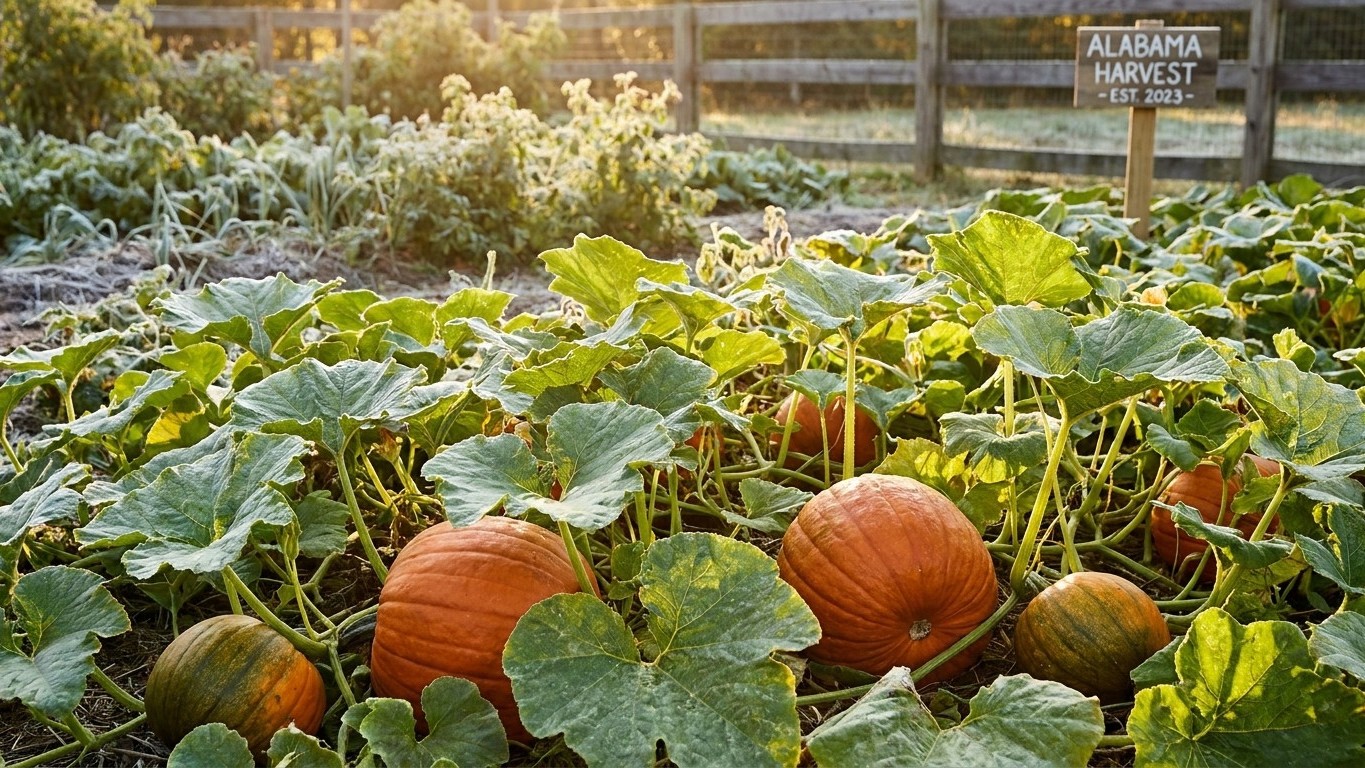

Whether a North Dakota pumpkin turns orange before the first hard frost comes down to one number gardeners rarely track: the flowering date, not the planting date. Cross that date against the state’s early fall frost window and the answer splits into two camps, one that ripens comfortably and one that gets caught green on the vine.
The short answer
North Dakota’s first fall frost typically lands between September 25 and October 5, based on the 1991-2020 climate normals for the reference weather station used by NOAA’s National Centers for Environmental Information. That’s the hard stop. Everything about pumpkin timing works backward from it.
Utah State University Extension puts pumpkin maturity at 45 to 55 days after flowering, not from the day the seed goes into the ground. Run that clock backward from the frost window and the math gets tight fast. If frost arrives on the early side, September 25, a fruit needs its flower open by roughly August 1 to bank the full 55 days some varieties need. If frost holds off until October 5, a flower opening as late as August 21 can still squeeze in the minimum 45 days. So the real target window for the last productive female flower sits somewhere between the first days of August and the third week of August, depending on how the season plays out.
That’s a three-week spread, and it matters because it’s not a date a gardener controls directly. Flowering follows from when seed went in, how warm the soil ran, and how the plant handled midsummer stress. A vine that got a slow, cool start in June is still setting flowers in late August when it should already be filling out fruit. That’s the mechanism behind every “my pumpkins didn’t turn orange” complaint: not bad luck, but a flower that opened too late for the days left on the clock.
Worth remembering, too, that these frost dates come from one airport-based station. Rural and low-lying gardens across the state commonly see frost arrive a week or two earlier than the station reading, and elevation shaves off more days still. A garden in a river valley or a frost pocket should treat late September as the realistic deadline, not October 5, and plan flowering accordingly.
When to sow here
Soil temperature drives the sowing date, not the calendar, and not the last frost. North Dakota’s last spring frost falls between May 4 and May 15, but pumpkin seed wants soil at 65°F, and soil warms far slower than air. Cold, often still-wet spring ground in this state typically doesn’t hold steady at 65°F until well into the back half of May, sometimes not until early June, weeks after that last frost has already passed. Sowing into cool soil doesn’t kill the seed outright the way frost would; it just stalls germination and pushes the entire flowering window later, which is exactly the delay that runs the clock too close to fall frost.
- Track soil temperature directly, with a soil thermometer pushed a few inches down, rather than counting days from the last frost. Air and soil temperatures do not move together, and the gap is the whole reason late plantings run out of season.
- Use row covers to move the date up. Utah State University Extension notes that row covers can buy about two weeks, warming the soil underneath faster than open ground and letting seed go in roughly two weeks ahead of where bare soil would allow.
- Hold transplants rather than risk cold soil if the 65°F mark hasn’t been hit yet; a pumpkin sown into ground that’s still in the high 50s often germinates unevenly and starts flowering on a delayed schedule that eats into the fall margin.
- Choose a sowing date that leaves room for both ends of the clock, the 45-to-55-day maturity window after flowering, and the September 25-October 5 frost window, rather than aiming for the earliest theoretically possible date.
Garden centers in the state carry a mix of names worth knowing even without attaching hard numbers to any of them: Connecticut Field, Jack-o’-Lantern, Howden, Big Max, Autumn Gold, Baby Bear, Jack Be Little, Sugar Pie, and Cinderella all show up in North Dakota seed racks and garden columns. None of that naming tells a gardener how many days a given plant needs or how large the fruit will run; that information isn’t published here, so treat the names as options to research locally rather than a ranked list.
What goes wrong here
- A flower opens too late to color up. This is the single most common North Dakota failure: a vine that set its last female flowers in late August, after a slow, cool start, runs out of the 45-to-55-day window before frost. The remedy isn’t fixing the fruit, it’s fixing the sowing date the year before, using soil-temperature tracking and row covers to push flowering earlier in the season.
- A near-ripe fruit gets caught by an early frost. Because the state’s frost window opens as early as September 25 in some years, a pumpkin that’s colored but still soft can be lost overnight if a cold snap arrives at the early edge of that range. Watching a frost forecast in the last two weeks of September and covering vulnerable fruit with blankets or tarps for a single cold night can carry a nearly-ripe pumpkin through to full color.
- The vine collapses before the rind hardens. Squash bugs and cucumber beetles both weaken vines late in the season, and a vine that dies back early leaves fruit exposed with a soft, unhardened shell that won’t store. Rather than re-covering that ground here, North Dakota gardeners dealing with either pest should check the dedicated squash bugs in North Dakota and cucumber beetles in North Dakota pages for the specific timing and control steps.
- Fruit is pulled with the stem cut flush to the pumpkin. Utah State University Extension is specific that harvest should keep the stem attached, and that pumpkins should be moved before frost to wherever they won’t freeze. No storage temperature or humidity figure is published in that guidance, so gardeners shouldn’t assume a refrigerator or root-cellar number that isn’t backed by the source; the safe rule is simply frost-free, stem intact.
Common questions
Can I still get a ripe pumpkin if my vine only flowered in mid-August?
It’s possible but tight. A flower opening around August 15 needs 45 to 55 days to mature, which lands the ripening date somewhere between late September and early October, right inside North Dakota’s frost window. Whether it makes it depends on which end of that frost window shows up locally.
Does a light frost kill an unripe pumpkin outright?
That specific distinction isn’t covered in the published frost data used for this state, which tracks the 32°F freeze probability window rather than separate light-frost and hard-freeze thresholds. The safest approach is treating any frost in the forecast during the September 25-October 5 window as a risk to uncovered fruit.
Should I start seeds indoors to get ahead of the soil temperature problem?
Starting indoors and transplanting can help sidestep slow spring soil warm-up, but transplants still shouldn’t go into ground colder than 65°F, since cold soil stresses transplants much the way it stalls direct-sown seed. Row covers remain the documented way to move that date up by about two weeks.
What if my pumpkin is orange but the vine is already dead?
A fully colored fruit can usually be harvested even if the vine has collapsed, as long as the rind has hardened, since color change and rind hardening are the two markers that matter at harvest, not vine health. Cut with the stem attached and move it somewhere it won’t freeze.