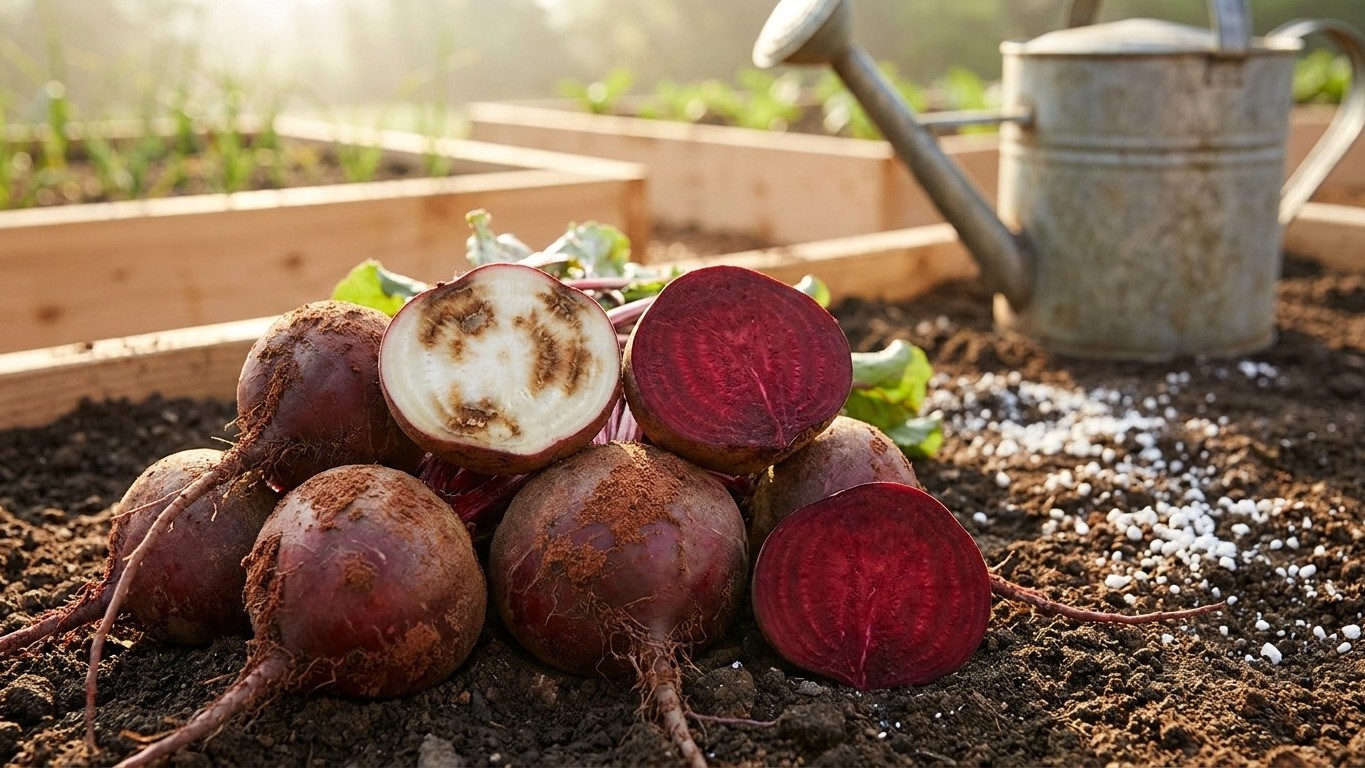

Three things eat a North Dakota beet crop, and none of them has legs. Thirst in the first six weeks sends plants to flower instead of building roots. Heat later in the season turns the root woody. A cellar that is too cold ruins what you managed to grow. This page covers those forces. It carries no calendar of insect or animal pests, because none is published here. For the full crop plan, start with Growing Beets in North Dakota.
The short answer
The soil that represents North Dakota is the Williams series, a Mollisol: deep, dark prairie ground of the kind that made the Corn Belt. USDA records its surface horizon at 38 percent sand, 22 percent clay and 40 percent silt, which makes a loam running toward silt. Organic matter sits around 4.0 percent, surface pH is about 7.2 (near neutral), and the drainage class is well drained. Those are representative values for the mapped surface layer of the series, drawn from 549 components in the USDA NRCS Soil Data Access database. They do not describe a worked garden bed.
Utah State University Extension describes the ideal beet soil as deep, sandy, well drained and rich in organic matter. Williams ground sits close to that on drainage and organic matter, and it is heavier than sandy because of the silt and clay. Silty loam holds moisture longer than sand does. That works in a beet’s favor when the weather turns dry, and it can work against you in a wet stretch. The same Extension guidance caps compost at no more than 1 inch of composted organic matter per 100 sq ft. A soil already near 4.0 percent organic matter does not need a thick blanket on top.
Treat all of this as a starting point. A state spans hundreds of soil series. River bottoms, hill country and any lot a builder has scraped or filled can look nothing like Williams. Use the series to understand what the region’s ground tends to do, then get a soil test for your own number. Never assume that 7.2 is your pH. The other piece of the puzzle is soil texture, covered in Beet Soil in North Dakota: What the Root Will Meet.
Heat is the second half of the answer, and one number is missing. The reference airport weather station is the source for this page’s frost dates, but the count of days a year it passes 90 F is not published here, and I won’t guess at one. What the Extension source does give is a threshold. Heat above 85 F combined with water stress makes the root woody. That is a different problem from bolting. Bolting comes from water stress early, in the first 6 weeks. Woodiness comes from heat and thirst later. Watering well in May does not protect a July root.
The six weeks that decide it here
The reference station’s last spring frost falls between May 4 and May 15, based on NOAA NCEI U.S. Climate Normals for the 32 F freeze probabilities (the 30 to 70 percent band). Sowing 2 to 3 weeks ahead of that puts seed in the ground from about April 13 at the early end to about May 1 at the late end. That is simple subtraction from the published dates. Beets are sown in place, so there is no transplant to fudge the count, and the 60 to 80 days to harvest run from seeding. For a finer calendar, see When to Sow Beets in North Dakota.
Run the clock forward and the first six weeks, the stretch the Extension source flags for water stress, land roughly between late May and mid June. That window sits at the front end of a North Dakota growing season. Spring on the northern plains tends to swing instead of settling: a warm, dry, windy week can follow a wet, cool one, and the pattern can flip again ten days later. I can’t give you a state-wide rainfall figure for those weeks, because none is published here. The swing itself is the point. Seedlings that get a good soaking one week and nothing the next are the ones that take the stress.
That puts the bolting risk in a specific place. It sits in any dry stretch that interrupts those six weeks, not in a cold snap on a calendar date. The loamy-to-silty Williams profile gives some cushion, since it holds more water than sand. A shallow-rooted seedling in the top inch or two of soil, though, dries out faster than the profile as a whole. Surface moisture is what the young plant is working with.
Your own garden will not match the airport. Suburban and rural plots usually see the last spring frost later than the station does, often by one to two weeks, and more at elevation. If your last frost is closer to the end of May, the whole six-week window slides toward the middle of July’s heat on one end. Check your county’s dates before you pick a seeding day.
The harvest arithmetic is worth a look as well. Seeds sown between about April 13 and May 1 would reach the 60 to 80 day mark roughly from mid June to late July. That is where the heat-and-thirst woodiness risk lives: in the last weeks before you pull the roots, when 85 F days can pair with dry soil. Early bolting and late woodiness hit the same crop at opposite ends of its life.
What goes wrong here
- Bolting after an early dry spell. Water stress in the first 6 weeks causes premature flowering. Keep the top few inches evenly moist through that window, and don’t let a swing week of wind and sun dry the seedbed to dust. A bolted plant won’t size up a good root, so pull it and resow if your season allows.
- Woody roots in summer heat. Heat above 85 F paired with water stress makes the root woody. This is a separate failure from bolting, so a plan that only covers spring will miss it. Water the bed steadily as the roots swell, and pull them before a long hot dry stretch if you can.
- Too much compost. Extension recommends no more than 1 inch of composted organic matter per 100 sq ft. The Williams series already carries about 4.0 percent organic matter at the surface, so a thick layer on top of similar ground is more than the crop asks for. Test first, then amend modestly.
- Trusting the state soil as your soil. Williams is the series that represents North Dakota, not the ground in every yard. Fill, river-bottom silt and hill soil behave differently. A soil test gives you the pH and texture that matter for your bed.
- Planting by the airport frost date. The May 4 to May 15 range belongs to the reference station. Rural and suburban beds often run one to two weeks later. Look up your county before you sow.
- Storing roots in a too-cold place. Colder is not better here, which is the reverse of most root crops. USDA Agricultural Handbook 66 says more black spot and rot occur at 32 to 34 F than at slightly warmer temperatures. Topped roots belong at 33 to 36 F and 98 percent relative humidity. In a pit or cellar, keep temperatures from dropping below 31 F or rising above 41 F.
- Storing them with the tops on. Bunched beets keep only about 10 to 14 days at 32 F and above 98 percent relative humidity. Cut the tops first if you want them to last longer.
- Saving the small roots. Large roots keep much better than small ones, which lose water and shrivel faster. Put the big roots away and eat the small ones first.
Common questions
Is North Dakota’s state soil good for beets?
It is a decent match on paper. The Williams series is well drained, near neutral at the surface (about 7.2) and carries about 4.0 percent organic matter, all of which suit a beet. It is a loam with 40 percent silt rather than the sandy soil Extension prefers. Your own bed may differ, so test it.
How many days above 90 F does the reference city get?
That count is not published here. The threshold that matters for beets in the cited source is lower: heat above 85 F combined with water stress makes the root woody. Keep an eye on the forecast during the final weeks before harvest.
Can I store beets at 32 F like other root crops?
You can, but you shouldn’t. The USDA handbook reports more black spot and rot at 32 to 34 F than at slightly warmer temperatures, and it puts topped roots at 33 to 36 F with 98 percent relative humidity. Trim the leaves first, and store large roots in preference to small ones.
How long from seeding to harvest?
Plan on 60 to 80 days, counted from seeding. Beets are sown in place, so there is no transplant date to count from. The range fits the sowing window of about mid April to the start of May at the reference station, and your county’s frost date may shift it later.