
North Dakota’s short growing season limits how much time any single insect has to build up numbers on a carrot bed, but the ones that do show up feed at very different points in the plant’s life. The honest answer starts with what’s actually documented for this state, and how thin that documentation is compared to states with longer growing seasons and more pest-monitoring history.
Which pests attack carrot in North Dakota

Here’s the limiting fact worth stating plainly: the sourced data behind this page covers soil conditions and crop requirements, not a county-by-county insect inventory for North Dakota. No state agency name or species list appears in the verified record used to build this article, and rather than invent one to fill the gap, it’s more useful to work from what’s solidly known about carrot pests in cool-season, short-summer vegetable gardens across the northern Plains generally, the insects a home gardener growing carrots in a place like Fargo or Minot is realistically likely to encounter.
Root maggots, the larval stage of the carrot rust fly, are the most commonly reported problem on carrot roots in cold-climate gardens, tunneling into the root itself rather than the leaves. Carrot weevil larvae feed in a similar way, working into the crown and upper root. Aphids cluster on the foliage and stems, sapping the plant rather than the root, and wireworms, the larvae of click beetles, chew into the root from the soil below, a habit that often gets blamed on rot instead. Carrots are sown directly in the ground and never transplanted, so any pest timeline for this crop runs from the seeding date, not from a transplant date the way it would for tomatoes or peppers.
What doesn’t belong on this list: the borers, scale insects, and bark-feeding beetles that show up in questions about North Dakota’s shelterbelt trees and orchard plantings. Those attack woody tissue an inch of topsoil away from a carrot row, and they have no reason to touch a root vegetable. If a name shows up in a search result attached to “North Dakota pests” but tied to trees or shrubs, it isn’t relevant here, and repeating it on a carrot page would be misleading.
When each one shows up, and what it does first
Without a published frost-free window specific to this page’s sourced facts, the safest anchor is the crop’s own clock rather than a calendar month. Root maggot damage tends to appear as plants establish, within the first few weeks after seedling emergence, when adult flies lay eggs at the base of young plants and the larvae tunnel inward almost immediately. The first visible sign is rarely a bug at all, it’s wilting or stunted growth in a seedling that looks otherwise healthy above ground.
Aphids show up earlier and more visibly, clustering on the undersides of leaves and along stems as the canopy fills in, and their presence is easy to spot because the leaves curl or yellow before any root symptom appears. Wireworm damage tends to surface later, as the root starts to bulk up and thicken, when a gardener pulling a test carrot finds narrow, straight tunnels bored through the flesh. Carrot weevil damage follows a similar late-season pattern, showing up as scarring and tunneling near the crown as the root matures.
Harvest itself runs 65 to 75 days after seeding, per Clemson Cooperative Extension guidance on carrots, and that window matters here for a practical reason: pulling roots on schedule, rather than leaving them in the ground out of habit, closes the exposure period before late-season feeders like wireworms and weevils do their worst damage. A carrot left in the ground an extra three or four weeks past that window isn’t getting meaningfully bigger, it’s getting more chances to be chewed.
None of this replaces a specific frost-free date for a given North Dakota county, which isn’t published in the sourced facts behind this page. A gardener planning sowing dates around the last spring frost should get that figure locally rather than from a generic national estimate.
Telling the damage apart from everything else
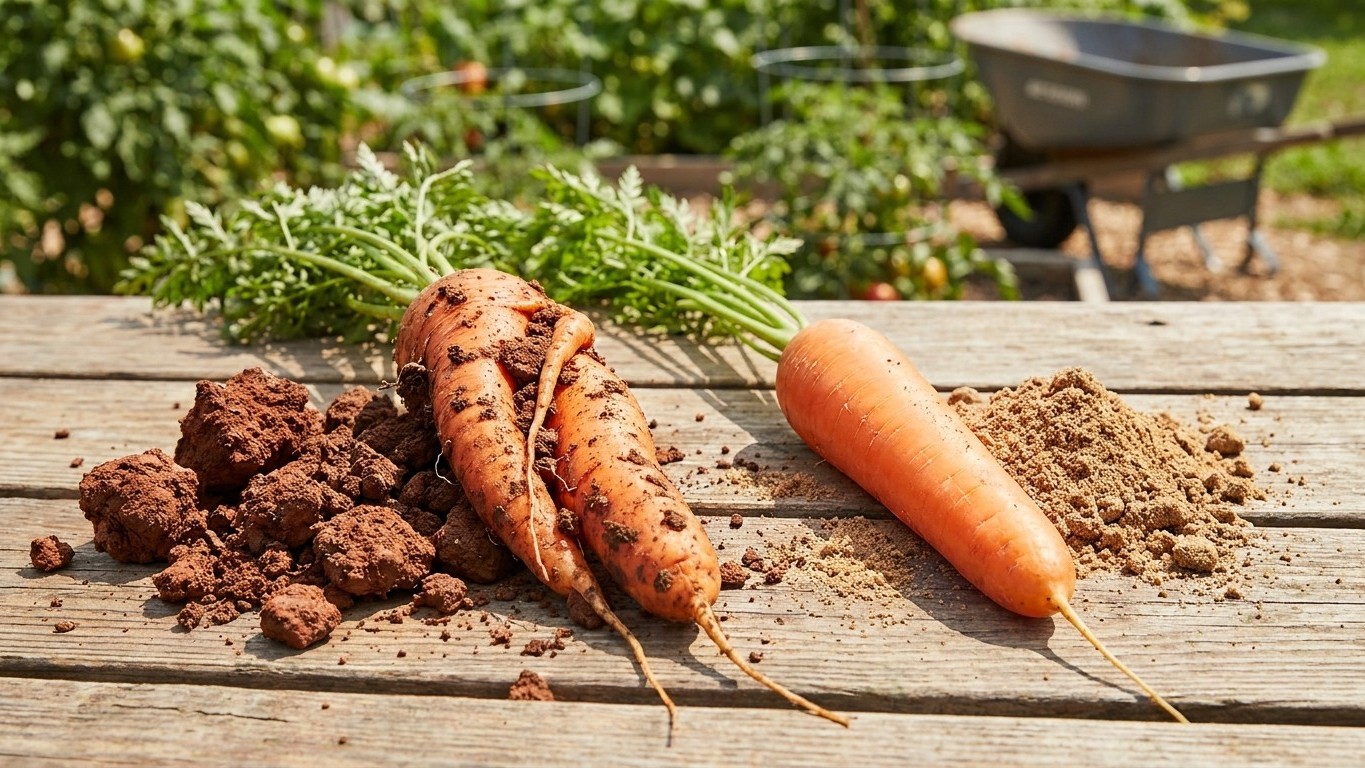
Misdiagnosis wastes more effort than the insects themselves. A forked or split root is the classic case: it looks dramatic, but it’s frequently a soil problem, not a pest problem. Heavy or rocky soil is what makes a carrot root fork, according to Utah State University Extension guidance on growing carrots, and North Dakota’s representative Williams series soil runs 22 percent clay against 38 percent sand and 40 percent silt, a loam that drains well but still carries enough clay to catch a taproot on the way down in a compacted or unamended bed.
| Symptom | Likely cause | What settles it |
|---|---|---|
| Root splits lengthwise or forks into two prongs | Heavy or rocky soil, uneven watering | No entry tunnel or larva present; soil test confirms texture |
| Narrow tunnels through the flesh | Wireworm or root maggot feeding | Larva or tunnel visible when root is cut open |
| Yellowing, curling leaves, no root damage | Aphids, or nitrogen deficiency | Aphid clusters visible on leaf undersides; deficiency shows no insects at all |
| Wilting seedling, healthy-looking foliage otherwise | Root maggot at the base, or transplant shock from disturbed roots | Carrots aren’t transplanted, so shock rules itself out; check the seedling base for tunneling |
The soil’s near-neutral pH, about 7.2 on the Williams series, and its organic matter figure near 4.0 percent describe the state’s representative surface soil, not any single garden bed. A yard built on fill, or a low spot that holds water differently than the mapped series, can behave nothing like these numbers, which is exactly why a home soil test settles a forking question faster than guessing from a state average.
When cutting a suspect root open doesn’t show a tunnel, larva, or clear insect sign, the more likely explanation is nutrition, water, or soil texture, and that’s a job for a soil test and a county extension office, not a pesticide.
What actually works here, and what is a waste of time
On a growing season this short, timing beats product every time. A lightweight floating row cover installed over the bed at seeding, before adult root maggot flies have a chance to lay eggs near the stem, physically blocks the problem before it starts. Put the cover on before symptoms appear, not after, because once larvae are inside the root, a barrier over the top does nothing for the plant already infested.
Crop rotation helps for the same reason: wireworms and root maggot pupae overwinter in soil, so moving carrots and other root crops to a different bed each year, rather than replanting the same row, reduces the population waiting for the next crop. Pulling roots at or near the 65 to 75 day mark instead of leaving them in the ground also limits how long a root sits exposed to late-season feeders.
What doesn’t help: reaching for a general-purpose insecticide without knowing which insect, and whether it’s legal to use on a food crop in this state, is guesswork at best and a wasted trip to the garden center at worst. This page doesn’t name products or active ingredients for that exact reason, because what’s labeled for use on carrots in North Dakota is a question for NDSU Extension, not a garden blog. Amending heavy soil with compost, meanwhile, addresses forking, not insects, and it’s worth doing regardless of pest pressure, but it won’t stop a root maggot.
Where to check this for your own county
North Dakota State University Extension is the land-grant extension service for the state, and its county offices are the right first call for confirming what’s actually active in a given garden this season, since insect presence varies inside a state’s borders as much as it varies between states. A pest confirmed in one county says nothing about the next county over, and a soil map built from one representative series, the Williams series used earlier in this article, describes a statewide average, not the bed behind any one house.
A county extension agent can identify a larva pulled from a split root, confirm whether row cover timing lines up with local frost dates, and point to what’s currently labeled for use on food crops in North Dakota specifically, none of which this page can responsibly guess at. The next step for a gardener staring at a damaged root is a call or a sample dropped off at that county office, not a search for a generic answer online.
Common questions
Does a pest list for North Dakota apply to every garden in the state?
No. Insect presence tracks local conditions, crop history, and even the individual yard, and a statewide inventory, where one exists, only describes what’s been documented somewhere in the state, not what’s present in any specific garden.
What does root maggot damage actually look like when the root is cut open?
Narrow, winding tunnels through the flesh, sometimes with a small white larva still inside, distinct from the clean split of a forked root caused by soil conditions.
Does storing carrots wrong cause damage that looks like a pest problem?
Yes, and it’s an easy mix-up. Carrots kept with their tops on continue losing moisture through the leaves and go soft within about 10 to 14 days, while roots stored at 33 °F with the tops cut off keep far longer, so a soft, shriveled carrot pulled from storage may have nothing to do with insects at all.
Does North Dakota’s soil make carrots more prone to pest damage?
Not directly. The state’s representative Williams series soil is a well-drained loam, which is favorable for root crops, but its clay content can contribute to forking in an unamended bed, a soil issue that’s easy to mistake for insect feeding unless the root is actually cut open and checked.