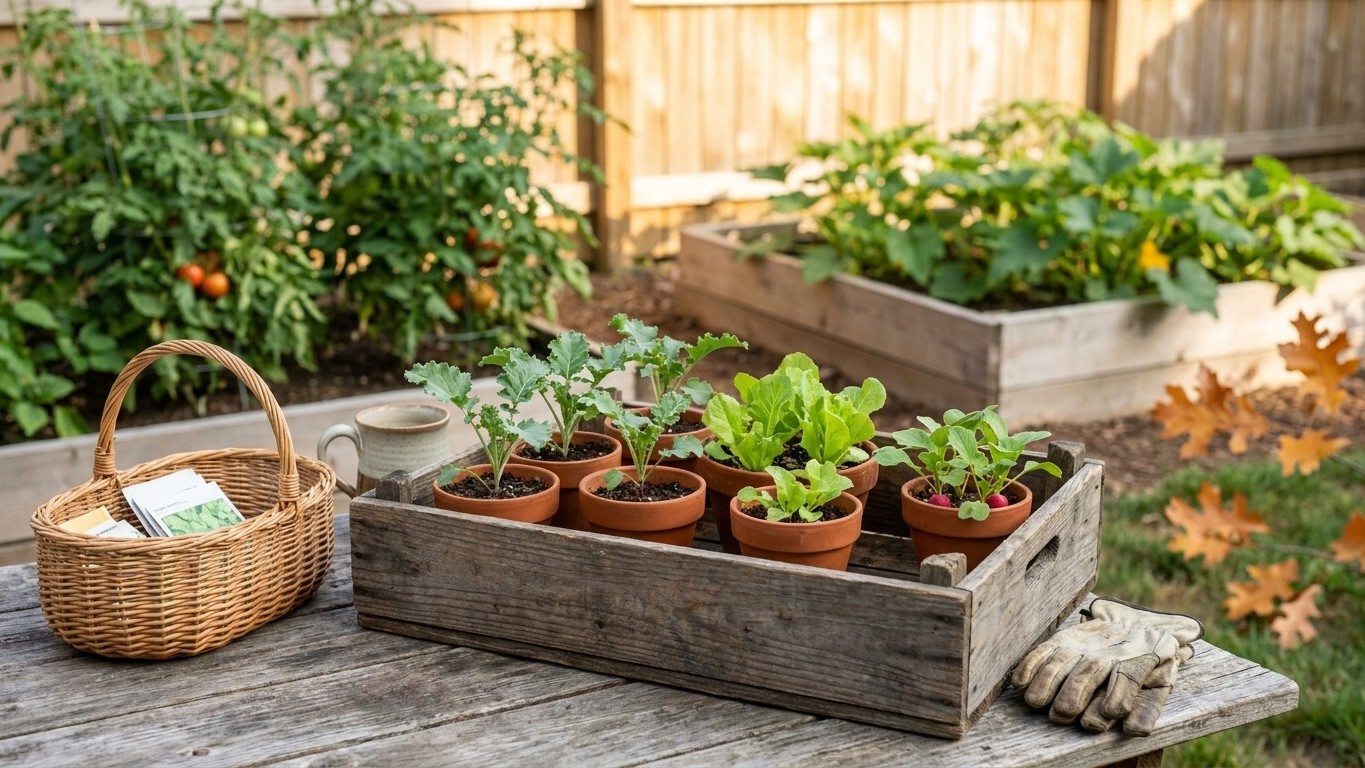

August in North Dakota gardens means harvesting the summer’s main crops, squeezing in one last fast round of greens and roots, and starting the pivot toward fall. This is not the month for warm-season transplants. It’s a month for counting days to frost and making every one of them count.
What goes in the ground in August

The number that actually decides what you can plant this month isn’t the calendar. It’s the gap between today and the first fall freeze, and that gap shrinks fast as August goes on. NOAA’s climate normals for 1991-2020 put the first fall frost at the reference weather station between September 25 and October 5. Count from there: a seed sown August 1 has roughly 55 days before that window opens; one sown August 25 has closer to 30. That’s the arithmetic behind every choice below, and it’s worth redoing for your own county rather than trusting a state-wide average.
Early August still leaves room for crops that mature quickly. Spinach, at 37 to 45 days, fits comfortably. Radishes, done in 25 to 30 days, can go in nearly all month. Turnips and fast lettuce varieties work well through the first half of the month, and kale sown now will size up before frost and keep going after it, since cold sweetens rather than kills it. Arugula and mustard greens round out the safe list; both bolt in summer heat but recover fast in the cooler, shorter days ahead.
What’s a gamble: bush beans need 50 to 55 days and cool nights slow that clock further, so anything sown after the first week of August is racing a closing door. Carrots are a harder no. Most varieties need 70 days or more, and a carrot sown in mid-August in a state that sits in USDA Hardiness Zones 3a to 4b, per the USDA Plant Hardiness Zone Map, simply won’t finish before the ground freezes. Save carrots for next spring’s calendar and use August for the crops built to move fast.
What to start under cover
Cold frames and low tunnels buy real time in a state where the growing window is already short, and August is when that extra time gets banked. The math works the same way as outdoor sowing, just with a longer runway: a lettuce or spinach transplant started indoors in trays in early to mid-August, then moved into a cold frame by early September, has six to eight weeks of protected growth before a hard freeze shuts things down. That’s often enough for a full head of lettuce or a second cutting of spinach that an open bed could never deliver this late.
Two mistakes show up every year. Starting too early, in the thick of August heat, means trays of leggy, heat-stressed seedlings that bolt before they’re even transplanted, since spinach and lettuce read long, hot days as a signal to flower rather than grow leaves. Starting too late runs into the opposite wall: seedlings that go into the cold frame in late September have too little daylight left to bulk up, and they sit stalled through the shortening days of fall without ever forming a usable harvest.
The safer play is to split the difference and stagger. A tray started the first week of August and a second one two weeks later gives two harvest windows instead of one, and if the earlier batch bolts in the heat, the later one is still coming. Brassica transplants for fall cabbage or broccoli are a tougher fit this late; they need 60-plus days from transplant to harvest, and only the very earliest August start gives them a real shot before frost closes in.
What is ready to pick
August is the payoff month, and the harvest list is long. Tomatoes color up and soften at the stem end; pick as soon as they give slightly to a squeeze rather than waiting for full ripeness on the vine, since ripening continues just fine on a counter. Peppers can be picked green or left to color, depending on preference, but leaving too many on the plant at once slows new fruit set. Cucumbers and summer squash need daily checking, since both go from perfect to oversized and bitter within a couple of days in ND’s August heat.
- Sweet corn: silk browns and dries, and a kernel pierced with a thumbnail releases milky, not clear, juice
- Green and wax beans: pods snap cleanly and seeds haven’t bulged inside the pod yet
- Garlic and onions: tops have flopped and started to yellow, ready to pull and cure in a dry, airy spot out of direct sun
- Raspberries: pull free from the core with the lightest tug, no resistance
- New potatoes: dig gently at the base of a flowering plant for smaller, thin-skinned tubers
Garlic and onion curing deserves particular attention this month, since it determines whether the crop stores through winter or rots by December. Both need one to two weeks in a shaded, ventilated space with the tops still attached before trimming and storing, and rushing that step is one of the more common regrets gardeners report later in the season.
The jobs that matter this month
Water is the job that decides everything else this month. August heat and wind pull moisture out of North Dakota soil fast, and fruiting crops like tomatoes and squash are especially unforgiving about inconsistency: uneven watering shows up later as blossom end rot and split fruit. A deep soak two or three times a week beats a light daily sprinkle, since it pushes roots down instead of keeping them shallow and heat-stressed.
Succession sowing has a closing window, and this is close to the last call for it. Getting a second round of radishes, spinach, or fast greens into open ground now is still realistic; waiting another two weeks starts eating into the margin the frost date leaves. Staking and tying sprawling tomato and cucumber vines now, before they collapse under their own fruit load, saves a scramble later and keeps fruit off damp soil where rot starts.
Pest scouting pays off disproportionately in August, when Japanese beetles, squash bugs, and corn earworm are all active at once. Checking the undersides of squash leaves and the base of corn ears every few days catches infestations while hand-removal or targeted treatment still works, rather than after populations have already exploded. Weeding matters too, not for tidiness but because many weeds are setting seed right now; pulling them before that happens is cheaper than fighting their seedlings all next spring.
Toward the back half of the month, especially in the northern part of the state or at higher elevation, it’s worth watching local forecasts for early frost warnings. The reference frost window of September 25 to October 5 is a range built on 30-to-70 percent freeze probability, not a guarantee, and a cold night can arrive on the early edge of that window in a low-lying or northern garden.
What not to do in August
The classic mistake is planting warm-season crops because a warm stretch of weather feels like summer is just getting started. Tomatoes, peppers, and squash sown or transplanted in August in a Zone 3a to 4b climate simply won’t have time to mature before frost, no matter how hot the air feels in the moment. Save that impulse for a cold frame experiment, not the open bed.
A second error is easing off on watering once evenings start feeling cooler. Daytime heat and wind haven’t backed off yet, and soil dries just as fast as it did in July; cutting back now stresses fruiting plants right when they’re finishing their crop.
Heavy nitrogen feeding is a third trap. Late-season nitrogen pushes soft new leaf growth instead of ripening fruit, and that tender growth is exactly what an early frost damages first. If anything, this is the month to taper nitrogen and let plants finish rather than push them to grow more.
Finally, don’t let mature harvest sit. Tomatoes and squash left too long split, overripen, or invite rot and pests, and garlic or onions left in the ground past their point of maturity lose storage life. Checking the garden every couple of days, not once a week, is the difference between a full harvest and a wasted one.
Checking this against your own county
Every figure above comes from one reference weather station, and North Dakota’s elevation changes, its lake and river valley effects, and the real distance between its northern and southern counties can shift frost dates by a week or two in either direction. A garden in a low frost pocket or at higher elevation should treat the September 25 to October 5 window as an early warning, not a fixed deadline. For a planting calendar built around your specific county, the NDSU Extension Service is the right next stop.
Common questions
Can I still plant tomatoes in August in North Dakota?
No. Tomatoes need 60 to 80 days from transplant to ripe fruit, and August plantings run out of time before the first fall frost, which the NOAA climate normals place between September 25 and October 5 at the reference station.
What’s the fastest crop I can direct-sow in August?
Radishes, ready in 25 to 30 days, are the quickest realistic option and can go in through most of the month with room to spare before frost risk builds.
When should I harvest garlic and onions?
Pull both once the tops have started to flop over and yellow, then cure them one to two weeks in a shaded, ventilated space before trimming and storing.
Is it too late to start a cold frame in August?
No. Transplants started indoors in early to mid-August and moved into a cold frame by early September typically get six to eight weeks of protected growth, enough for a full crop of lettuce or spinach.