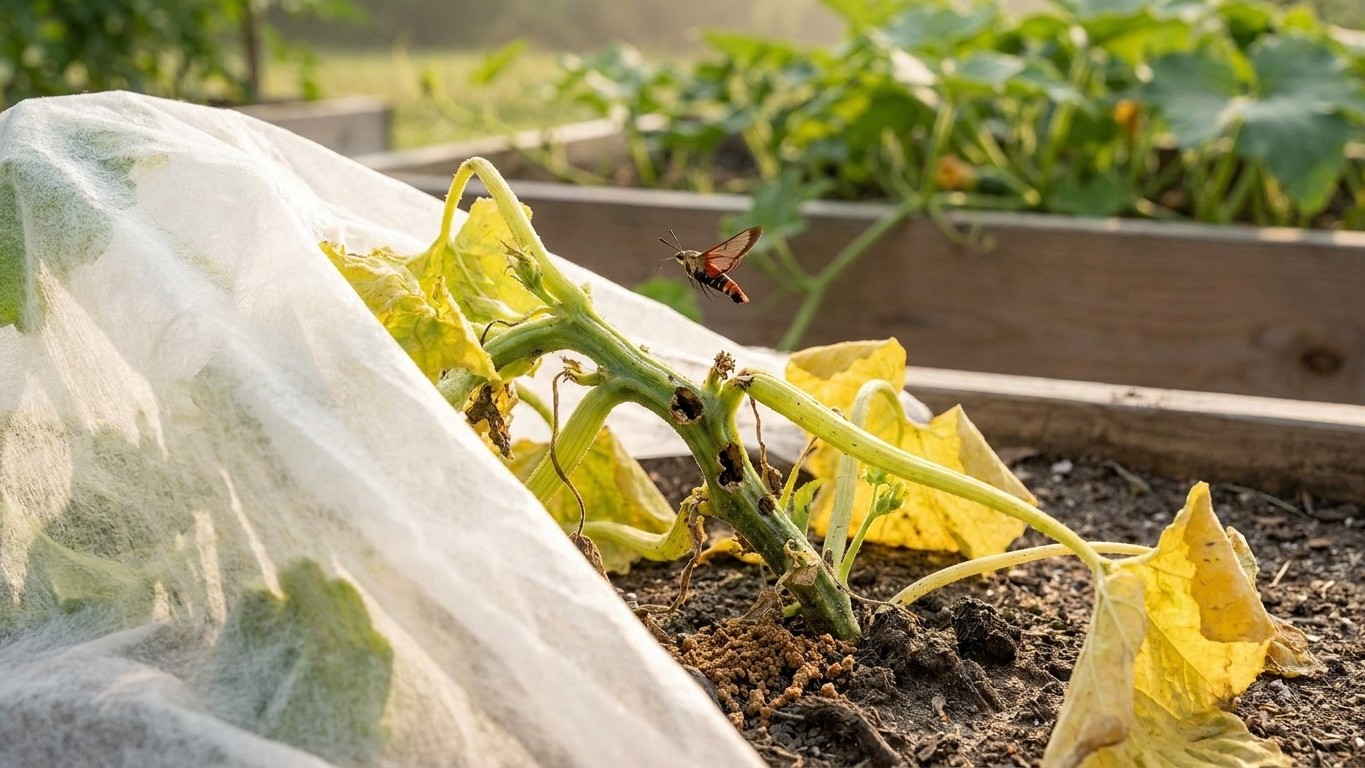

North Dakota’s summer squash rarely runs into a dedicated pest problem. NDSU Extension’s documented pest list for the state leans toward tree fruit, shade trees, and potatoes, not the vine crops growing in a backyard bed. The one name on that list that occasionally reaches squash is corn earworm, a moth that migrates north each summer and tends to show up late, closer to the season’s end than its start.
Which pests attack summer squash in North Dakota

NDSU Extension documents six pests for this territory: apple maggot, boxelder bug, Colorado potato beetle, corn earworm, emerald ash borer, and yellowheaded spruce sawfly. That’s the full list tied to this state through NDSU Extension’s tracking, and it’s short by design, not because squash goes unbothered, but because most of what’s on it has no connection to a vine crop at all.
Five that are off-topic
Apple maggot is a fruit fly that lays eggs inside developing apples and a handful of other tree fruits; it needs a pome-type fruit to complete its life cycle, so a squash plant offers it nothing. Boxelder bug feeds mainly on the seeds of boxelder and maple trees and turns up on siding and windows looking for a place to spend the winter, but it doesn’t chew leaves or vines. Colorado potato beetle is a specialist on the nightshade family, meaning potatoes, eggplant, and tomato relatives, and it doesn’t recognize squash as food. Emerald ash borer tunnels under the bark of ash trees and kills them from the inside out, with zero relationship to garden vegetables. Yellowheaded spruce sawfly larvae strip needles from spruce trees each spring, which puts it about as far from a squash patch as this list gets.
The one with any overlap
That leaves one name with real relevance: corn earworm. It’s a generalist caterpillar best known for damaging corn ears and tomato fruit, but its moths lay eggs across a range of garden crops when conditions line up, and summer squash blossoms and young fruit are an occasional, secondary host, not its main target. Corn earworm also doesn’t reliably survive North Dakota winters in the soil the way it does farther south, so each season’s population arrives fresh, riding weather systems north rather than building up locally.
For a gardener growing squash in this state, that means the pests NDSU Extension has flagged mostly target other plants entirely. A short list like this one isn’t proof of a low-risk garden, it just as often means the tracked species have nothing to do with the crop in question.
When each one shows up, and what it does first
Corn earworm moths have to fly north from warmer states before they ever reach a North Dakota garden, and that travel time sets the calendar. Moths generally don’t build meaningful numbers in the state until well into the growing season, arriving on wind currents rather than emerging locally the way a native insect would. Squash planted soon after the region’s last spring frost, which falls between May 4 and May 15 at the reference weather station, has usually put on several weeks of vine growth before earworm activity picks up.
What shows up first
The first sign isn’t damage to leaves. It’s small, ragged holes in open blossoms, sometimes with a bit of dark frass, the caterpillar equivalent of droppings, caught in the folds of a petal. A closer look can turn up a pale green to brown caterpillar, faintly striped, tucked down inside the flower or working into a young fruit near the blossom end. Because the moth lays eggs directly on flowers and new growth, early damage concentrates wherever the plant is actively flowering, not on older leaves lower on the vine.
Risk builds through the season instead of tapering off. Moth flights into the northern Plains typically strengthen in the second half of summer, which puts the highest-risk window for North Dakota squash somewhere in the weeks leading up to the region’s first fall frost, typically September 25 to October 5 at the reference station. A late-planted bed, or one still sending out fresh blossoms into early fall, carries more exposure than a planting that finished its main flowering earlier.
That timing cuts against the instinct to watch hardest right after transplanting. The highest-risk stretch lands closer to the first fall frost than to planting day, the opposite of how many garden pests behave, and it’s the detail most likely to catch someone off guard once the plants look Established and checks slow down.
Telling the damage apart from everything else
Squash throws off a lot of stress signals that look alike from a few feet away. Wilting, yellowing, and chewed-looking tissue can come from a caterpillar, but they can just as easily come from dry soil, a nutrient shortfall, a fungal disease, or a rough afternoon with a hoe. The detail that actually separates insect feeding from everything else is a caterpillar, or its frass, physically present inside a flower or fruit, not just a hole or a wilted leaf.
Side-by-side comparison
| Symptom | Likely cause | What tells them apart |
|---|---|---|
| Ragged holes in blossoms, dark specks nearby | Caterpillar feeding | Frass visible, or a caterpillar found when the petal is opened |
| Whole vine wilts despite damp soil | Vascular disease or mechanical injury | No chewing marks, wilt spreads evenly rather than starting at one flower |
| Yellowing between leaf veins | Nutrient deficiency | Pattern is uniform across older leaves, no holes or frass present |
| White powdery film on leaf surfaces | Fungal disease | Coating wipes off as dust, no feeding damage underneath |
| Mottled, curled new growth | Viral infection | Distortion appears on new leaves first, spreads without any chewed tissue |
None of this replaces a proper identification. A photo or a sample carried to a local extension office settles the question faster than guessing from a symptom chart, and it avoids the common mistake of treating a nitrogen shortage as if it were an insect problem.
What actually works here, and what is a waste of time
Timing does more work than any single tactic on a growing season this short. A floating row cover put over squash right after transplanting keeps moths off the plant, but it has to come off once flowers open, since squash depends on pollinators to set fruit and a sealed cover blocks bees along with the moth. Growers who want the cover’s protection later in the season, closer to that pre-frost risk window, can hand-pollinate a few flowers each morning and keep the cover on longer instead.
What holds up
Checking blossoms every few days during the weeks before the first fall frost catches caterpillar damage while it’s still limited to a flower or two. Picking off and destroying an affected bloom or young fruit promptly keeps a single caterpillar from moving on to the next one, since larvae will relocate once their food source is exhausted. Clearing old plant debris at the end of the season helps more with other insects than with this one, since corn earworm doesn’t overwinter here, but it’s still worth doing for general garden health.
What doesn’t
Spraying early in the season on a preventive schedule wastes effort, because the moths that matter for North Dakota squash haven’t arrived yet by early summer. Treating the whole plant when damage is confined to flowers misses the point of where the caterpillar actually feeds. And assuming any chewed leaf or wilted vine must be an insect at work, without checking for frass or an actual caterpillar, leads a lot of gardeners to treat a problem that was never insect damage in the first place. For anything beyond physical removal and row covers, a county extension office can say what’s actually labeled for use on vegetables in the state.
Where to check this for your own county
Everything above comes from NDSU Extension’s statewide documentation, and a statewide list doesn’t describe any one garden. Pest pressure inside North Dakota varies by county, shaped by what’s growing nearby, local weather in a given year, and how far a garden sits from the row crops that draw moths in the first place. A squash bed a few miles from a cornfield sees different pressure than one tucked into a small-town backyard.
NDSU Extension maintains county offices across the state, and that’s the direct line to information specific to a given location, including whether corn earworm has been active locally in a given season. Bringing in a photo, or a sample sealed in a bag, gets a faster and more reliable answer than trying to match symptoms to a chart from a screen.
That call is the next useful step for anyone looking at actual damage on a squash plant right now, not another round of comparing it to descriptions online.