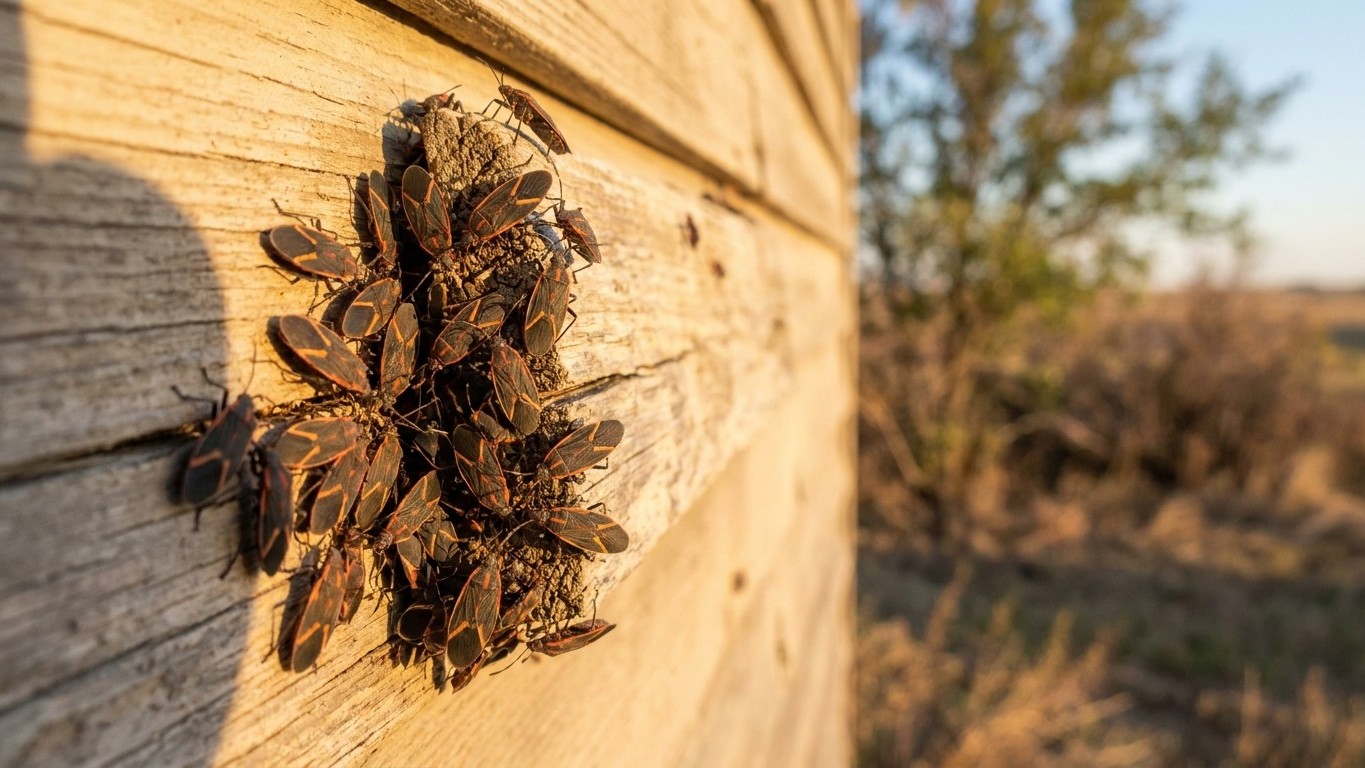

Boxelder bugs show up in North Dakota twice a year on a predictable schedule: they emerge from overwintering spots in April or May as temperatures climb past 70°F, then swarm again in September and October, hunting for cracks and crevices to spend the winter. What actually stops them isn’t a single spray. It’s a combination of sealing entry points, managing the boxelder and maple trees that feed them, and timing any treatment to hit the bugs before they tuck themselves into your walls.
Why North Dakota Has So Many Boxelder Bugs

North Dakota’s boxelder bug problem traces back almost a century, to a tree-planting campaign most homeowners never think about. During the Dust Bowl era, the federal Prairie States Forestry Project pushed farmers across the Great Plains, North Dakota included, to plant fast-growing shelterbelts to slow wind erosion. Boxelder trees (Acer negundo) were a top pick because they grow quickly in poor soil and tolerate brutal cold. Decades later, those same shelterbelts, plus countless boxelders planted as shade trees in towns from Fargo to Minot, are still standing. And boxelder bugs (Boisea trivittata) depend on those trees almost exclusively for food.
The insect itself is easy to identify: about half an inch long, charcoal black with three reddish-orange stripes running down its back, and a habit of clustering by the dozens or hundreds on warm, sun-facing surfaces. They feed on the seeds and leaves of female boxelder trees, and to a lesser extent on maple and ash seeds. Male boxelder trees don’t produce seed pods, so they don’t attract nearly the same bug pressure, a detail that matters a lot if you’re deciding what to plant or remove.
North Dakota’s flat terrain and wide temperature swings actually work in the bug’s favor. Open landscapes mean fewer natural windbreaks other than the shelterbelts themselves, which concentrates boxelder bug populations wherever those trees still stand. A single mature female boxelder near a house can support a population that swarms that house’s south and west walls every fall, sometimes for years, as long as the tree survives.
The North Dakota Boxelder Bug Calendar
Boxelder bugs don’t appear randomly. Their activity in North Dakota follows soil and air temperature closely, which means the calendar shifts a bit year to year but stays within a fairly tight window.
Spring Emergence: April Through Early June
Adults that survived winter in wall voids, attics, or leaf litter start moving once daytime highs consistently clear 70°F, typically mid-to-late April in the southern part of the state and into May farther north near the Canadian border. They head straight for boxelder trees to feed and mate. Homeowners in Fargo and Grand Forks often report the first sightings on sunny building walls before the trees even fully leaf out, because the bugs bask on warm brick and siding before dispersing to feed.
Females lay eggs on tree bark, leaf litter, and even in cracks in siding through late spring. Eggs are reddish and easy to miss unless you’re looking closely at the underside of boxelder leaves. A single female can lay clusters of a few dozen eggs at a time, and nymphs (bright red, wingless) hatch within about two weeks in warm conditions.
Summer: Feeding and a Second Generation
Through June, July, and August, boxelder bugs mostly stay on and around their host trees, feeding on developing seed pods. North Dakota summers are usually warm enough to support one full generation, and in hotter years, a partial second generation can develop before fall. Drought years tend to stress boxelder trees into producing fewer seeds, which sounds like good news but can actually push hungry nymphs toward nearby structures earlier looking for alternative shelter and moisture.
Fall Invasion: September Through Late October
This is the stretch every North Dakota homeowner recognizes. As days shorten and nighttime temperatures start dropping into the 40s, adult boxelder bugs abandon the trees en masse and search for overwintering sites. They gravitate toward the warmest, sun-exposed surfaces available, south and west-facing walls, window frames, foundation cracks, and gaps around utility penetrations. This is when populations that seemed manageable all summer suddenly look like an infestation, with bugs covering siding by the hundreds on clear October afternoons.
Once temperatures drop into the 30s consistently, usually by early to mid-November across most of the state, the swarming stops. Bugs that found their way into wall voids or attics go dormant. Bugs that didn’t find shelter mostly die outdoors, unable to survive North Dakota’s winter exposed.
Winter: Indoor Stragglers
Bugs that made it inside walls don’t stay put perfectly. Warm spells during a North Dakota winter, or the heat escaping through interior walls near furnace ducts, can wake a few and send them wandering into living spaces. It’s common to see a handful of boxelder bugs on a windowsill in January during a mild thaw, even though the bulk of the population stays dormant until spring.
What Actually Stops Boxelder Bugs
No single tactic eliminates boxelder bugs for good, because as long as boxelder, maple, or ash trees are within a few hundred feet, adults can fly or crawl back. But a layered approach cuts populations down to a nuisance level rather than a swarm.
Seal Before the Fall Swarm
Since the fall migration into structures is the main entry event, sealing gaps before mid-September makes the biggest difference. Focus on:
- Gaps around window and door frames, especially on south and west-facing walls
- Utility penetrations for cable, gas lines, and dryer vents
- Cracks in foundation walls and where siding meets the foundation
- Damaged or missing screens on attic and soffit vents
Caulk, weatherstripping, and door sweeps handle most of this. It’s the same prep work that improves winter energy bills in North Dakota’s cold climate, so the effort pays off twice.
Manage the Host Trees
Because female boxelder trees are the food source driving local populations, tree choices matter more here than in most pest situations. Removing a female boxelder growing within 50 to 100 feet of a house, or replacing it with a male boxelder or a different maple species that doesn’t attract the same feeding pressure, tends to reduce bug pressure over a few seasons. This isn’t always practical in a shelterbelt setting where the trees serve a wind-protection purpose, but for a single problem tree near a home, removal is often more effective long-term than repeated pesticide applications.
Raking up fallen boxelder seed pods and leaf litter in fall also removes overwintering and feeding material close to the foundation, an easy task that gets skipped more often than it should.
Direct Control for Active Swarms
When bugs are already massed on a wall, a few approaches work without heavy chemical use:
- A strong blast from a garden hose knocks bugs off siding and drowns many outright
- Insecticidal soap sprays kill bugs on contact without leaving long-lasting residue
- A shop vacuum with a bit of soapy water in the canister makes quick work of large clusters
- Diatomaceous earth dusted along foundation cracks and window tracks helps for indoor stragglers
Broad-spectrum pesticide sprays on exterior walls can knock down a swarm quickly, but they lose effectiveness fast once rain or fresh bugs arrive, and repeated treatments through fall get expensive without addressing the tree source. Treating trees directly with a labeled insecticide when nymphs first appear on leaves in early summer is more targeted, though it requires reaching the canopy and is often better handled by a professional applicator for anything beyond a small ornamental tree.
Indoor Cleanup
Bugs found inside during winter thaws or spring emergence are best removed with a vacuum rather than crushed. Boxelder bugs release a mild odor and can leave a reddish stain when squished against fabric or walls, particularly noticeable on light-colored siding and curtains. A vacuum with a disposable bag makes disposal simple and avoids the stain problem entirely.
North Dakota’s boxelder bug pressure tends to track directly with how many mature seed-bearing boxelders exist in a given neighborhood, which is why some blocks in Bismarck or Williston deal with heavy fall swarms year after year while a street over stays mostly clear. Checking which mature trees, yours or a neighbor’s, are feeding the local population is often more useful than any single product on a store shelf.