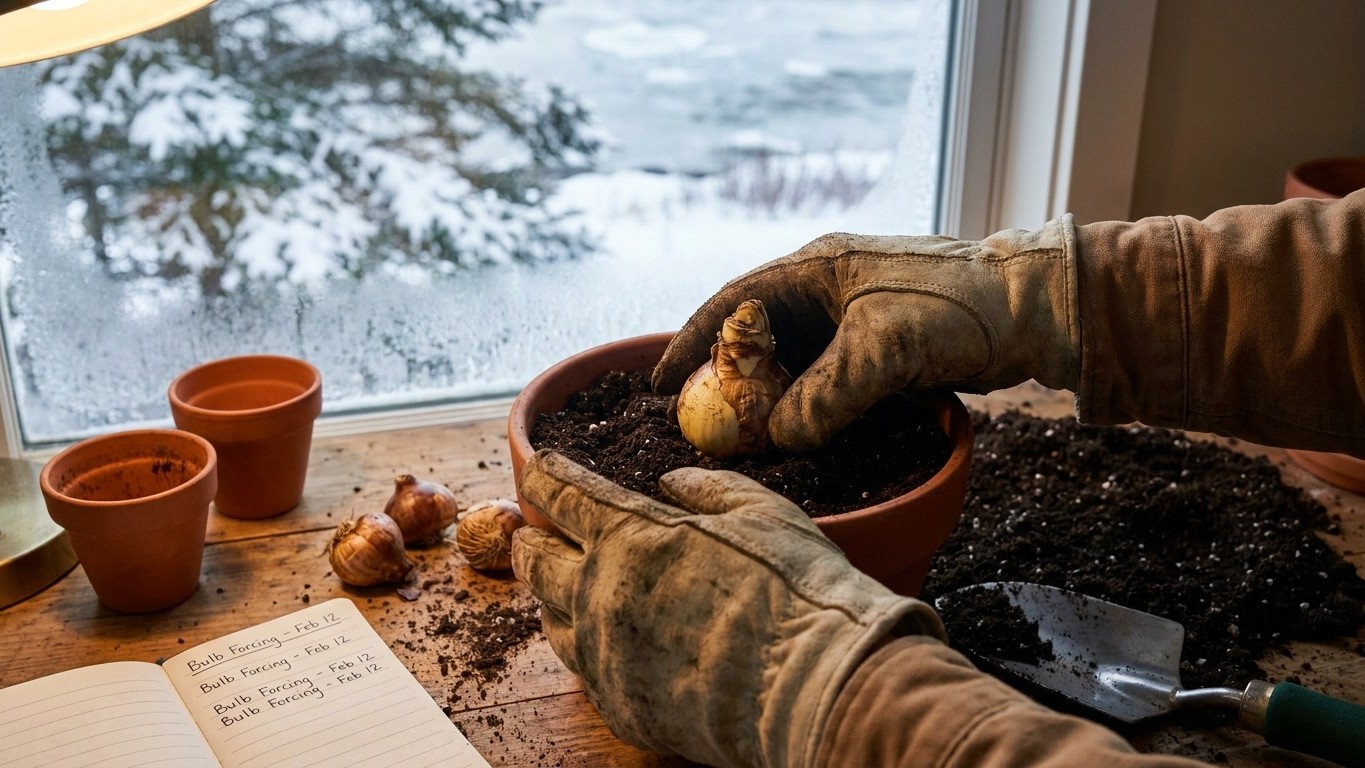

Forcing Spring Bulbs Indoors works well in Nova Scotia, though not because the province lacks winter cold. It has plenty of it. The real problem is that a pot left outside here freezes straight through, roots and all, long before the bulb gets the steady chill it actually needs. Bringing bulbs indoors, into a refrigerator or an unheated garage, is what keeps them alive long enough to flower.
Why this matters in Nova Scotia

Halifax’s coldest month brings a mean daily minimum of 13.3°F, according to Environment and Climate Change Canada’s 1981-2010 Climate Normals. That single figure decides which of two very different problems a Nova Scotia gardener is actually solving when they force bulbs.
A spring bulb needs roughly twelve to fourteen weeks below 45°F to break dormancy and start pushing up a flower stem. In places where winter never gets cold enough, for long enough, forcing means manufacturing that chill artificially, usually in a refrigerator, because the outdoors simply won’t deliver it. That is not the Nova Scotia situation. At Canadian hardiness zone 6b, with a coldest-month average minimum sitting at 13.3°F, the region has far more than the required chill hours. Garden soil here doesn’t run short of cold; if anything it has a surplus.
The trouble shows up somewhere else: Containers. A pot behaves nothing like garden soil. Ground below the frost line stays buffered by the earth’s mass and rarely dips anywhere near air temperature, which is exactly why a bulb rated hardy in a Nova Scotia bed survives winter without help. A container has no such buffer. Exposed to air on every side, its internal temperature tracks the outdoor air closely, so when the coldest month averages a minimum of 13.3°F, an unprotected pot left on a step or porch freezes solid through its whole volume, bulb included.
That’s the piece worth remembering: a bulb that is perfectly hardy planted in the ground at zone 6b can still die in a pot exposed to that same air, because the insulating mass that protects its roots in a bed simply isn’t there in a container. So the case for forcing indoors in this province isn’t a missing-cold argument. It’s an exposure argument. Bringing pots into a controlled space, a fridge drawer or a garage that stays reliably above freezing, delivers the same twelve to fourteen weeks of chill the bulb’s biology calls for, without the deep freeze that kills it outdoors in a pot.
How to do it here
The sequence below is built around what a Nova Scotia gardener can actually check with a thermometer, not around a generic timeline.
- Pick bulbs suited to forcing. Short, sturdy varieties with a modest cold requirement handle the process far better than tall, late-season types (see the next section for which is which).
- Pot them in well-draining mix, noses just above the soil line, and water once thoroughly so the chilling period starts on damp, not soggy, soil.
- Find a chill space that holds steady. A refrigerator’s produce drawer works, but keep it well away from ripening fruit: apples and pears give off ethylene gas, and ethylene can kill the flower bud forming inside the bulb before it ever gets a chance to open.
- Or use an unheated garage, as long as it stays above freezing but stays cold, below roughly 45°F, through the winter. Don’t assume; check it with a thermometer over a few days, since an attached garage can run warmer than the outside air while a detached one can track it closely.
- Check the container’s hardiness margin. If a pot will spend any part of the winter outside rather than in a controlled space, it needs to be rated at least two zones hardier, in the Canadian system, than the bulb inside it. Nova Scotia’s reference zone of 6b is a Canadian rating built from seven climate variables, not a USDA zone, and the two systems don’t convert directly, so don’t borrow a USDA number from a seed catalog to judge the margin here.
- Hold the twelve to fourteen weeks, keeping the soil barely moist, and check the drainage holes after about ten weeks for visible root growth, a sign the chill is doing its job.
- Move to a cool, bright spot, around 55 to 60°F, once shoots reach an inch or two. Let them green up there for a week or so before moving to full warmth and light, which is what keeps the stem from stretching out weak and floppy.
Which bulbs are worth it
Not every bulb repays the effort of chilling and monitoring for three months. A short cold requirement means a faster turnaround and less time managing a fridge drawer; a tall natural stem means a floppy, top-heavy pot no matter how well the chill went. And for bulbs that were never going to survive a Nova Scotia winter outdoors anyway, forcing costs nothing in the long run since the bulb was a one-season purchase from the start.
- Paperwhite narcissus, no cold period required at all, making them the simplest starting point
- Amaryllis, also skips the chill entirely and blooms on a predictable schedule from planting
- Hyacinths, short, sturdy stems that hold up well in a pot after chilling
- Crocus, low growing and quick to finish once brought into warmth
- Muscari (grape hyacinth), compact and reliable, rarely needs staking
Some bulbs sulk in a pot no matter how carefully the chill was managed, usually because their natural height or their chill demands were never suited to container life.
- Large trumpet daffodils (the tall King Alfred type), which topple in a lightweight pot once the flower opens
- Tall Darwin tulips, which combine a long chill requirement with a stem that outgrows most indoor containers
- Alliums, whose bulbs are large and whose chill period runs long relative to the payoff of a single indoor bloom
- Fritillaria, fussy about timing and prone to rot if the chill period runs even slightly too wet
What goes wrong, and when you can still fix it
Leaves but no flower
This means the chill period was cut short. The bulb has enough stored energy to push up green growth, but the flower bud never finished the biological signal that a full cold cycle triggers. There’s no fix for the plant now this season; a bulb that’s genuinely hardy can go into a garden bed to try again naturally, while a tender one is best composted and replaced.
A flower on a stem too short to see
This happens when the pot was moved from cold storage straight into full warmth and bright light, skipping the cool, dim transition stage. The stem never got the chance to elongate before the flower opened. Nothing rescues that bloom this season; next time, hold the cool 55 to 60°F stage for a week or more before giving the plant full sun and warmth.
Rot in the pot
Soft, discolored bulbs during or after the chill period point to standing water, usually from a pot without adequate drainage holes or soil packed too dense to let excess moisture escape. This one isn’t salvageable. The bulb and the old soil mix should be discarded, and the next attempt needs a pot that drains freely and a lighter hand with the watering can during the chill weeks.