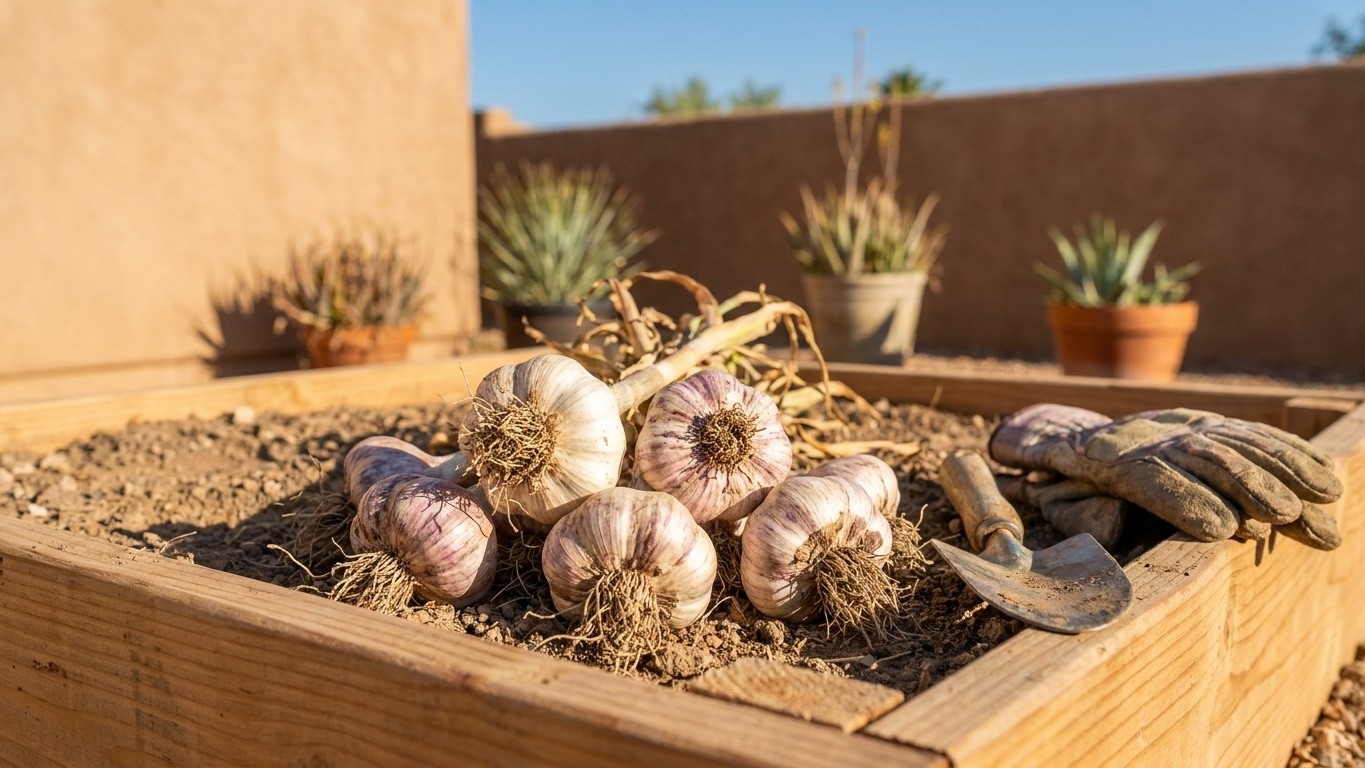

Garlic in the Northwest Territories goes into the ground in fall, before the soil locks up, and comes out the following summer once the lower leaves have died back but a handful of green ones remain standing. Curing takes several weeks in a dry, shaded, airy spot, and storage through the winter demands cool, dark conditions that stay well above freezing but never warm enough to wake the cloves.
When garlic is ready to lift in Northwest Territories
The signal that matters isn’t a date on a calendar. It’s the plant itself. Garlic tells you it’s done by dying from the bottom up: the lower leaves brown and collapse first, while the upper few stay green. Most growers wait until somewhere around five or six leaves are still standing and green, because each green leaf roughly corresponds to a layer of papery wrapper protecting the bulb underneath. Pull too early, with too many green leaves left, and the bulbs are undersized with wrappers that haven’t finished forming. Wait too long, past the point where nearly everything has browned, and the wrappers split, cloves separate, and the bulb no longer stores well.
In a territory this far north, the growing season itself is the constraint. The autumn planting date depends on how much cold the ground can take before it locks up, and Yellowknife’s average first fall frost lands on September 18, according to Environment and Climate Change Canada’s Canadian Climate Normals for 1981-2010 at station YELLOWKNIFE A. That figure is a mean, not a guarantee. In one year out of two, frost actually arrives later than that date, so treat it as the midpoint of a window rather than a line you can plant right up against. It also comes from a single station near Yellowknife. Communities further north or at higher elevation typically see frost weeks earlier, which pushes their whole planting and lifting calendar back to match.
That short season means the harvest window itself is compressed compared to milder regions. Garlic planted in fall has to build its root system before hard freeze-up, sit dormant through a long winter, then push through a brief summer with limited accumulated warmth before bulbing finishes. Growers here often find the lift happens later in summer than gardening guides written for temperate climates suggest, simply because the plant needs every available warm week to catch up. Checking a bulb or two by digging carefully at the edge of a row, rather than guessing from a printed date, remains the more reliable approach in this territory.
The territorial government’s agriculture program, through the Department of Industry, Tourism and Investment, maintains growing information relevant to northern conditions at iti.gov.nt.ca/en/services/agriculture, which is worth checking for season-specific updates before you commit to a lift date.
Curing it, and where to hang it here
Curing is what turns a freshly pulled bulb, still full of moisture, into something that can sit in storage for months without rotting. The process is simple in concept: get the bulbs somewhere dry, shaded, and ventilated, and leave them alone for a few weeks while the outer wrappers dry down and seal the cloves inside.
The complication in the Northwest Territories is finding that space at all during the short window when it’s needed. Curing has to happen after the summer harvest but before the weather turns, and outdoor drying racks that work fine in a longer, drier growing season aren’t always practical here. Direct sun is the main thing to avoid regardless of location, since it can scorch bulbs and cause uneven drying, but the bigger local issue is often humidity swings and unpredictable early cold snaps interrupting an outdoor cure before it’s finished.
Practical spaces that work
Most growers end up curing indoors, in whatever unheated or lightly heated structure keeps air moving without exposing bulbs to rain or frost. A few options that come up repeatedly:
- A garage or shed with a window cracked or a small fan running for airflow
- An enclosed porch, screened from direct sun, with garlic hung or laid on mesh racks
- A dry barn or outbuilding, provided it doesn’t dip below freezing during the cure
- An indoor spare room with a dehumidifier if the local humidity runs high that season
Hanging bulbs in loose bundles, or laying them in a single layer on screens or mesh, keeps air circulating around each one. Stacking or piling bulbs traps moisture and invites rot before curing even finishes. Whatever the space, a stretch of three to four weeks with steady airflow and no freezing temperatures gives the wrappers time to tighten down properly. Trimming roots and tops, and brushing off loose soil without washing the bulbs, happens after curing is complete, not before.
Storing it through a Northwest Territories winter
Once cured, garlic needs a resting place that stays cool, dark, and dry for the months ahead, and that’s where a northern winter cuts both ways. Cold storage is easy to find here. Keeping bulbs cool without letting them freeze solid is the harder part.
Garlic stored at temperatures that stay consistently just above freezing, in the dark, with moderate humidity, tends to hold the longest without sprouting or shriveling. The problem in this territory is that unheated storage spaces, whether that’s an entryway, a shed, or a garage, can swing from cool to genuinely frozen once outdoor temperatures drop far below zero for extended stretches, which happens routinely across the Northwest Territories in deep winter. A space that seemed adequately cool in October can freeze hard by January.
Finding the right spot
A root cellar, or any below-grade space that stays buffered from outdoor extremes, is the classic answer, and if a household has access to one, it usually beats anything above ground. Absent that, an unheated closet against an interior wall, a cold pantry near an exterior wall but not directly against it, or a basement corner away from a furnace all tend to hold a steadier middle ground than an attached garage or garden shed once deep cold sets in.
Mesh bags, cardboard boxes with ventilation holes, or open crates all work better than sealed plastic containers, which trap the moisture bulbs give off and encourage mold. Checking stored garlic periodically through the winter, and pulling any bulb that’s gone soft or moldy, keeps a single bad bulb from spreading trouble to its neighbors. Bulbs meant for spring planting are usually kept separate from bulbs meant for the kitchen, since the two get handled differently as winter wears on and warmer storage can trigger early sprouting in cloves destined for eating.
What goes wrong here
Most storage failures trace back to moisture, not cold. Garlic that goes into the cure damp, or that sits in a storage space with poor airflow, molds from the inside out long before the wrappers show any visible sign of trouble. By the time a soft spot appears on the outside, the clove underneath is often already gone.
Pests are a smaller but real factor in the field before harvest ever happens. The UAF Cooperative Extension, covering the neighboring Alaska region with a comparable northern climate, documents aphids, cutworms, root maggots, slugs, and spruce beetle as pests relevant to this area. Root maggots in particular can damage bulbs underground before lifting, which shows up later as soft or discolored tissue that won’t cure properly no matter how careful the drying process is. Slugs tend to be a bigger nuisance early in the season, chewing foliage rather than the bulb itself, while aphids and cutworms affect the growing plant’s overall vigor rather than the storage crop directly.
Cold is the other recurring failure, but it cuts in an unexpected direction. Gardeners braced for winter often overcorrect and store garlic somewhere too cold, not realizing that a hard freeze in an unheated shed can damage cloves just as thoroughly as heat and humidity do elsewhere. A bulb that’s been frozen solid and thawed repeatedly often turns mushy or develops an off smell, even if it looked fine going into storage. The safest range sits in that cool-but-not-frozen middle ground, which in a territory this cold sometimes takes more effort to maintain indoors than the growing itself took outdoors.
Common questions
Can garlic be harvested the same year it’s planted in the Northwest Territories?
No. Garlic here is planted in autumn before the ground freezes and lifted the following summer, after it has spent the winter dormant underground.
How long does curing take before garlic can go into storage?
Roughly three to four weeks in a dry, shaded, well-ventilated space, though the exact time depends on airflow and humidity in whatever space is available.
Is the September 18 frost date a safe cutoff for fall planting?
No. That date is a long-term average from Environment and Climate Change Canada for the Yellowknife A station, and frost arrives later than that in about half of all years, so it should be treated as a rough midpoint rather than a guaranteed deadline.
What’s the biggest risk to stored garlic over a Northwest Territories winter?
Two opposite problems: storage that’s too humid, which invites mold, and storage that freezes solid, which can turn cloves mushy. A cool, dry, consistently above-freezing spot avoids both.