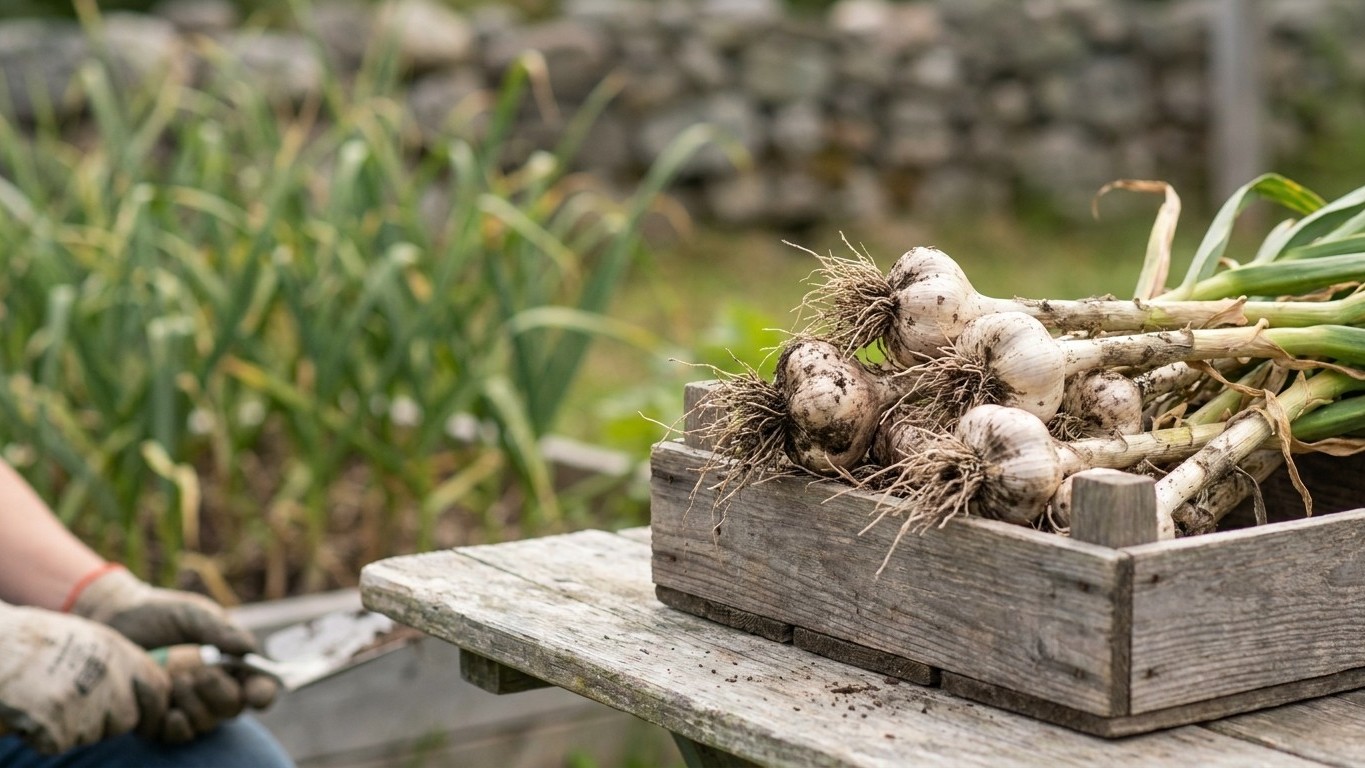

Nova Scotia’s winters give garlic more cold than it needs to split into cloves, so both hardneck and softneck types grow well here. Environment and Climate Change Canada’s 1981-2010 climate normals for Halifax Stanfield put the average first fall frost at October 18, and that date anchors the planting window that gets cloves rooted before winter sets in. For most gardens, that means ordering cloves now and getting them into loosened, well-drained soil in late September, a hardneck like German Red or Chesnok Red for the coldest sites.
The short answer for Nova Scotia

How much cold garlic actually needs
Halifax Stanfield’s ground freezes hard enough, long enough, that garlic here lives through a real winter, not the mild wobble coastal growers further south worry about. That depth of cold is what settles the variety question before you even open a catalog: hardnecks like German Red, Duganski, and Chesnok Red aren’t a gamble in this ground, and softnecks like Inchelium Red or Italian Late take the freeze just as well while storing longer after harvest.
What that means for variety choice
Given that much cold, hardnecks are not a gamble in Nova Scotia the way they can be in a milder coastal state. Varieties like German Red, German White, Duganski, Chesnok Red, Georgian Fire, Georgian Crystal, Bavarian Purple, Blue Music, Ivan and Fall Festival all suit the cold end of this climate, and several are known for bolder flavor than softnecks. Softnecks including Inchelium Red, Italian Late, Lorz Italian and Early Red Italian handle the winter equally well and reward the grower with longer storage after the summer harvest.
The frost date is a midpoint, not a deadline
Every cultivar on this list is set out in late September in Nova Scotia. That timing is built around Environment and Climate Change Canada’s October 18 average first frost at Halifax Stanfield, but that date is a mean, not a guarantee. In roughly half of the years behind that average, the actual first frost fell later than October 18, and in the other half, earlier. Treat the date as the middle of a window, not a line you can plant right up to.
Working it out for your own garden
The arithmetic
The late-September planting window used across this list is not arbitrary. It comes from working backward from the average first fall frost, then giving cloves enough time in warm soil to root before the ground itself cools past the point roots can grow. Start with Environment and Climate Change Canada’s Halifax Stanfield figure: an average first fall frost of October 18. Late September, the window given for every variety, falls roughly three to four weeks ahead of that date, which is enough for a clove to push root growth before soil cooling slows it down. If your property sits close to Halifax Stanfield’s climate, that arithmetic applies directly.
Adjusting for your own site
Most gardens in the province do not sit at the reference station, and the same three-to-four-week gap needs to be checked against your own conditions rather than assumed.
- Find the closest weather station to your property in Environment and Climate Change Canada’s climate normals and read its own average first fall frost, not Halifax’s.
- Count back three to four weeks from that date to land on your own set-out window.
- Adjust earlier if your site sits at elevation or in a low frost pocket that cools faster than the surrounding land.
- Adjust later if you are close to open water, where the coastline holds heat longer into the fall.
The three-to-four week gap is a rule of thumb, not a fixed rule. Push planting later than that and cloves may go into the ground without enough time to root before the soil cools past the point new roots can form. Wait too long and a clove sits dormant with no anchor, which raises the risk of frost heave lifting it during freeze-thaw cycles. Push it earlier by more than a week or two and top growth may emerge before winter, which does not kill the plant given how cold the season runs, but it puts green growth through a harder winter than it would face dormant.
Soil temperature, not the calendar, is what a clove actually responds to, and soil lags air temperature by weeks and swings less than the air above it. A stretch of unusually warm or cold weather right around your calculated date is worth watching for before you commit cloves to the ground. For the fuller breakdown of counting back from frost date to planting day, see When to Plant Garlic in Nova Scotia: Counting Back From the First Frost.
What changes across Nova Scotia
One station, many districts
Halifax Stanfield’s October 18 average frost date describes one station on the Atlantic side of the peninsula, not the whole province. Move away from that station and the same season runs on a different schedule.
Where the season runs longer or shorter
The Annapolis Valley, sheltered between the North and South Mountains and warmed somewhat by the Bay of Fundy’s tidal water, tends to hold a longer frost-free season than exposed coastal ground, which can push the practical planting window a little later than Halifax’s figure suggests. Cape Breton’s highlands and the interior valleys of the mainland sit at higher elevation and cool faster once fall sets in, which argues for growers there to err toward the earlier end of the late-September window rather than the later end. The Atlantic coastline south and east of Halifax, exposed directly to the open ocean, often keeps milder air longer into autumn than inland ground at the same latitude, but that same moisture keeps soil wetter, a detail that matters more for disease pressure than for frost timing.
| Region | Main influence | Likely effect on timing |
|---|---|---|
| Annapolis Valley | Sheltered by North and South Mountains, warmed by the Bay of Fundy | Later effective frost than Halifax Stanfield |
| Cape Breton highlands and interior valleys | Higher elevation, more distance from the coast | Earlier frost, favors the early end of late September |
| Open Atlantic coastline | Direct exposure to the ocean | Milder air later into fall, but wetter soil |
Environment and Climate Change Canada’s normals are published station by station, and the closest station to your own garden is a better guide than a province-wide average. Where two districts are only a short drive apart, elevation and distance from open water usually explain more of the difference between them than latitude does.
The mistakes this climate punishes
Two mistakes account for most of the lost garlic beds in this province, and neither is about picking the wrong variety.
Treating October 18 as a safe date
Environment and Climate Change Canada’s October 18 average first frost at Halifax Stanfield is a midpoint, and in roughly half of the years behind that average, the real first frost arrived later than the date itself. A gardener who waits for frost as the cue to finish planting can end up putting cloves into cold, slow-to-root soil weeks later than intended. The safer approach is to work from the calendar window, not from the weather outside it, and get cloves in during late September regardless of whether frost has shown up yet.
Planting shallow or skipping mulch
Nova Scotia’s freeze-thaw cycles heave a shallow-planted clove right out of loosened soil over the winter, breaking the roots it worked all fall to grow. A layer of straw or leaf mulch put down before the ground locks up holds soil temperature steadier through those swings and reduces how far a clove can be pushed. This matters more here than in a climate with one hard freeze and a stable frozen ground all winter, because Nova Scotia’s coastal air brings repeated thaws through the cold season rather than a single continuous freeze.
Rot risk in wet, cool stretches
White rot, caused by the pathogen Sclerotium cepivorum, has a published temperature range of 50 to 75°F, according to the University of California’s UC IPM guidelines for onion and garlic, UC ANR Publication 3453. Nova Scotia’s growing-season air temperature falls inside that range for three months, September, June and July, which covers both the planting month and the run-up to harvest. That is an air-temperature reading, not a soil reading, and soil lags air and swings less, but it means the window when this fungus is active overlaps directly with when garlic sits in the ground. Fusarium basal rot, caused by Fusarium oxysporum f. sp. cepae, has a higher range of 59 to 90°F and only overlaps June and July here, closer to harvest than to planting. Buying certified disease-free seed stock and rotating away from any bed that has grown alliums recently matters more than any variety choice on this list, since both pathogens travel in infected cloves and neither cares which cultivar it infects. Southern blight and pink root need warmer soil than this province’s air temperature reaches in any month of the growing season, which makes them less active here, not absent, since infected planting stock can still introduce either one.
Checking this against your county
For a planting date or frost figure specific to your own county, the Nova Scotia Department of Agriculture keeps resources through its agriculture services page and can point you toward the nearest weather station. Bring your civic address or nearest town when you search, since the office needs a location to give you a location-specific answer, not just “Nova Scotia.” If your garden sits inland, at elevation, or right on the coast, say so. Those three details narrow down your real frost window better than the province-wide average ever will, and the same office is a starting point for garden basics covered in Growing Garlic in Nova Scotia.
Common questions
Can I plant garlic in Nova Scotia in spring instead of fall?
Garlic planted in spring here almost always comes up as a single Round Bulb Instead of separate cloves, because it misses the extended cold stretch that triggers division. That cold requirement is why fall planting, described above, is standard practice in this province.
Do I need different garlic for the south shore versus the annapolis valley?
Not a different variety, just different timing at the margins. Any cultivar on this list handles either district’s winter, but a South Shore garden close to the ocean can often plant a little later in the window than an Annapolis Valley garden further from open water, since the coast holds warmth longer into fall.
Is hardneck or softneck better for storage in Nova Scotia?
Softnecks generally outlast hardnecks in storage, so Inchelium Red, Italian Late, Lorz Italian and Early Red Italian are the better pick if you want bulbs to last well into winter. Hardnecks such as German Red or Chesnok Red have a shorter storage life but many growers prefer their flavor and how easily the cloves peel.
What if I miss the late september window, can I still plant in october?
You can plant into early October in many years, since October 18 is only an average and the ground rarely freezes solid right at first frost. Pushing later cuts into the root-establishment time a clove needs before winter and raises the heaving risk described above, so mulch heavier if you plant late, and don’t count on the same margin every year given how much the actual frost date can swing.