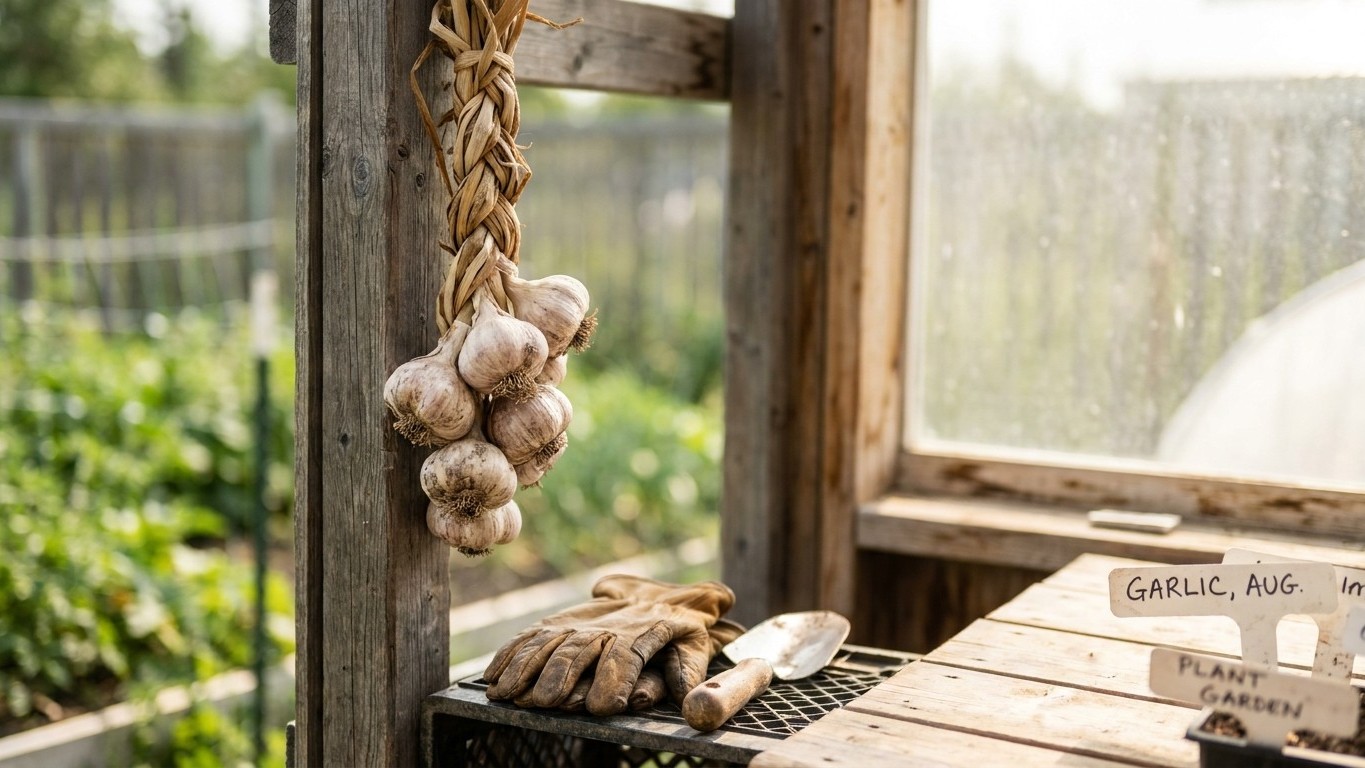

Environment and Climate Change Canada’s 1981-2010 climate normals for the Yellowknife A station put the average first fall frost at September 18. That figure is a midpoint, not a safe date. Get garlic cloves into the ground by late August so the roots have three to four weeks to establish before the ground starts to lock up.
The short answer for Northwest Territories

Plant garlic in late August across most of Northwest Territories. That window is built by Counting Back From the average first fall frost that Environment and Climate Change Canada records at the Yellowknife A station (climate ID 2204100): September 18. Every cultivar in the catalogue used for this territory, from softnecks like Inchelium Red to hardnecks like German White, is set out on that same late-August timing because garlic needs those final weeks of warm soil to grow roots before winter arrives, not to grow top growth.
September 18 is an average of thirty years of data, not a promise. Environment and Climate Change Canada’s own normals mean that in roughly half the years on record, the first frost lands after that date, and in the other half it lands before it. Treat the date as the center of a window that could shift a week or two in either direction, and plant on the early side of your plan rather than the late side. A grower who waits for a calendar date and gets an early frost has already lost root establishment time that cannot be made up later.
This figure describes one station near Yellowknife. Northwest Territories spans several climate zones from the Mackenzie Delta to the southern boundary near Alberta, and a single reading from one airport cannot stand in for the whole territory. The general shape of the calendar, planting in late August ahead of a mid-to-late September frost, holds reasonably well across the southern half of the territory. Communities further north or at higher latitude should expect the whole calendar to shift earlier, sometimes by weeks, which the next section works through.
Working it out for your own garden
The arithmetic behind late August
Garlic cloves need roughly four to six weeks of soil above freezing to grow a root system before winter, and they benefit from several more weeks of cold storage after that to trigger the clove division that gives you a full head rather than a single round bulb. Counting Back From the Yellowknife A station’s September 18 average first frost, late August lands about three weeks ahead of that date. That gap gives roots time to grow while the risk of an unusually early frost catching bare, unrooted cloves stays low.
The cold that follows planting is not the limiting factor here. Winter at the reference station holds air temperatures below 40°F for an average of 39.1 weeks a year, which comfortably clears the six to eight weeks of chilling garlic needs after planting to split into cloves, a threshold documented by the University of Georgia Extension (publication C854). The risk in this territory runs the other way: not enough warm weeks before the ground freezes solid, not too few cold ones after.
The full catalogue list for this territory, all timed to the same late-August window, looks like this:
- Early Red Italian (softneck)
- Inchelium Red (softneck)
- Italian Late (softneck)
- Lorz Italian (softneck)
- Bavarian Purple (hardneck)
- Blue Music (hardneck)
- Chesnok Red (hardneck)
- Duganski (hardneck)
- Fall Festival (hardneck)
- Georgian Crystal (hardneck)
- Georgian Fire (hardneck)
- German Red (hardneck)
- German White (hardneck)
- Ivan (hardneck)
If you haven’t built the bed yet, the soil prep and mulching steps this planting date assumes are covered in Growing Garlic in Northwest Territories. For the practical differences between these hardnecks and softnecks once they’re in the ground, see Garlic Varieties That Suit Northwest Territories Winters.
A large lake near your garden moderates the swing between day and night temperature and can push a local frost date later than a station reading taken from open, unshielded ground nearby. Elevation works the other way: a garden a few hundred feet higher than the valley floor around it cools faster in the evenings and can see frost arrive earlier than the regional average suggests. Neither effect is precisely measurable without your own recorded observations over a few seasons, but both are worth factoring in as a week or two of buffer rather than ignoring.
What changes across Northwest Territories
South versus north
Communities in the southern part of the territory, around Hay River and Fort Smith near the Alberta border, sit at lower latitude and generally hold warmer air longer into the fall than Yellowknife itself. Yellowknife sits on the shore of Great Slave Lake, and that large body of water delays the first hard freeze near town compared with inland ground a short distance away that has no lake to buffer it.
Communities further north and along the Mackenzie Delta, including Inuvik, sit above or near the Arctic Circle and lose usable growing season from both ends: the ground stays cold longer into spring and freezes earlier in fall. A grower gardening that far north should plan on the whole late-August window sliding earlier, potentially into early or mid-August. Treat any date outside the Yellowknife reading as a direction, not a number, until you have your own local records or a figure from a nearer station.
River valleys along the Mackenzie, including around Norman Wells, tend to pool cold air on clear, still nights even when the surrounding high ground stays a few degrees warmer. A garden set low in a valley bottom can see frost on a night when a garden a short drive uphill does not. None of this changes the logic behind the late-August planting window, only where inside it a given garden should sit.
The mistakes this climate punishes
Timing and depth, not variety choice
Because winter cold is abundant here, the mistake that actually costs a crop in Northwest Territories is planting late, not planting the wrong cultivar. Cloves set into cold, near-frozen ground in mid-September have had almost no time to root before the soil locks up, and a shallow root system going into winter is far more likely to heave out of the ground during freeze-thaw cycles than a clove that had its full three to four weeks. Depth matters as much as date: cloves planted too shallow, especially in loose or sandy soil, are the ones that end up sitting on the surface by April.
Mulch failure is the second common loss. A garlic bed left bare through winter loses insulation exactly when the soil needs it most, and freeze-thaw cycling at the surface is what pulls shallow cloves upward. A four to six inch layer of straw or leaf mulch put down right after planting, while the ground is still workable, does more for winter survival here than any choice between hardneck and softneck.
What the disease numbers actually mean here
Garlic disease pressure in this territory is a different kind of risk, tied to the harvest months rather than the planting ones. UC IPM’s Pest Management Guidelines for Onion and Garlic (UC ANR Publication 3453) publish soil temperature ranges for the fungi that cause white rot and fusarium basal rot, and comparing those ranges against the mean air temperatures of a Northwest Territories growing season shows real, if narrow, windows of risk:
| Disease | Published range | Months in range here | What that means |
|---|---|---|---|
| White rot (Sclerotium cepivorum) | 50-75°F | June, July (July at the published optimum) | Highest risk of the four; avoid planting seed stock with any soft or discolored cloves |
| Fusarium basal rot (Fusarium oxysporum f. sp. cepae) | 59-90°F | July | Risk rises during curing and storage more than at planting |
| Southern blight (Sclerotium rolfsii) | 86-95°F (optimum) | None | Less active outside its optimum, not eliminated |
| Pink root (Setophoma terrestris) | 75-85°F (optimum) | None | Less active outside its optimum, not eliminated |
The published figures are soil temperatures, and the table above compares them against air temperatures, which lag and swing less than the soil actually does. A month averaging inside a disease’s range does not mean every day in that month sat there. None of the four diseases can be called impossible in this territory. All of them travel on infected seed stock regardless of climate, which is the real reason to buy clean bulbs from a known source rather than replant a head that showed any rot the previous season.
Checking this against your county
Before you commit a full planting to late August, check the Northwest Territories agriculture services page for guidance closer to your own district, particularly if you’re gardening well north of Yellowknife or in a low river valley where cold air tends to pool.
If your community keeps its own frost records, even a few years of informal notes on when the first hard frost actually hit will tell you more than a territory-wide average ever can. Local observation beats a station reading once you have more than a season or two of it.
Common questions
Can I still plant garlic in September if I missed late August?
You can, but expect weaker root establishment going into winter. Plant as soon as possible, set cloves slightly deeper than usual, and mulch heavily right away to compensate for the lost weeks of rooting time.
Does hardneck or softneck garlic matter more for cold survival?
Hardnecks are generally considered the hardier group for cold winters, but every cultivar named for this territory, hardneck and softneck alike, is planted on the same late-August timing. The bigger factor in survival here is planting date and mulch depth, not the neck type.
What happens if the first frost comes earlier than September 18?
Nothing dramatic to garlic that’s already rooted. A light frost on unmulched, newly planted cloves is more of a concern than one on an established bed, which is another reason to plant on the early side of the window rather than counting on the average holding.
Should I plant garlic in spring instead if I run out of time in fall?
Garlic planted in this territory is a fall crop lifted the following summer, and spring-planted cloves generally produce smaller, undivided bulbs because they miss the cold period that triggers clove formation. If you miss the fall window entirely, it’s better to wait for the next fall than to plant in spring.
The Moon calendar is a separate, older custom: see when to plant garlic by the moon, written as tradition rather than fact.