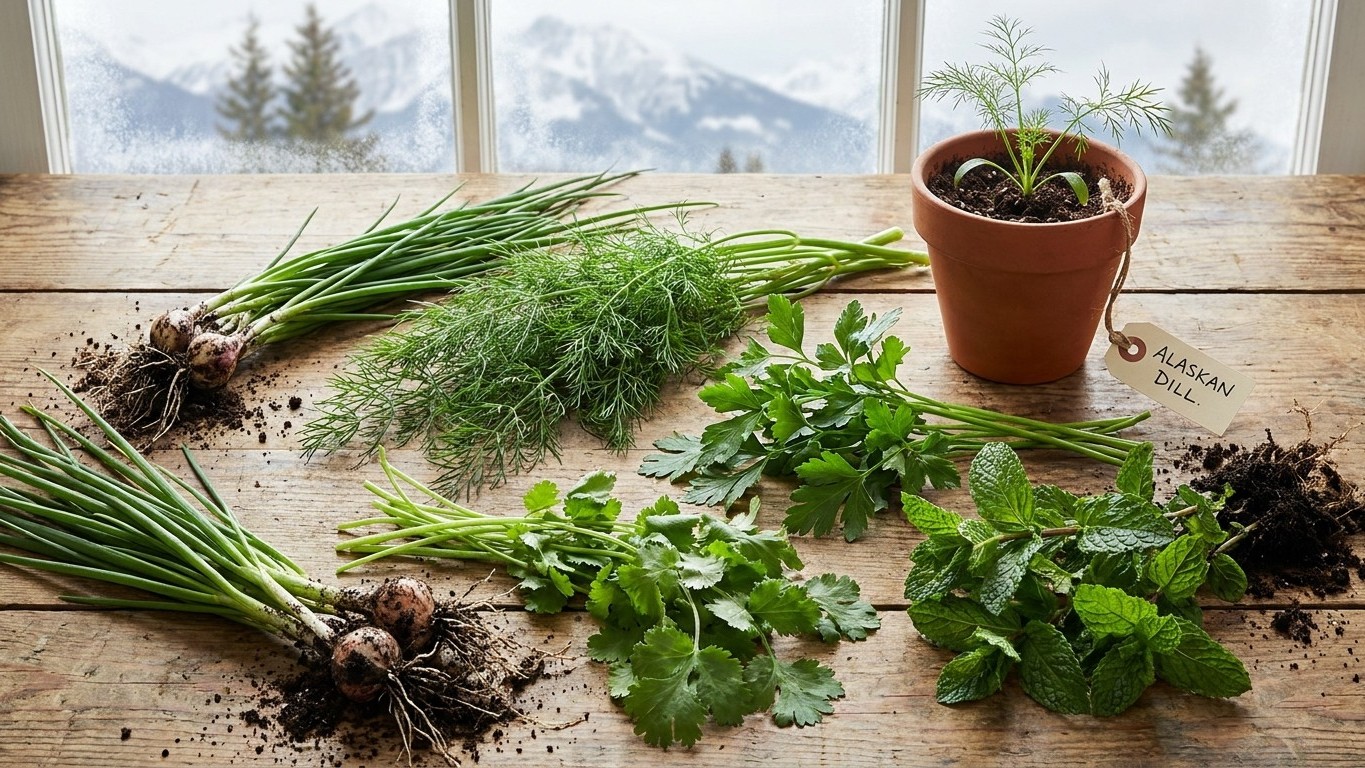

Fast, cold-hardy annuals are your best bet here: dill, cilantro, parsley, and chives thrive in the roughly 116-day window between the territory’s mean frost dates. Slow-growing or heat-loving herbs like rosemary, bay, and basil struggle badly, since winters average -21.1°F in the coldest month and summers rarely bring the warmth these plants need.
The short answer for Northwest Territories
Yellowknife’s climate normals put the mean last spring frost at May 25 and the mean first fall frost at September 18. Count the days between those two dates and you get about 116 days of theoretically frost-free growing. That’s the frame every herb choice here has to fit inside, and it’s tight by any garden standard south of the 60th parallel.
The catch: those are mean dates, not guarantees. In roughly half the years on record, frost arrives later in spring or earlier in fall than the average suggests. Treat May 25 and September 18 as the midpoint of a risk window, not a green light and a red light. A gardener planting to the mean date is planting to a coin flip.
Given that math, the herbs worth your seed money are the ones that finish fast and tolerate a chilly night without sulking. Dill, cilantro, and chervil all mature in 40 to 70 days and can be direct-sown once soil has warmed, leaving margin on both ends of the season. Parsley takes longer, 70 to 90 days from seed, so it does better started indoors a few weeks early and transplanted out once the frost risk has clearly passed.
Chives and mint are the two perennials most likely to reward the effort of planting them in the ground rather than a pot. Both are genuinely cold-hardy plants, and both regrow fast from the crown once soil warms, which matters when your growing season is this compressed. Everything else on the perennial herb list, rosemary, bay laurel, lavender, sage in most varieties, is fighting a winter that averages -21.1°F on its coldest nights. That number describes the mean daily minimum of the coldest month, not a rare cold snap, which means it happens most years, not once a decade.
| Herb type | Typical days to harvest | Fits the ~116-day window? | Best approach here |
|---|---|---|---|
| Fast annual leaf herbs (dill, cilantro, chervil) | 40-70 days | Yes | Direct sow once frost risk has clearly dropped |
| Parsley | 70-90 days | Marginal | Start indoors, transplant after last frost |
| Chives | Perennial, fast regrowth | Yes | Grow in-ground, mulch for winter |
| Mint | Perennial | Yes | Contain the roots, mulch heavily |
| Basil | 60-90 days, heat-loving | Poor | Indoors or greenhouse only |
| Mediterranean shrubs (rosemary, bay, lavender) | Long season, frost-tender | No | Container culture, overwinter indoors |
What will not work here
Start with the winter number, because it rules out more herbs than the short summer does. An average of -21.1°F on the coldest month’s nights kills any woody Mediterranean herb left in open ground. Rosemary, bay laurel, and lemon verbena are typically damaged well above that threshold, often at temperatures in the teens or single digits below zero. Even the cold-hardiest lavender cultivars, bred for northern gardens, are commonly rated only down to somewhere between 0°F and -20°F, and that’s usually an extreme low rating, not a mean. Here the mean night is already sitting at or past that line. Planting these outdoors as perennials isn’t a gamble worth taking in this territory; it’s a loss you should plan for in advance and treat as a container project instead.
The short growing season does its own damage, separately from the cold. A 116-day frost-free window, and one that’s shorter in roughly half the years since these are mean dates, defeats any herb that needs 90-plus days to reach a harvestable size when grown from seed directly in the ground. Long-season parsley strains, some slower cilantro varieties bred for bolt resistance rather than speed, and anything marketed for “extended harvest” rather than quick turnover will often get caught by frost before they’re worth cutting.
Basil deserves its own mention, because it fails here for a reason that has nothing to do with frost dates. Basil is chilled and set back by nights in the 40s, well above freezing. Even inside the mean frost-free window, a subarctic summer delivers plenty of cool nights that stunt basil outdoors, turn leaves dark and mottled, and stop growth cold. It’s not a frost problem. It’s a summer that never gets consistently warm enough, which is a different failure mode than the one that kills rosemary in January.
Lemongrass, ginger, and other tropical or subtropical culinary herbs sit in their own category of no. These plants have zero frost tolerance and need a long, hot season to bulk up. Neither condition exists here outdoors, and there’s no amount of mulch or row cover that changes that math.
What changes across Northwest Territories
The hardiness zone figure for this territory, 1b in the Canadian system, comes from a single reference station at Yellowknife. That number already describes conditions harsh enough to eliminate most perennial herbs, and it’s worth remembering that the Canadian zone system is built from seven climate variables, not the single figure USDA zones use, so this number doesn’t translate onto a USDA scale at all. Don’t try to match it to a familiar American zone map; the two systems aren’t built to line up.
More importantly, one station can’t speak for a territory this size. Northwest Territories stretches from roughly the 60th parallel up past the Arctic Circle, covering more than 442,000 square miles, an area larger than California, Oregon, and Washington combined. A frost date and a winter minimum measured at Yellowknife tells you about Yellowknife’s surroundings, not about a community hundreds of miles north near the Mackenzie Delta or the Arctic coast, where the frost-free window closes earlier in fall and opens later in spring, and where winter minimums run colder still.
Communities to the south, closer to the Alberta and British Columbia borders, or those sitting near large lakes that moderate temperature swings, likely see a somewhat gentler version of the same climate, though this page has no station-level facts for those locations and won’t guess at numbers it can’t source.
The honest answer is that there is no single hardiness picture for the whole territory, only a spread that runs from harsh at the reference station to harsher further north. Anyone gardening outside the immediate Yellowknife area should check Natural Resources Canada’s plant hardiness map for their own location rather than assume the territorial reference number applies to their yard.
Where to check this for your own county
Northwest Territories doesn’t organize itself into counties, but the same logic applies at the community level: a local recommendation will always beat a territory-wide one, and this page is the territory-wide one. The frost dates and winter minimum cited here describe Yellowknife specifically. Your own community’s growing conditions may run noticeably earlier, later, colder, or milder, and only a local source can tell you which.
The territorial government’s agriculture services page is the right place to start looking. That’s the Department of Industry, Tourism and Investment’s agriculture portal, and it’s the closest equivalent to a state extension service for gardeners here.
What to look for once you’re there: any planting calendar or seasonal guide specific to your community or region, rather than a territory-wide date. Also worth searching for is a list of herb and vegetable varieties that have actually been trialled in northern gardens, since seed catalogs written for temperate climates routinely oversell how well their “quick” or “cold-tolerant” varieties perform once nights start dropping into the 30s in August, which happens routinely here well before the mean fall frost date.
If a community garden project, territorial demonstration plot, or local agricultural society has published results for herbs grown in your specific area, that information will outrank everything on this page, because it reflects real outcomes at your latitude rather than a calculated mean from one weather station. This page can tell you what the territory’s numbers say. It can’t tell you what grows in your particular yard, on your particular soil, behind your particular windbreak or lack of one.
Checking this against your own garden
Calendar dates are a starting point, not a verdict. Your own garden will tell you more than the mean frost dates ever will, and it does it for free, without needing a weather station of your own.
Watch the soil first. Push your fingers a couple of inches into the bed where you plan to sow dill or cilantro. If it still feels cold and damp rather than merely cool, seeds will sit and rot rather than germinate, no matter what the calendar says about the frost date having passed. Warm, slightly dry-to-the-touch soil is the real green light.
Watch how fast true leaves appear after the first seed leaves (the cotyledons) unfold. A quick push to true leaves within a week or so suggests your particular spot is running warm for the season, favorable ground for pushing your luck with a longer-season herb like parsley. A slow, stalled seedling that sits at the cotyledon stage for two weeks is telling you the site runs cooler than the territory’s averages, and that you should lean harder on the fastest herbs on the list, dill and cilantro especially.
Watch your chives and mint for new shoots each spring. If they’re pushing up strong new growth well before the mean frost date has arrived, that’s a sign your particular corner of the yard, maybe against a south-facing wall, maybe in a raised bed that warms faster than open ground, is running ahead of the territorial average. That’s useful information for next year’s planting, and it’s information no station reading from Yellowknife can give you.