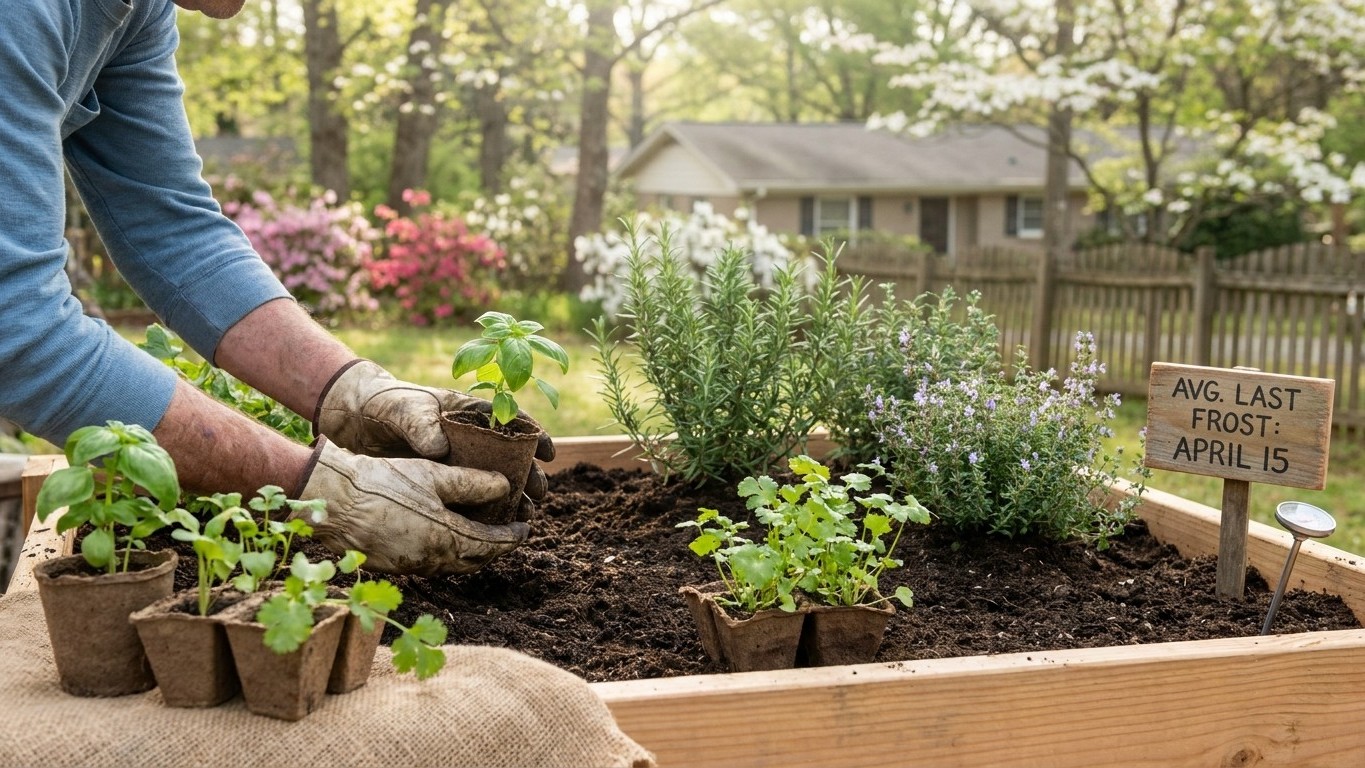

Northwest Territories herb growers work with a mean frost-free window from May 25 to September 18 (Yellowknife A station), a stretch of roughly 116 days. That figure is a midpoint, not a guarantee: tender herbs like basil need transplanting well after that date, hardy herbs like chives and parsley can go in closer to it, and every date on this page should be read as the center of a range, not a safe line.
The short answer for Northwest Territories
Those two dates, May 25 and September 18, come from Environment and Climate Change Canada’s 1981-2010 normals for the Yellowknife A station. They are averages calculated across three decades, which means that in roughly half of those years, the last spring frost actually fell after May 25, and the first fall frost arrived before September 18. Treat the gap between them as a target, not a promise, and build in a buffer on both ends.
For hardy herbs, chives, parsley, mint, and dill tolerate a light frost and can be direct-sown or transplanted starting around the mean last-frost date, though many growers here wait until the first week of June before trusting the soil and air. These plants germinate at cooler soil temperatures and can handle a surprise cold night better than their Mediterranean cousins.
Tender herbs are a different story. Basil in particular has almost no frost tolerance and stalls out in cool soil even without a frost event. Starting it indoors six to eight weeks ahead and transplanting only once nighttime lows have stabilized, typically not before early-to-mid June, gives it a fighting chance in a territory where the mean last frost is already a coin flip.
On the fall side, September 18 is the average date the first killing frost shows up, but the same math applies in reverse. In roughly half the years on record, that frost arrived earlier. Any herb still counting on warm days into late September is gambling against its own climate record. Harvesting tender herbs, or covering them, by early September is the more realistic plan for most gardens working from the Yellowknife normals.
The hardiness zone rating for the reference city, 1b under the Canadian system, adds another layer: this is one of the coldest zones on the national scale, and it shapes which herbs can even be attempted as perennials versus which must be treated as one-season annuals no matter how mild a particular summer feels.
What will not work here
A mean frost-free window of about 116 days already sounds tight. Once you account for the fact that both frost dates are midpoints rather than guarantees, the realistic safe window shrinks further, likely closer to 80 to 100 days in a cautious year. That number defeats any herb that needs a long, slow run to maturity outdoors. Slow-bolting cilantro varieties, seed-grown thyme, and second-year sage grown from seed rather than a starter plant are all poor candidates for direct outdoor sowing in this territory; they simply run out of season before they finish.
Perennial Mediterranean herbs are the clearest failure case. Rosemary and bay laurel are woody perennials adapted to mild coastal winters, and neither one comes close to surviving a Northwest Territories winter outdoors. The coldest month here averages a daily minimum of -21.1°F. That is not a record cold snap; it is the average low for the coldest month of a typical year. No amount of mulch or wind protection turns rosemary into a zone 1b perennial. If you want it season after season, it lives in a pot that comes indoors, full stop.
Day length works against some herbs too
Northwest Territories sits far enough north that early summer brings extremely long daylight hours, and for some herbs that is its own kind of stress rather than a bonus. Cilantro and dill are notorious for bolting, running straight to flower and seed, once day length and warmth both spike. A garden further south might buy an extra few weeks of leafy growth before that happens; here, the long June days can push bolting earlier than a grower expects, cutting the usable harvest window down even inside an already short season.
None of this means herbs are a lost cause in the territory. It means the list of realistic candidates is shorter than in most of Canada, and the margin for error on timing is smaller. Betting on a slow herb, a tender perennial, or a bolt-prone annual sown too late is where most disappointment here actually comes from.
What changes across Northwest Territories
The 1b hardiness rating cited on this page belongs specifically to Yellowknife, the reference city in the Canadian government’s zone data, not to the territory as a whole. Northwest Territories stretches from around the 60th parallel up into the high Arctic, covering a huge range of latitude, elevation, and distance from moderating water bodies. A single zone number cannot describe that whole span, and Natural Resources Canada does not try to make it do so.
Communities further north or further from the modest moderating influence of larger lakes will typically run colder and see an even shorter frost-free season than the Yellowknife normals suggest. Communities in more sheltered valleys or closer to large water bodies may see slightly milder minimums. The direction of the shift is predictable; the exact number for any specific community is not something this page can responsibly supply.
This is also a good moment to flag the difference in systems: the 1b zone figure here is Canadian, built from seven climate variables, not the single-variable USDA system used elsewhere in North America. Natural Resources Canada is explicit that the two scales don’t convert cleanly. A Canadian zone 4a, for comparison, can overlap nine different USDA zones. So a Northwest Territories zone number should never be read against a USDA zone map or a US planting guide as if they were speaking the same language.
Rather than guessing which zone applies to a particular community, the practical move is to check the official plant hardiness map at planthardiness.gc.ca, which lets you look up the zone assigned to a specific municipality rather than relying on the territorial average.
Where to check this for your own county
This page describes Northwest Territories using one weather station’s normals. That is useful for a general sense of timing, but it is not a substitute for local guidance tailored to your own community’s conditions. The territorial government’s agriculture services, reachable at iti.gov.nt.ca/en/services/agriculture, is the place to look for guidance closer to your actual growing conditions.
When you get there, look specifically for two things. First, any planting calendar or seasonal guidance calibrated to your region of the territory rather than to Yellowknife alone, since frost timing and season length shift meaningfully as you move north or into different terrain. Second, any list of herb or vegetable varieties that have actually been trialled successfully in northern or subarctic conditions locally, since seed catalog maturity dates are usually calculated for milder climates and can run optimistic here.
A community-level recommendation will always beat a territory-wide one, for the same reason a local weather forecast beats a seasonal outlook. This page works from a single station’s decades-long average. Local agricultural staff and experienced growers in your own area are working from direct observation of what actually survives and produces where you live, year after year, which is a different and more reliable kind of evidence.
If your community doesn’t have a dedicated calendar published yet, the agriculture services contact is still worth reaching out to directly. Someone there can usually speak to regional patterns even without a formal published document, and that kind of informal local knowledge often fills gaps that station-based averages can’t.
Checking this against your own garden
Frost date averages tell you what tends to happen across thirty years at one weather station. Your own garden will tell you what’s actually happening this year, and that observation should outrank every date on this page when the two disagree.
Start with soil warmth, checked by hand rather than by calendar. Push a finger a couple of inches into the bed where you plan to sow or transplant. If it still feels cold to the touch even on a mild, sunny afternoon, tender herbs like basil will sit and sulk rather than grow, no matter what the calendar says about the mean last frost having passed.
Watch for the first true leaves on anything you’ve started indoors or direct-sown outside. The initial pair of leaves that unfurl from a germinating seed are seed leaves, not true leaves, and they tell you little. The next set to appear, which actually look like the mature plant’s foliage, are a better signal that the seedling has enough root and leaf development to handle transplant stress or a light chill.
Finally, keep an eye on cilantro and dill for the first flower buds forming at the center of the plant. That’s the early sign of bolting, and once it starts, leaf production drops off fast. Seeing it earlier than expected is useful information about your specific spot: it usually means the bed is getting more heat or more daylight exposure than the average garden nearby, and next year’s sowing date should probably shift earlier to get ahead of it.