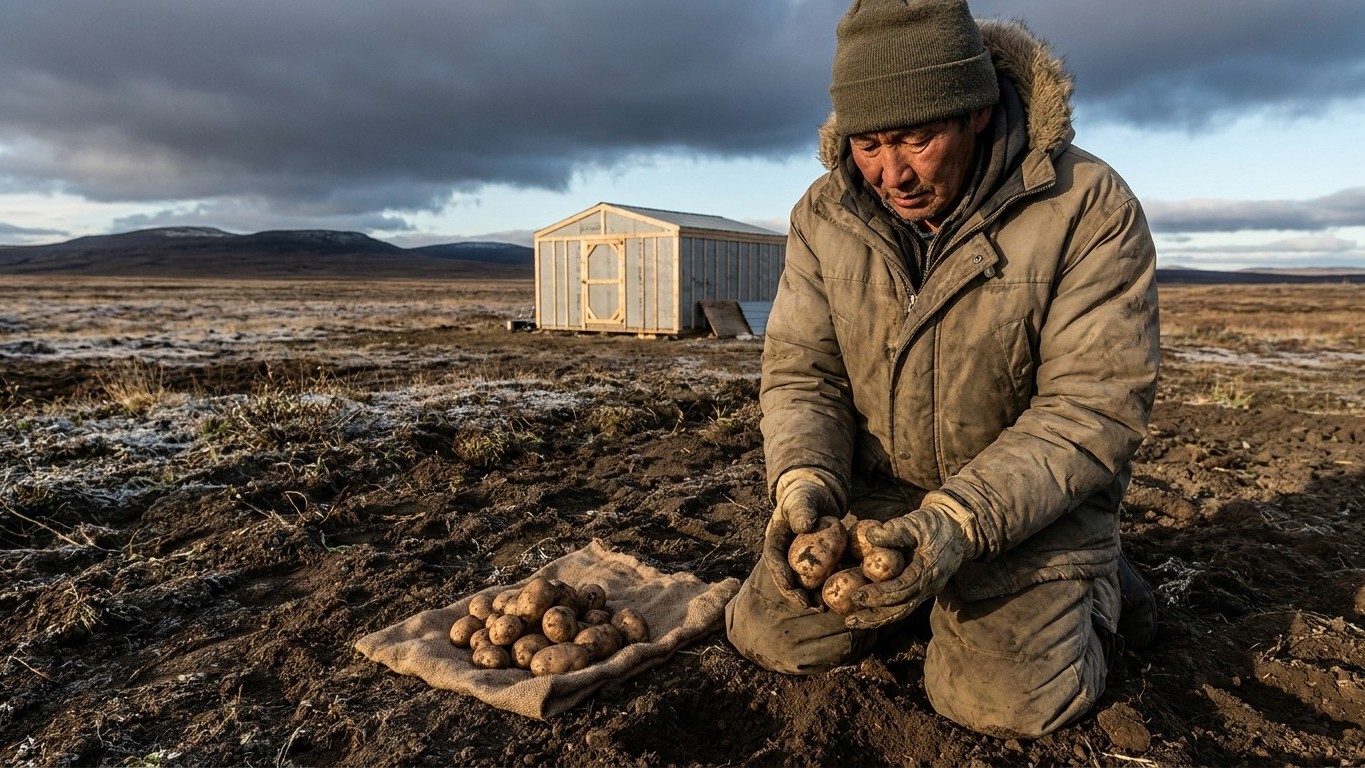

Potatoes need to come out of Nunavut’s ground before the first hard frost arrives, and that window closes fast this far north. Once dug, nothing left in an unheated shed or porch survives the Arctic winter: the tubers freeze solid within weeks. Curing and storage here call for an insulated, heated space held near 40-45°F, not a garage or a root cellar dug into frozen ground.
The short answer
Rankin Inlet’s climate normals put the average first fall frost at September 13, and the coldest month of the year runs a mean daily minimum of -29.8°F, according to Environment and Climate Change Canada’s Canadian Climate Normals for 1981-2010, station RANKIN INLET A. Those two numbers set the whole calendar for a potato crop in this territory.
The frost date is a mean, not a promise. In roughly half the years on record, the first frost at that station actually landed later than September 13, and in the other half it came earlier. A grower who waits for a calendar date is gambling on a coin flip. Watch the sky and the forecast instead, and treat mid-September as the center of a window rather than a line you can plan around with confidence. Communities north of Rankin Inlet, or at higher elevation, should expect that window to close even sooner.
Digging needs to happen while the soil is still workable and before a hard freeze locks it up. Once frost has blackened the foliage, the tubers underground are still fine for a short while, but the safe move is to get them out rather than leave them exposed to a soil freeze that can start creeping down within days of that first frost.
As for wintering potatoes in an unheated space, the answer is no. A mean daily minimum of -29.8°F in the coldest month means an uninsulated shed, porch, or garage tracks close to outdoor air for months at a stretch. That is nowhere near the 40-45°F storage range recommended by Utah State University Extension. Potatoes left in a cold, unheated structure through a Nunavut winter will freeze into a soft, unusable mass, and there is no way around that without adding heat.
Curing, and where
Utah State University Extension recommends curing potatoes at 55-60°F with high humidity for two to three weeks before they go into storage. That range is nowhere to be found outdoors in Nunavut at harvest time. By mid-September, air temperatures are already sliding toward the season’s first frost, and a shaded porch or an open garage will typically sit well below what curing requires. There is no naturally occurring curing spot in this climate the way there might be farther south. Curing has to happen indoors, in a heated room, with help to keep the humidity up.
- Dig on a dry day, before the ground freezes and while the soil is still loose enough to lift tubers without bruising them.
- Brush off loose soil by hand rather than washing the tubers, since wet skins are slower to heal and more prone to rot.
- Move the crop indoors right away. Outdoor conditions at harvest are already too cold and too dry for curing to happen naturally.
- Find a heated interior room that can be held near 55-60°F. In most homes this means a spare room, a laundry area, or a heated closet, not an attached but unheated space.
- Boost humidity around the crop with damp cloths, shallow trays of water, or a small humidifier, and cover the potatoes loosely with breathable cloth or paper, never plastic.
- Hold them there for two to three weeks, checking a few tubers along the way for skins that have toughened and minor cuts that have healed over.
- Once cured, move the crop straight to its winter storage space, since curing conditions are too warm for long-term keeping.
Storing through this winter
Long-term storage wants dark conditions and a temperature of 40-45°F according to Utah State University Extension, or 38°F at 95 percent humidity according to the University of Maine Cooperative Extension. Both figures assume a space that stays reliably cool but well above freezing, all winter long. Nunavut’s coldest month, with a mean daily minimum of -29.8°F, makes that a real engineering problem rather than a simple matter of finding a cool corner of the house.
Many buildings in Nunavut sit on pilings above the permafrost rather than over a dug basement, so the classic root cellar option that works in warmer climates is often not available at all. That removes one of the usual fallback spaces for winter storage and pushes the solution toward a purpose-built space inside the heated envelope of the home: an insulated closet, a small unheated-but-buffered room backed against a heated wall, or a cabinet fitted with a small heat source and a thermometer.
Whatever the space, the target stays the same: dark, and somewhere in the 38-45°F band the two extension sources describe. Too warm and the crop sprouts early, using up its own stored starch and turning soft. Too close to freezing and the potatoes convert starch to sugar, changing texture and flavor, and if the temperature actually drops to or below 32°F the cells rupture and the tubers turn to mush once they thaw. Given how far below freezing this territory’s coldest month runs, a stored crop with no heat source at all is not a risk, it is a certainty of loss. A simple thermometer left in the storage space, checked through the darkest months, is the only way to know which side of that line the crop is actually on.
What goes wrong here
- Frost reaches the tubers before harvest. Waiting for the average date of September 13 leaves no margin in the years frost arrives earlier. Dig as soon as foliage dies back and the forecast turns, rather than watching a calendar.
- Stored potatoes freeze solid in an unheated space. With a coldest-month mean minimum of -29.8°F, any structure without added heat will track well below freezing for weeks at a time. Move storage into a heated, insulated interior space and check it with a thermometer.
- No indoor room ever reaches curing humidity. Heated homes in a cold, dry climate often run very low humidity, which slows or stops the skin-healing curing is meant to achieve. Add a humidifier or damp cloths near the curing crop and check tubers partway through the two-to-three-week period.
- No basement to fall back on. Because many Nunavut buildings sit on pilings above permafrost rather than over a basement, there is often no natural cool, dark space at all. Build a small dedicated storage cabinet or closet inside the heated part of the home instead of assuming one exists already.
- Condensation and rot in a sealed, heated storage space. A warm, tightly built home can trap moisture around stored potatoes, encouraging rot even when temperature is otherwise fine. Use breathable containers, such as burlap or ventilated crates, and check on the crop periodically rather than sealing it away and forgetting it.
Common questions
Can potatoes be left in an outdoor shed once the ground freezes?
No. With a coldest-month mean minimum of -29.8°F, an unheated outdoor structure will sit far below the 40-45°F range Utah State University Extension recommends, and the crop will freeze solid.
How early should harvest happen relative to the average frost date?
Because September 13 is a mean figure from Environment and Climate Change Canada’s 1981-2010 normals, not a guaranteed date, frost arrives earlier than that in roughly half of all years on record. Plan to dig before that window, watching the forecast rather than the calendar.
Is a basement a realistic storage option in Nunavut?
Often not. Many buildings here are built on pilings above the permafrost rather than over a dug basement, so a heated interior closet or cabinet is usually the more realistic substitute.
Which is worse for stored potatoes, too warm or too cold?
Both cause failure in different ways. Too warm and the crop sprouts and softens; too close to or below freezing and the starches turn to sugar before the tubers eventually rupture, which is why the 38-45°F range described by Utah State University Extension and the University of Maine Cooperative Extension matters on both ends.