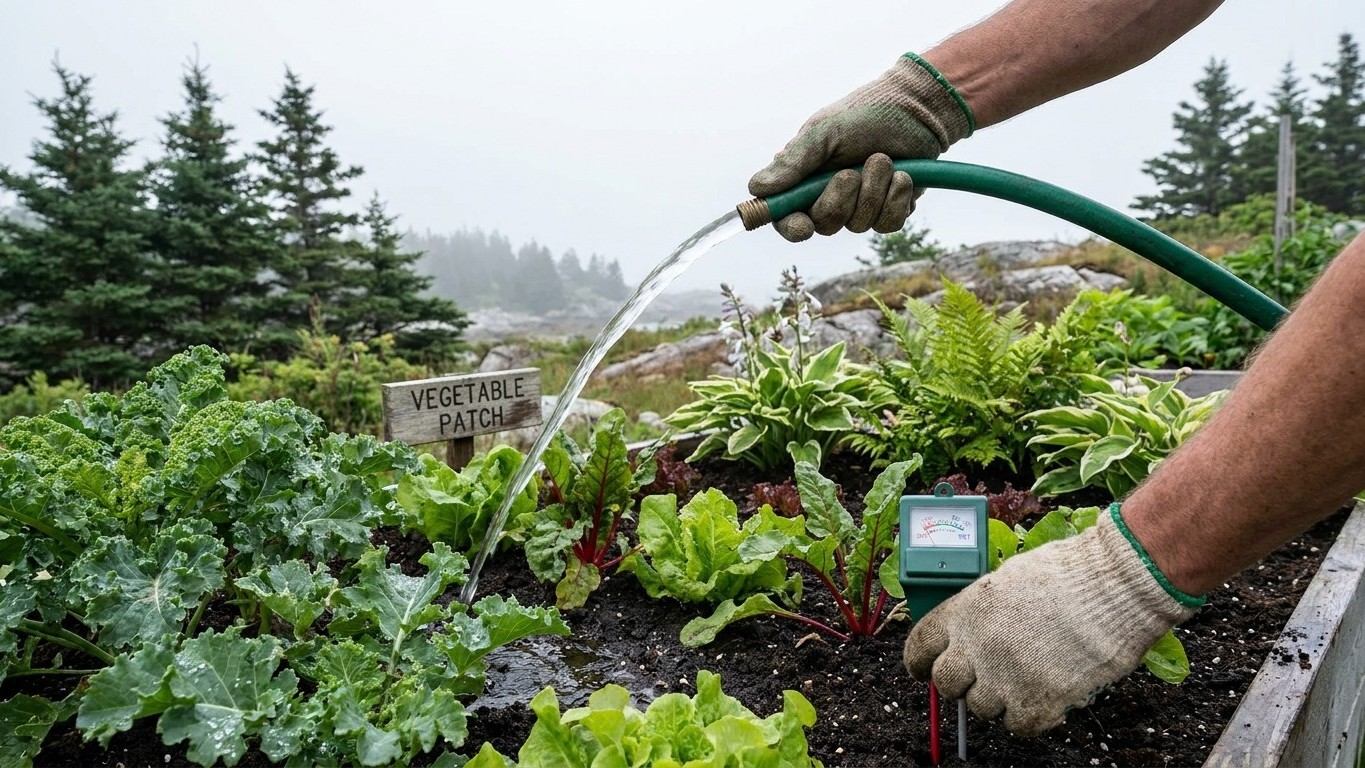

Nova Scotia rarely turns into a true drought garden. Between an average of 3.68 inches of rain in August, the driest summer month, and exactly zero days a year that reach 90F, the dry spells that do happen are short and mild by national standards. The real skill here isn’t fighting heat, it’s knowing when a wet-looking week actually left the root zone dry.
What changes here

Two numbers set the terms for watering in Nova Scotia. The driest summer month, August, averages 3.68 inches of rain. And the number of days a year that hit 90F or higher sits at 0.0. Put those together and you get a garden that almost never bakes, but one where rain still has to be checked rather than assumed.
Do the arithmetic on that August figure and it looks generous on paper. A garden bed wants roughly an inch of water a week to keep most vegetables and ornamentals happy. Spread 3.68 inches evenly across a 31-day August, and you get about 0.83 inches of rain arriving in an average week, close to what a bed asks for. June and July aren’t far behind, at 3.79 and 3.76 inches for the month. On paper, Nova Scotia’s summer rainfall covers most of the garden’s weekly need almost on its own.
The catch is that rain doesn’t arrive in neat, even doses. A summer month’s total is usually delivered across a handful of storms rather than a gentle daily drizzle, and a single downpour that dumps half an inch in twenty minutes sends much of that water running off the surface instead of soaking down to root depth. That’s why the same 3.68 inches that looks sufficient in a spreadsheet can still leave a bed dry two days after a “rainy” week, because the water that mattered ran into the storm drain, not into the soil.
Zero days above 90F changes the other side of the equation: evaporative demand. In territories where summer routinely pushes past 90F, the sun pulls moisture back out of the soil almost as fast as it goes in, and a bed can go from moist to dust in 48 hours. Nova Scotia’s mild summer temperatures mean water that does soak in tends to stay put longer, which is exactly why an overwatered clay bed here is more likely to drown than dry out. The dry spell that matters in this province usually isn’t a heat wave, it’s a two- or three-week gap between storms with mild temperatures on either side.
How to water when it matters
The method that works in Nova Scotia’s climate is the same one gardeners use everywhere dry spells are short and heat is mild: water deeply, water rarely, water at the base, and water in the morning. Each of those does something specific for the plant. A deep soak pushes moisture down six to eight inches, which is where a healthy root system actually lives, so roots grow downward instead of staying shallow. Watering at the base, rather than overhead, gets water to those roots directly instead of losing a third of it to evaporation and wind drift before it ever hits the soil. Morning watering gives leaves time to dry in the sun before evening, which matters more in a humid maritime climate than almost anywhere else, since damp foliage overnight is exactly what fungal disease needs to take hold.
Checking the soil rather than the calendar is the part most gardeners skip. A finger pushed two inches into the bed, or a trowel lifted at the edge of a row, tells you what the surface never will: whether moisture reached root depth or stopped an inch down. Surface soil can look and feel damp within hours of a storm while the root zone six inches down is still bone dry, especially after the kind of short, heavy summer downpour that’s common in this region.
Soil texture changes the rhythm, not the principle. Sandy soil, common in parts of the province’s coastal and river-valley ground, drains fast and holds little, so it asks for shorter soakings delivered more often, sometimes every two to three days in a dry stretch. Heavy clay, found across much of inland Nova Scotia, holds a week’s worth of water in reserve but turns waterlogged and starves roots of oxygen if it’s watered again before it’s had the chance to dry out.
Here’s a sequence to start from and adjust against your own soil:
- Check moisture two inches down with a finger or trowel before deciding to water at all, regardless of what the sky did that week.
- If dry at that depth, deliver about one inch of water in a single session, roughly 0.6 gallons per square foot, applied at the base of the plants.
- Water in the early morning, before 9 a.m. if possible, so foliage that gets splashed has hours to dry before evening.
- Recheck at two inches every two to three days on sandy ground, or once a week on clay, rather than watering on a fixed daily schedule.
- Skip a scheduled watering entirely if the two-inch check still shows moisture from the last soak or from rain.
Treat that one-inch, once-a-week starting point as exactly that, a starting point. A raised bed with amended soil, a container, and a patch of native clay will each ask for something slightly different, and the only way to know is the finger test, not the forecast.
What goes wrong
A daily sprinkle that never reaches the roots
Light, frequent watering feels responsible but trains roots to stay near the surface, where the season’s mild heat still bakes the top inch of soil dry between waterings. Those shallow roots have no reserve to draw on when a real gap between storms shows up, which is exactly when a two- or three-week dry stretch does the most damage in this climate.
Watering the leaves after supper
An evening pass with the hose feels efficient at the end of the day, but wet foliage that doesn’t dry before nightfall gives fungal spores hours of humid darkness to establish, and Nova Scotia’s humid maritime air makes that risk worse than in a drier inland climate. Morning watering avoids the problem entirely.
Letting a clay bed sit soaked
This is the mistake that costs Nova Scotia gardeners the most, precisely because the region’s rainfall is generous and its summer heat is mild. A clay bed that gets watered again while still holding last week’s rain drowns roots by starving them of oxygen, and with zero days a year above 90F to dry that clay back out quickly, a waterlogged bed can stay that way for a discouragingly long time. Checking with a finger before adding more water matters more here than almost anywhere hotter.
Local help
The Nova Scotia Department of Agriculture is the province’s extension-style resource for garden and soil questions specific to local conditions. Watering restrictions during dry stretches are set at the municipal or utility level and change from one district to the next, so check current rules with your own water provider before planning heavy watering during a summer dry spell.
Common questions
Does Nova Scotia get real droughts? Extended droughts are uncommon given the province’s rainfall averages, but shorter dry spells of two to three weeks between storms happen most summers and can still stress a garden that’s been watered shallowly.
How often should I water tomatoes during a dry spell here? Start by checking soil moisture two inches down every two to three days, and water deeply only when that depth is dry, rather than watering on a fixed daily routine.
Is it ever too wet to water in Nova Scotia? Yes. On clay soil especially, adding water to a bed that’s still holding last week’s rain risks drowning roots rather than helping them, since the region’s mild summer heat doesn’t dry that clay out quickly.
What time of day is best for watering? Morning, so foliage dries before evening. That single habit does more to prevent fungal disease in this humid climate than almost any other watering choice.