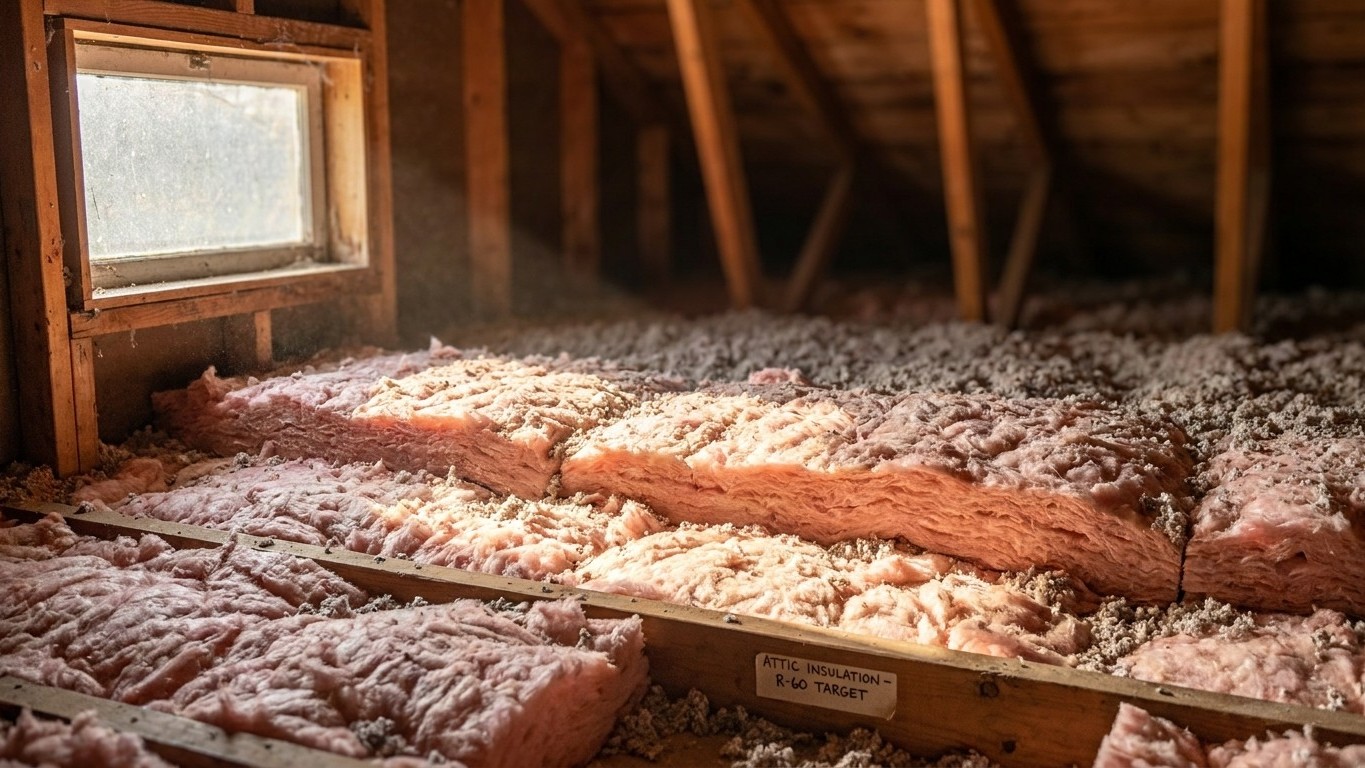

Nova Scotia’s reference weather station, Halifax Stanfield, sits in Natural Resources Canada’s climate zone 6. For that zone, NRCan recommends RSI 4.8 (R-27) for walls, RSI 4.2 (R-24) for basement walls, RSI 10.6 (R-60) for roof or ceiling, and RSI 7.1 (R-40) for floors over unheated space. These are nominal minimums, and where exactly you live in the province can push the real number higher.
Which climate zone Nova Scotia is in

Natural Resources Canada draws its climate zones from one measurement: annual heating degree-days below 18°C. Zone 4 covers anything under 3,000 of those degree-days; zone 5 runs 3,000 to 3,999; zone 6 runs 4,000 to 4,999; zone 7a runs 5,000 to 5,999; zone 7b runs 6,000 to 6,999; and zone 8 is anything over 7,000. At Halifax Stanfield International, the airport reports about 4,263 heating degree-days a year below 18°C, which puts that station squarely in zone 6.
That figure describes one weather station, not the whole province. Nova Scotia stretches from the Atlantic coastline to inland valleys and higher ground in Cape Breton, and heating demand doesn’t sit still across that kind of terrain. A milder coastal community can log fewer degree-days than an inland one at the same latitude, simply because the ocean moderates winter lows. NRCan’s own zone table exists precisely so a homeowner can check their own municipality’s degree-days rather than borrow a number measured somewhere else.
The zone number itself is a shorthand for how much heating a building has to do over a year, nothing more exotic than that. Where the system splits zone 7 into “7a” and “7b,” it’s using the same degree-day yardstick, just cut at a finer interval, so a home a little further inland or a little further north can land in a noticeably colder bracket without crossing into zone 8. That split matters because it changes which row of the insulation table applies to a given house, and the rows are not close to each other.
None of this means a homeowner in, say, the Annapolis Valley or northern Cape Breton should assume zone 6 minimums apply to their own address. The honest answer is to look up local heating degree-days before buying material, rather than assume the airport’s number travels with you across the province.
The insulation levels that apply here
For climate zone 6, the reference station’s zone, NRCan’s recommended minimums break out by building assembly, not by attic depth alone. The table below reproduces those figures exactly as published.
| Assembly | RSI | R-value |
|---|---|---|
| Walls | 4.8 | R-27 |
| Basement walls | 4.2 | R-24 |
| Roof or ceiling | 10.6 | R-60 |
| Floor over unheated space | 7.1 | R-40 |
Notice these are four separate assemblies, not four variations on attic depth. A roof or ceiling assignment of R-60 has nothing to do with the floor assignment of R-40; treating them as interchangeable, or averaging them into one “attic number,” misses the point of the table entirely.
These are minimums, not a ceiling
NRCan labels these figures “recommended minimum insulation values,” and that word choice matters. The Nova Scotia Building Code, administered provincially and enforced at the municipal level, sets the actual legal requirement for new construction and major retrofits, and it can ask for more than NRCan’s baseline in specific assemblies or specific municipalities. A homeowner retrofitting an older wood-framed house should treat these numbers as a floor to build up from, not a target to stop at.
They’re also specific to zone 6, the bracket that fits the Halifax Stanfield reference station. A property that sits in a colder pocket of the province, one with more heating degree-days than the airport logs, would fall into zone 7a or 7b under NRCan’s own table, and those brackets call for higher minimums across the same four assemblies. This page doesn’t reproduce those higher figures because they don’t apply to the reference station this data describes, and printing a zone’s numbers without confirming a house actually sits in that zone is how a retrofit ends up under-insulated.
Sealing comes before insulating
U.S. ENERGY STAR treats air sealing and insulation as two stages of a single project, and its own project guidance puts attic air sealing ahead of attic insulation, not the reverse. Insulation slows heat moving through a material, layer by layer. It does nothing to stop air moving around that material, through a gap, a penetration, or a poorly sealed hatch. Insulation laid over an unsealed gap doesn’t close the gap. It just hides it under a blanket, and the air keeps moving.
That’s the practical reason the order matters more than the material choice. A retrofit that skips straight to adding depth in an attic that’s full of unsealed wiring penetrations, plumbing stacks, and a leaky hatch is spending material on a problem sealing would have solved for less effort. The sequence that actually gets results runs in a specific order:
- Seal the attic first, closing every penetration, gap, and the hatch itself
- Add or top up attic insulation once the air leaks are closed
- Address the rim joist, a spot that loses heat year-round and is often skipped entirely
- Insulate the floor over unheated space, or the crawlspace, depending on the house
- Move to walls last, since they typically offer the smallest return relative to the effort involved
This page isn’t the place to walk through how each of those five steps gets done. This site’s national insulation guides cover the mechanics of air sealing an attic, insulating a rim joist, and treating a floor over a crawlspace in more detail than a provincial page like this one should try to duplicate.
What the winter here actually asks for
Halifax Stanfield logs about 4,263 heating degree-days a year below 18°C. That number isn’t a Temperature reading; it’s a measure of accumulated demand, the sum, day by day, of how far below 18°C the outside air sat and for how long. Twice the degree-days means, roughly, twice the fuel burned to hold the same indoor temperature in the same house. A single figure like this one describes the season’s overall workload, not any particular cold snap.
What that workload runs on, in Nova Scotia homes, breaks down unevenly. Statistics Canada’s 2023 survey on primary heating systems found heat pumps as the single largest category at 25%, followed by electric baseboard heaters at 20%, forced-air furnaces at 17%, and boilers paired with hot-water or steam radiators at 16%. Heating stoves didn’t get a published figure in that survey; the data was suppressed as unreliable, which is not the same thing as saying nobody heats with one.
Why the heating type changes the priority list
A home heated by a forced-air furnace typically has ductwork running through it, and if any of that ductwork passes through an unconditioned attic, it’s losing heat before the air ever reaches a room, no matter how much insulation sits at the ceiling above it. A home on baseboard heaters or a boiler with radiators doesn’t have that particular leak point, because there’s no ductwork to lose heat through in the first place. Given that forced-air furnaces account for 17% of primary heating systems here, and given how many attics have some run of ductwork passing through them, that’s not a small share of homes carrying an invisible loss the attic insulation alone won’t touch.
For a Nova Scotia home, the practical order of attention looks like this:
- Seal and insulate the attic to the zone 6 minimum before anything else
- Check whether any ductwork runs through that attic, and if so, seal and insulate the ducts themselves
- Address the rim joist and floor over unheated space to the zone’s recommended minimums
- Confirm the heating system itself, furnace, boiler, heat pump, or baseboard, is matched to the house’s actual heat loss after the above work
This site’s duct guides cover sealing and insulating ductwork in an unconditioned attic in more detail, and they’re worth a look for any home on forced air.
What the work is worth
U.S. ENERGY STAR’s own estimate, from its published methodology, reads: “EPA estimates that homeowners can save an average of 15% on heating and cooling costs (or an average of 11% on total energy costs) by air sealing their homes and adding insulation in attics, floors over crawl spaces, and accessible basement rim joists.” Both numbers matter, and so does what each one is measured against, 15% of the heating and cooling portion of a bill, 11% of the whole energy bill.
These are averages built from energy modeling of a typical existing home, not a forecast for any one address. A house that’s already reasonably sealed and insulated has less room to gain than one that’s never had either done, and Nova Scotia’s older housing stock varies a great deal on that front. The estimate is also specific about location: it covers attics, floors over crawl spaces, and accessible basement rim joists. It doesn’t cover walls, windows, or doors, and stretching the figure to include those assemblies isn’t something the source itself supports.
It’s worth keeping this number separate from two others that sound similar but measure something else entirely. ENERGY STAR’s own program landing page cites “up to a 10% savings on your annual energy bills” for the same category of work, phrased as a ceiling rather than an average, against a different baseline. The Department of Energy’s commonly cited 10% figure is unrelated to insulation altogether, it describes the effect of a 7 to 10 degree thermostat setback held for eight hours a day. Three real figures, three different claims, and conflating them is how an accurate number turns into a misleading one.
For Nova Scotia specifically, where roughly two in five homes lean on either heat pumps or electric baseboard heaters (Statistics Canada, table 38-10-0286), the cost of a degree-day adds up directly on the electricity bill rather than through a fuel delivery. That’s one more reason the sealing-then-insulating order, done to the zone’s actual recommended minimums, is worth getting right the first time.