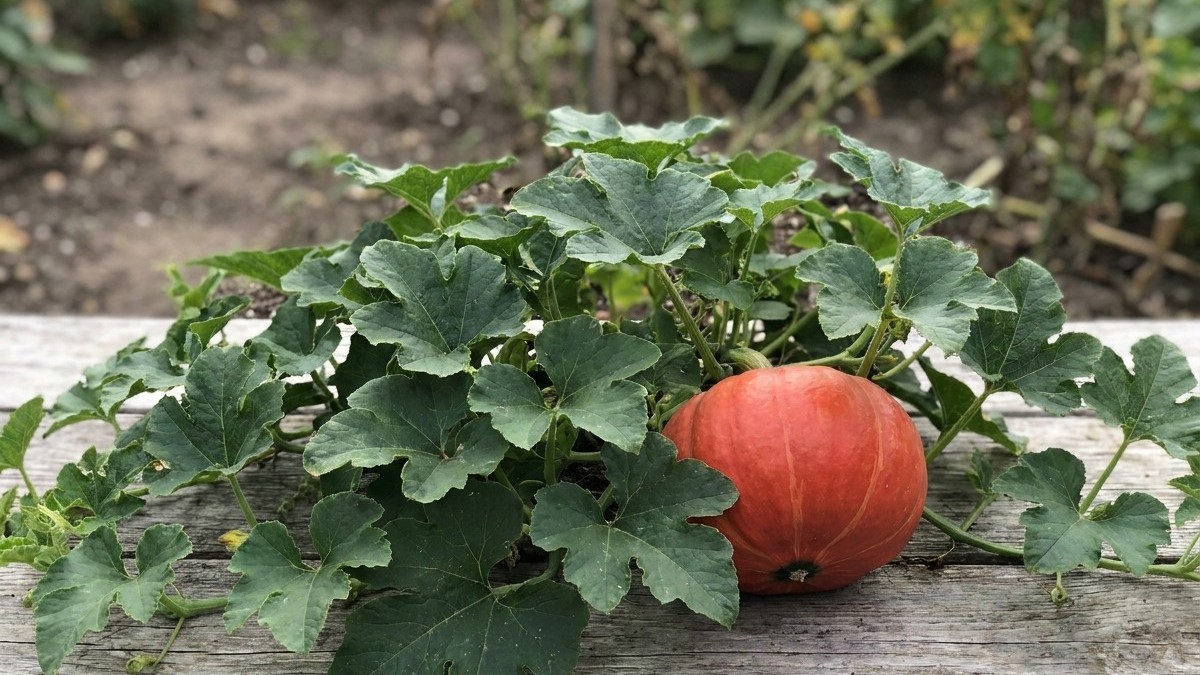

Cut a pumpkin when the rind is hard enough that a thumbnail won’t dent it, the color is deep and even, and the stem has dried and turned woody. In Nova Scotia that usually falls between late September and the middle of October, and always ahead of the first frost. Kept whole, in a cool and dark spot, a pumpkin can last up to three to six months. A warm kitchen counter or a porch beside the apple crate shortens that a lot.
When pumpkins are ready in Nova Scotia
A ripe pumpkin shows it on the vine: a hard rind, full color, and a dried, corky stem. Plan on roughly late September to mid-October, then let the weather forecast overrule the calendar. Seed packets count their days from sowing, but the clock that matters at harvest starts at flowering. Pumpkins take 45 to 55 days to mature after flowering, according to Utah State University Extension.
The start of that clock is easy to muddle with the spring dates. Seeds go in when the soil reaches 65 F. That is a soil reading, and soil trails the air by weeks, so it can’t be matched to the last spring frost. Environment and Climate Change Canada’s climate normals for the Halifax Stanfield airport station put the last spring frost on average at May 7 and the first fall frost on average at October 18. That leaves the reference station about 164 frost-free days between the two.
Both dates are averages, so treat October 18 as the middle of a window. In one year out of two, the first frost arrives earlier. The same goes for May 7: in half of years the last spring frost falls later. Halifax is also a single station. Northern and upland districts of the province run weeks behind it, so a grower there should shorten the season on paper. The local agricultural office can say how far.
Will a late flower give a ripe pumpkin?
Count backward from the average first frost. Fifty-five days before October 18 is about August 24, and 45 days before is about September 3. A flower that opens in the first half of August has time to finish. One that opens in mid-September gives a fruit that stays green, however warm the fall turns out. Since frost comes earlier in half of years, flowers that open after late August are a gamble. For what to do with the green ones, see Will Pumpkins Ripen Before Frost in Nova Scotia?
How do you cut a pumpkin without shortening its life?
Use pruners or a sharp knife, and leave a good length of stem attached, because Utah State advises harvesting with the stem on. Pumpkins left on the vine past frost lose their best storage life, so cut the colored ones when frost is in the forecast. Handle them gently and carry them by the body, since a stem that snaps off leaves an opening for rot. Give any pumpkin with a gouged or scarred rind a close look. Feeding damage is where decay tends to start, and What Eats Pumpkin in Nova Scotia, and When covers which pests leave those marks. Anything blemished goes to the kitchen first.
Keeping them, and for how long
University of Illinois Extension, in its guide to choosing a pumpkin, says a whole pumpkin keeps for three to six months in a cool, dark location between 45-50 F. That duration is a ceiling reached only when everything goes right: a sound rind, an attached stem, and a steady temperature. A pumpkin with a bruise, or one kept somewhere warm, won’t reach it. Buy or grow with the shorter end of the range in mind and think of the longer end as a bonus.
Utah State University Extension adds a simple rule on the cold side: keep pumpkins where they will not freeze. A pumpkin that freezes and thaws turns soft and watery, and nothing brings it back. Nova Scotia’s late fall and winter nights make this worth taking seriously, since an unheated space that holds steady in October can drop below freezing by December.
Why can’t pumpkins sit next to apples?
The Illinois guidance includes a second instruction that few people follow: store pumpkins away from any ripening fruit or vegetables, such as apples, potatoes, or tomatoes. Ripening produce gives off a gas that ages the pumpkin faster. That explains why the porch beside the apple crate is such a poor place for it, and why a cellar shelf shared with a bin of potatoes shortens the keeping time. In a province full of orchards and root cellars, the crowding is easy to fall into. Give the pumpkins their own corner and put the apples and potatoes across the room, or in a different room if the house allows.
How long does a carved pumpkin last?
The three-to-six-month window and the 45-50 F range belong to a whole pumpkin. A cut one is a different case. Once the skin is open, rot has an easy way in, and the guidance for a sound, whole fruit no longer applies. If you want a jack-o’-lantern in good shape for Halloween, carve it close to the day you plan to display it. Keep the uncarved ones back for the long haul, and use any soft or damaged pumpkin first, since it won’t keep anyway.
Where in the house that actually is
The target of 45-50 F sits between the usual rooms of a house. A kitchen fridge runs colder than that range, and a whole pumpkin doesn’t fit in one anyway. Any heated living space is warmer, and a pumpkin on a sunny sill or beside a radiator ages quickly. An attached garage or a three-season porch swings with the weather, running warm on a mild October afternoon and dropping to freezing on a clear night in November. Neither holds the steady, cool temperature the pumpkin needs, and the freeze is the real hazard.
The closest match in most Nova Scotia houses is an unheated but insulated space that stays out of the weather: a basement corner away from the furnace and water heater, a cold spare room with the register closed, or an old cellar with a dirt or concrete floor. Choose somewhere dark, or cover the pumpkins with a cloth, since the guidance calls for a dark location. Then look at what else shares the space. If the basement is where the apples and potatoes live, move the pumpkins to the far wall or to another room.
A guess about temperature is the weakest link here, because basements vary by house and by season. Leave a min-max thermometer in the chosen spot for several days before you carry the pumpkins in. Skipping that check can cost the whole stack, since a space that looks cool might spend half the day at 60 F or sink toward freezing after a cold snap. Read the lows and highs. If the readings sit in the 45-50 F range, move the pumpkins in. If they run warmer, try a lower shelf or another corner, and check again after the first hard cold arrives.
Common questions
Is it safe to wait until October 18 to cut pumpkins in Nova Scotia?
No. October 18 is the average first fall frost at the Halifax Stanfield airport station, so in about half of years the first frost arrives earlier. Cut the ripe pumpkins when a frost shows up in the forecast, and in northern or upland areas expect the frost to come sooner than at the airport.
How long do whole pumpkins keep?
University of Illinois Extension says three to six months, in a cool, dark place between 45-50 F. That is the best case for a sound whole pumpkin with the stem attached. A bruised pumpkin, a warm room, or a neighbor like the apple bin will cut the time short.
Can I store pumpkins next to apples or potatoes?
Keep them apart. Ripening fruit and vegetables such as apples, potatoes, and tomatoes give off a gas that ages pumpkins. A separate room is best, and if that isn’t possible, use the far end of the space.
Is 65 F soil the same as the last frost date?
No. Seeds go in when the soil reaches 65 F, and the soil lags the air by weeks, so that moment usually comes well after the average last spring frost of May 7 at the Halifax Stanfield airport station. Since that date is only the middle of a window, the pumpkin’s 45 to 55 days after flowering still have to fit before the first fall frost. The guide to Growing Pumpkins in Nova Scotia covers the planting side in full.