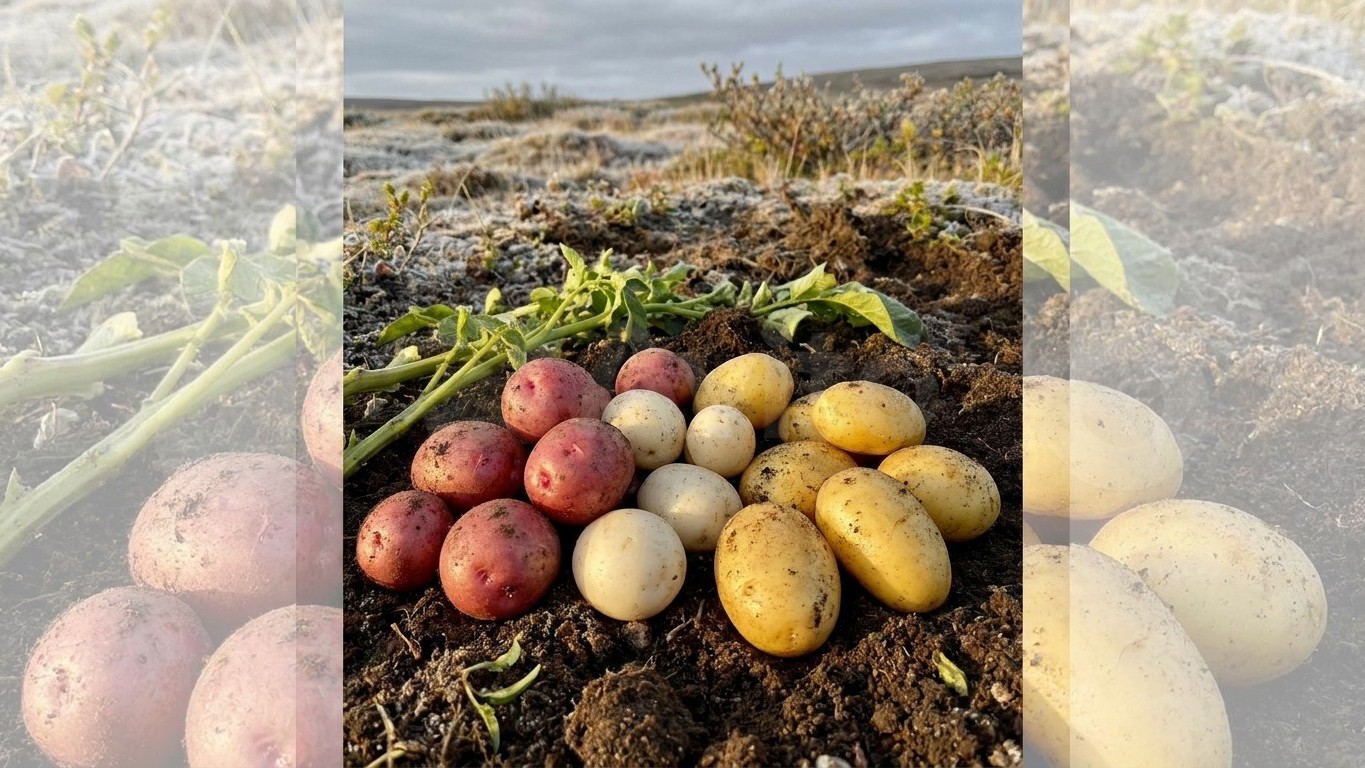

Early-season potatoes are the ones that suit Nunavut, and the reason comes down to a single date: the average last spring frost at Rankin Inlet A lands on June 19, according to Environment and Climate Change Canada’s Canadian Climate Normals for 1981-2010. That’s a short window before the ground freezes again, and it leaves almost no room for a slow-maturing crop to finish sizing.
The short answer
June 19 is a mean, not a promise. Environment and Climate Change Canada compiles it from three decades of readings at the Rankin Inlet A station, and a mean by definition sits in the middle of a spread: in one year out of two, the last frost actually falls after that date. Some seasons it’s earlier, some seasons a gardener is still watching for ice in early July. Treat June 19 as the midpoint of a window, not a green light, and plan the planting date around the soil, not the calendar.
That single fact reshapes which potatoes make sense here. Utah State University Extension and the University of Maine Cooperative Extension both classify potato varieties by season length, early, mid-season, or late, rather than by a fixed number of days to maturity, because maturity time shifts with soil temperature, daylight, and moisture. What both sources agree on is the logic: the shorter the frost-free stretch, the more the advantage goes to early-season stock.
In a territory where the frost-free period is already compressed by a late, uncertain spring, a mid-season or late variety simply runs out of runway. It may flower, it may even set tubers, but it won’t have the weeks needed to bulk them up before fall cold shuts growth down. Early-season types are built to do most of their bulking in a compressed window, which is exactly the constraint Nunavut imposes.
End use matters as much as season length. Extension guidance splits varieties by what they’re grown for, baking or boiling, rather than by texture words like waxy or floury, because that’s the terminology the research actually publishes. A gardener choosing for Nunavut should pick an early-season variety suited to boiling if the goal is a reliable table crop from a small plot, since boiling types tend to be the ones extension programs recommend for short, cool-season gardens where the priority is a usable harvest rather than a specialty crop for baking.
The short answer, then, isn’t a variety name. It’s a category: early-season, chosen for boiling use, planted around soil temperature rather than the frost-date average, because the average is the one number in this whole equation that will fool you half the time.
What actually decides it
The frost window is a coin flip, not a calendar date
A climate normal is an average of real years, and averages hide the years that missed. When Rankin Inlet A’s last-frost mean sits at June 19, it means the underlying thirty years of readings straddle that date about evenly, some frosts in late May, some pushing into July. A gardener who plants exactly on June 19 every season is, by definition, getting caught by frost roughly half the time. The mechanism that should drive the planting decision isn’t the date at all, it’s the soil thermometer, because soil temperature is the trigger that actually controls germination and early growth, and it lags air temperature by days or weeks depending on how wet and shaded the ground is.
The heat ceiling that never arrives
Utah State University Extension and the University of Maine Cooperative Extension both flag a heat ceiling for potatoes: soil above 90 F inhibits tuber set and fill, which is why hot-summer growers are told to get a crop in the ground early and dig it before peak heat rather than nursing it through a hot stretch. In Nunavut this mechanism almost never triggers. Soils this far north rarely approach that ceiling even in the warmest weeks of summer. That doesn’t cancel the guidance, it flips which half of it matters. The same sources say potatoes are planted as soon as soil reaches 50 F, 14 to 21 days before the last frost date, and that’s the half of the rule that does the real work here. The plant date is set by a soil reading in the 50s, not by fear of overheating, because overheating isn’t the constraint this far north. Cold, short seasons are.
Put those two mechanisms together and the reasoning generalizes past Nunavut. Anywhere the frost-free season is short and the summer never gets hot, the deciding factor is how fast a variety can bulk tubers before cold returns, not how it tolerates heat. Anywhere summers run hot and long, the reverse mechanism kicks in and the 90 F ceiling becomes the real limit. Knowing which mechanism is live in a given place, frost-window length or heat ceiling, is what lets a gardener choose correctly anywhere.
How to do it
- Track soil temperature at planting depth with a soil thermometer rather than relying on the calendar or the air temperature reading from a weather report.
- Plant once the soil reaches 50 F, which University of Maine Cooperative Extension and Utah State University Extension place at 14 to 21 days before the local last-frost date, keeping in mind that Rankin Inlet A’s last-frost mean is June 19 and can run later in half of all years.
- Choose certified seed potatoes rather than saved or uncertified stock, since uncertified seed carries virus that a short northern season gives no time to outgrow.
- Select an early-season variety over a mid-season or late one, matching the variety’s published season class to the length of the frost-free window rather than to taste preference alone.
- Pick the variety by its stated end use, boiling for a reliable short-season table crop, and skip cultivars marketed for baking unless the season length has been confirmed to support them.
- Cover or delay emergence if a late frost threatens after planting, since the June 19 mean means a real chance of frost arriving after the crop is already up.
- Monitor for the crop’s maturity signals rather than counting days, since neither Utah State nor Maine extension publishes a days-to-maturity figure to count toward.
- Harvest promptly once foliage dies back, since a short northern fall gives little buffer between vine death and hard ground freeze.
What goes wrong
- Planting on the average frost date instead of the soil reading. Because June 19 is a mean, planting exactly then means frost still arrives afterward in roughly half of all years. The fix is to plant by soil temperature, waiting for a consistent 50 F reading, and treating the frost-date average only as a rough midpoint to plan around, never as a safe cutoff.
- Choosing a mid-season or late variety for its flavor or storage reputation. A longer-season variety simply runs out of frost-free weeks in Nunavut before it can bulk properly. The remedy is to check the published season class before buying seed and default to early-season stock whenever the frost-free window is uncertain or short.
- Using saved or uncertified seed potatoes. Uncertified seed carries virus load that builds season over season, and a short growing window leaves no slack for a virus-weakened plant to recover. Buying certified seed each planting removes that risk at the source.
- Assuming heat is the enemy and planting late to dodge it. The 90 F soil ceiling that troubles hot-region growers rarely applies this far north, so delaying planting to avoid heat sacrifices weeks the crop doesn’t have to spare. The correct read of the guidance here is the early half of it, plant as soon as soil hits 50 F, not the late half meant for hot climates.
- Picking a variety by texture words like waxy or floury. Those terms don’t appear in the extension sources, and matching by them can lead to a mismatch between the variety’s actual use and what the garden needs. Matching by stated end use, boiling versus baking, keeps the choice grounded in what’s actually documented.
Common questions
Can a late-season potato variety still mature in Nunavut if planted early enough?
Planting as early as the soil allows, at 50 F, helps any variety, but a late-season class is built around a longer bulking period than an early-frost, short-summer territory reliably provides. Extension guidance frames the choice by season class precisely because the frost-free window, not the planting date alone, sets the ceiling on what a late variety can achieve.
Is the June 19 frost date safe to plan around exactly?
No. It’s the mean of thirty years of readings from the Rankin Inlet A station under Environment and Climate Change Canada’s 1981-2010 Canadian Climate Normals, which means frost falls after that date in roughly half of those years. Treat it as a midpoint for rough planning, and let the soil thermometer make the actual planting call.
Does the 90 F heat ceiling ever matter for potatoes grown this far north?
Rarely. That ceiling, documented by Utah State University Extension and the University of Maine Cooperative Extension, describes soils in hot-summer regions where tuber set and fill shut down above 90 F. Nunavut’s cool summers make that threshold an edge case rather than a routine concern, which shifts the practical focus to the frost window instead.
Why does certified seed matter more in a short northern season than elsewhere?
Uncertified seed can carry virus that reduces vigor and yield, and a crop with only a narrow frost-free window has no spare time to compensate for a weakened start. Certified seed removes that variable before the season even begins.