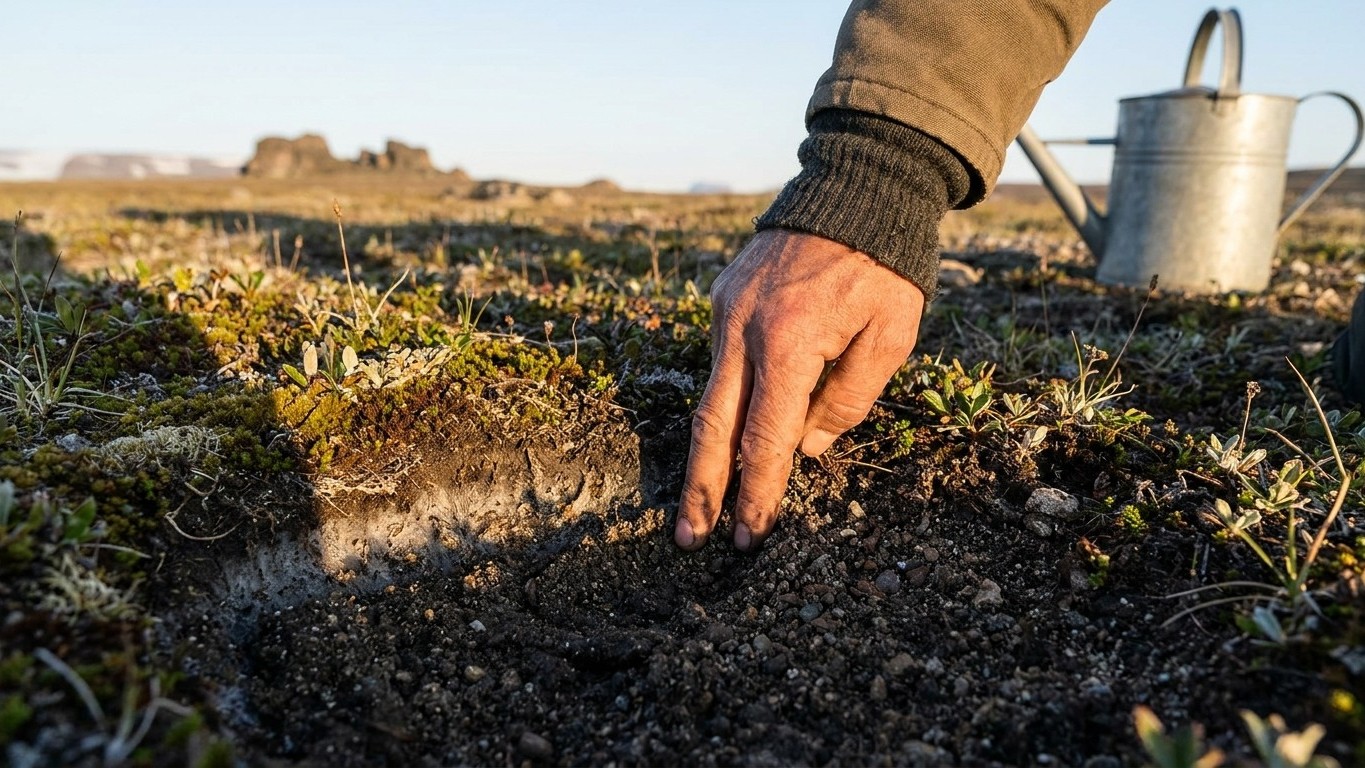

Watering rules in Nunavut aren’t about drought bylaws so much as they’re about a growing season that opens in mid-June and can close by mid-September. The territory sees zero days a year above 90°F, so the usual heat-driven watering math doesn’t apply. What matters instead is soil that sits on permafrost, water that often arrives by truck rather than pipe, and a frost window tight enough that every watering decision has to respect the calendar first.
How much, how often

The old rule of thumb still holds here, maybe more than anywhere else: water deep and infrequently, not a little bit every day. Shallow daily watering trains roots to stay near the surface, where the top inch of soil heats and dries the fastest and where a single windy afternoon on the tundra can undo a whole day’s work. Deep watering pushes roots down where moisture actually lingers, which matters in a place where the growing window won’t give plants a second chance to recover from a bad root system.
The way to know if watering is even needed isn’t a schedule, it’s your finger. Push it two inches into the soil near the base of the plant. Dry at that depth means water now; still cool and damp means wait. A trowel works just as well if the ground is too gravelly for a finger check, which it often is across Nunavut’s thin, rocky soils. This same finger test applies to Watering Pots and Containers in Nunavut, where soil dries out even faster than in the ground. Water in the morning, always at the base, never over the leaves, since wet foliage overnight in a cool climate invites fungal problems that a plant with an already-short season can’t afford to fight off.
Soil texture changes the math directly. Much of Nunavut’s usable garden ground is sandy or gravelly on top, which drains fast and holds little moisture, meaning shorter, more frequent soakings rather than one big drink. But that same thin layer often sits directly over permafrost, which acts like a lid: water that should drain away instead pools just below the root zone. That means never watering ground that’s already saturated from a recent rain or thaw, since the excess has nowhere to go and roots can drown even in soil that looks dry on the surface. Clay pockets, where they occur, behave the same way anywhere else: they hold a week’s worth of water but must never be worked or soaked while still wet, or the structure collapses and drainage gets worse permanently.
With no days above 90°F on record for the territory, evaporation demand from heat alone is close to nonexistent. What dries soil in Nunavut is wind and low humidity, not sun intensity, so watering decisions should track the soil check above rather than the temperature. Watering Through a Dry Spell in Nunavut means paying closer attention to wind and humidity than to any thermometer reading. And because the season itself is short, bookended by a mean last spring frost around June 19 and a mean first fall frost around September 13, there’s rarely room to wait out a mistake. Both of those dates are averages, not guarantees. Frost lands later than June 19 in about half of all years, and earlier than September 13 just as often, so treat that window as roughly twelve weeks at best, not a fixed calendar.
- Check soil moisture two inches down with a finger or trowel before watering anything.
- Water only at the base of the plant, early in the morning, never on the foliage.
- Apply water slowly and steadily until it reaches root depth, adjusting the amount for sandy or gravelly soil, which needs less per session but more frequent sessions.
- Skip watering entirely if the ground is already saturated from rain or thaw, since permafrost close to the surface can trap that moisture against the roots.
- Start and stop watering with the frost window in mind, roughly mid-June through mid-September, and shift indoors or under cover earlier than that window suggests if a cold snap threatens.
Restrictions and rules
Formal outdoor watering bylaws of the kind common in southern Canadian cities aren’t well documented for Nunavut’s communities, and it would be misleading to invent a specific rule here. What’s worth knowing instead is the water system itself. Most Nunavut hamlets rely on trucked water delivery and local storage tanks rather than buried municipal pipe networks, because permafrost makes underground infrastructure difficult and expensive to maintain. That system shapes water use in practice even without a posted bylaw: household tanks have a fixed capacity, and outdoor watering competes directly with drinking water and sanitation needs in a way it rarely does in a city on a river-fed reservoir.
That’s a good reason to check locally before setting up any regular watering routine, garden hose or drip line included. A hamlet office or local water authority will know the current status of the community’s water supply and whether any conservation measures are in place for a given season. For general guidance on agricultural and water-use practices at the federal level, Agriculture and Agri-Food Canada is a reliable starting point, since it’s the federal department that publishes current information when provincial or territorial sites are unavailable.
The short, low-precipitation character of an Arctic summer also makes restrictions more likely in principle than in a region with steady summer rain to fall back on. A place that can’t count on rain to fill the gap between waterings is a place where any formal or informal conservation measure deserves attention before a routine gets set. Assume tank capacity and delivery schedules are part of the equation, not just what’s growing in the ground.
Using less
Every gallon saved in Nunavut is a gallon that didn’t have to be trucked, stored, or hauled by hand, which makes water efficiency a practical concern here more than an environmental slogan. A handful of techniques do most of the work, and they’re worth listing separately rather than folding together, since each saves water in a different way and at a different point in the process.
- Mulch around the base of plants slows evaporation from that same thin, fast-draining topsoil, meaning fewer trips back to check moisture and longer stretches between waterings even in windy conditions.
- Drip lines or soaker hoses put water directly at the root zone instead of across the whole bed, cutting the amount lost to surface evaporation and to wind drift, which matters more here than the heat ever will.
- Grouping plants by water need means the thirstier vegetables aren’t sharing a bed with hardier tundra-adapted plants that would rather stay on the dry side, so no single planting gets over- or under-watered to satisfy its neighbor.
- Working organic matter into the soil gives that thin gravelly layer something to hold onto, improving its ability to retain moisture between waterings without creating the drainage problems that come with underlying permafrost.
- Rain barrels, where local rules allow them, capture roof runoff for reuse. As a rule of thumb, an inch of rain falling on a thousand square feet of roof yields roughly 600 gallons of collectible water. In a territory with a summer this short and this dry, that math works against the gardener: a barrel fills slowly across June, July, and August, and it can sit empty for stretches with no rain to refill it, so it’s worth treating as a supplement to careful watering rather than a primary source.
None of these techniques requires much investment, and most gardeners who adopt even two or three of them cut their watering frequency noticeably by midsummer. In a place where water often arrives by truck, that reduction isn’t a minor convenience.
Common questions
Can you actually grow a garden in Nunavut?
Yes, though the window is narrow. With a mean last spring frost around June 19 and a mean first fall frost around September 13, the frost-free period runs roughly twelve weeks in an average year, and shorter in years when frost arrives later in spring or earlier in fall. Cold-hardy vegetables and quick-maturing varieties fare best inside that stretch.
How often should I water a garden bed in Nunavut?
Skip the calendar and check the soil instead. Push a finger or trowel two inches down; if it’s dry, water deeply at the base in the morning. If it’s still damp, especially in soil sitting over permafrost, hold off, since that layer can trap moisture longer than it appears from the surface.
Are there official water restrictions for Nunavut gardens?
No broadly documented territorial bylaw exists for outdoor watering, but many communities rely on trucked water and tank storage rather than piped municipal supply, which effectively limits how much can go toward a garden. Check with the local hamlet office for the current status before setting up a routine.
Does the short summer change what watering method makes sense?
It does. With zero days a year above 90°F, heat-driven evaporation isn’t the concern that wind and low humidity are. Deep, infrequent watering at the base, paired with mulch to hold what moisture the thin soil does retain, does more good here than frequent light watering ever would.