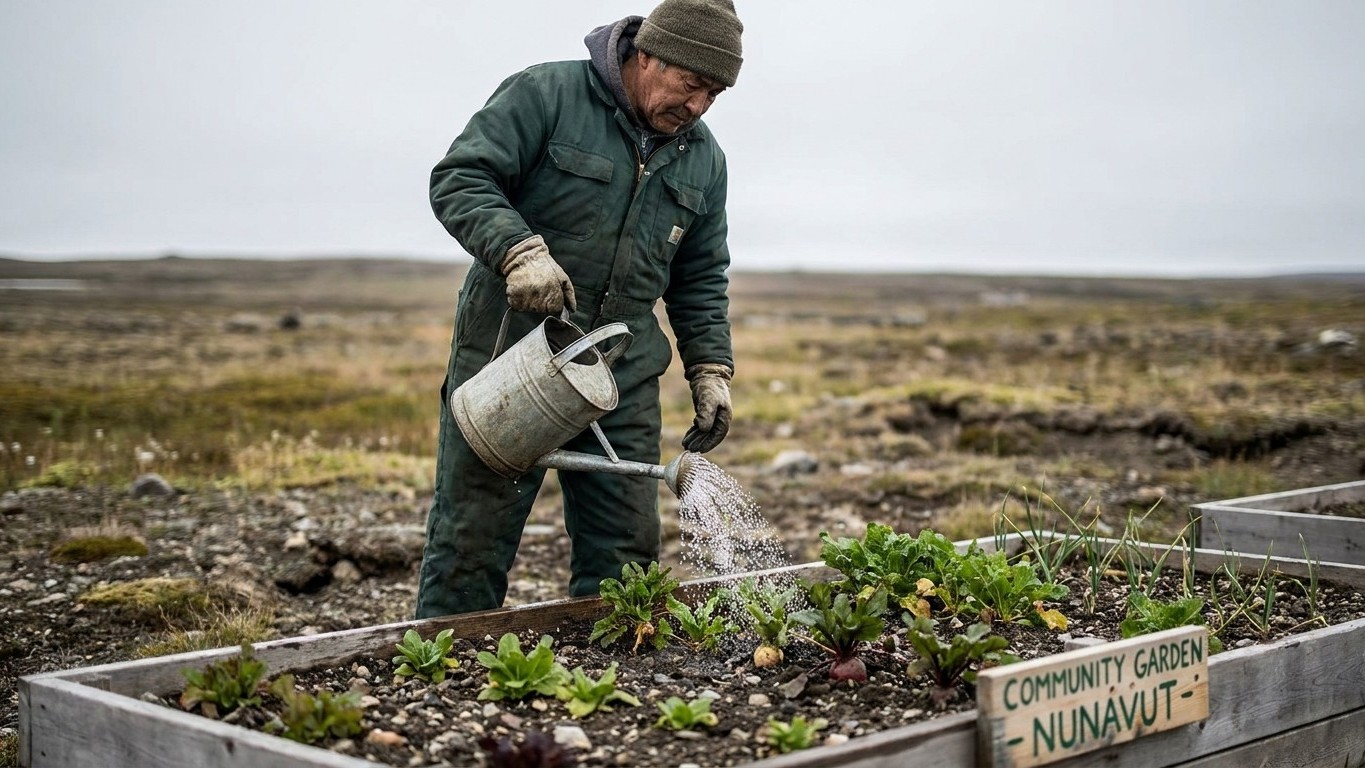

In Nunavut’s short summer, the ground rarely dries out from heat alone, since the mercury almost never climbs into stress territory. The real issue is that so little rain falls in the first place. A garden bed here needs a deliberate watering plan built around the region’s actual numbers, not general advice meant for warmer, wetter states.
What changes here

Two numbers set the terms for every gardener working this ground: the driest summer month, June, averages just 1.05 inches of rain, and the region logs 0.0 days a year at or above 90F. Put together, that means water stress in a Nunavut garden comes almost entirely from a shortage of rainfall, not from heat driving moisture out of the soil the way it does farther south. A plant here isn’t fighting evaporation from a blazing afternoon. It’s fighting a sky that simply doesn’t deliver much.
Run the arithmetic and the gap becomes concrete. A vegetable bed generally wants about an inch of water a week to keep growing steadily. June has roughly 4.3 weeks in it, so that 1.05 inches of monthly rain works out to about 0.24 inches arriving from the sky in an average week. That leaves close to 0.76 inches the gardener has to carry, bucket or hose, every single week of the driest stretch of summer, just to close the gap between what the tundra sky provides and what a bed actually needs.
That 0.76 inches doesn’t behave the same on every plot. Sandy, well-drained soil, common in disturbed or graded areas around Nunavut communities, lets water pass through fast, so the same inch disappears from the root zone within a day or two, demanding it be split into smaller, more frequent sessions. Heavier ground with more clay content holds onto that inch far longer, sometimes close to a week, which changes the whole rhythm of when to water again. Since no single soil reading applies across a territory this size, and permafrost sits under much of it besides, the safest move is to check your own bed with a trowel rather than assume either extreme.
The 0.0 days-above-90F figure matters for a second reason: it rules out one entire failure mode. Gardeners in hot states have to worry about midday wilting and scorched leaves from sheer heat load. That risk barely exists here. The tradeoff is a shorter, tighter growing window where every one of those 0.76 weekly inches counts more, because there’s less time in the season to recover from a missed watering.
How to water when it matters
The method that works on this ground is deep, infrequent watering at the base of the plant, done in the morning. Deep watering pushes moisture down to where roots actually live, training them to grow downward instead of clustering near a surface that dries out fast. Watering at the base, rather than overhead, means the water goes where it’s needed instead of evaporating off leaves or blowing sideways in wind, which is a real factor on open tundra ground. Morning watering gives the plant a full day to draw up moisture before any overnight cooling, and it also lets any water that does land on foliage dry off before dark instead of sitting damp all night.
Checking soil moisture at root depth matters more than checking the surface, because the surface here can look damp from a passing shower while the inch below stays bone dry. A finger pushed two inches down, or a trowel pulled up for a quick look, tells the real story. If that depth feels dry and crumbly, it’s time to water. If it’s still cool and slightly moist, it can wait another day.
Given no fixed soil reading applies across the whole territory, treat the following as a starting sequence to adjust once you’ve felt your own ground:
- Push a finger or trowel two inches into the bed before watering, every time, rather than judging by the surface or by memory of the last rain.
- If the soil drains fast and feels sandy, plan on watering every two to three days through June, in shorter sessions, since it holds little moisture at a time.
- If the soil is heavier with more clay, water less often, roughly once every five to seven days, but never before that two-inch depth has actually dried, since clay drowns roots given water too soon.
- Aim to add close to 0.76 inches of water across the week during June specifically, the driest summer month, splitting that total across your chosen watering days rather than dumping it all at once.
- Water at the base of each plant in the morning, letting it soak in slowly rather than running off across the surface.
That 0.76-inch weekly target is a starting point built from the regional averages, not a rule fixed to every plot. A rain gauge left in the actual garden, checked after each shower, is what tells a gardener whether they’re really closing the gap or still falling short.
What goes wrong
“I water a little bit every day, just to be safe”
A light daily sprinkle wets only the top inch or so of soil, and roots respond by staying shallow, right where that moisture sits. Those shallow roots then have nothing to draw on the moment a few days pass without watering, which is exactly the pattern of Nunavut’s uneven summer rainfall. Deep, less frequent watering builds a root system with reserves; daily sprinkling builds one with none.
“I water the leaves in the evening so they look fresh overnight”
Wetting foliage after the sun goes down leaves it damp for hours in cool overnight air, which is close to ideal conditions for fungal disease to take hold. Morning watering at the base sidesteps that risk entirely.
“It rained yesterday, so the bed should be fine”
A passing shower can wet the surface and evaporate before it ever reaches root depth, especially in a territory averaging only 1.05 inches across all of June. The only way to know is that two-inch check with a finger, not a glance at wet-looking topsoil.
“I didn’t bother with mulch, the season’s short anyway”
Bare soil gives back moisture to the air faster than mulched ground, undoing part of every watering session. In a territory already running a rainfall deficit against garden needs, skipping mulch means carrying more water by hand than necessary to make up for what the sun takes back. Given how little slack the 1.05-inch June average leaves, this is the mistake that costs the most here: every dry spell hits harder when there’s no mulch layer slowing evaporation down.
Local help
Nunavut doesn’t run its own provincial-style extension service the way many U.S. states do, so the federal Department of Agriculture and Agri-Food Canada is the practical starting point for growing guidance suited to the far north. Watering restrictions, where they exist, are set community by community, so checking with your local water provider before setting a watering schedule is worth doing every season, not just once.
Common questions
Does Nunavut ever need drought watering the way hot states do?
Not for heat stress, since the region averages 0.0 days a year at or above 90F. The need comes from low total rainfall, not from evaporation driven by extreme temperatures.
How much extra water does a garden need during June specifically?
Based on June’s 1.05-inch average and a one-inch weekly target, a gardener typically needs to add close to 0.76 inches by hand each week that month, adjusted for their own soil’s drainage.
Is sandy or clay soil more common across Nunavut gardens?
No single figure applies across a territory this size, and permafrost complicates drainage further. Checking your own bed with a trowel is the reliable way to know which watering rhythm fits.
Are there official watering restrictions to worry about?
Rules vary by community and change over time, so the safest step is confirming current restrictions directly with your local water provider rather than assuming territory-wide guidance applies.