
Yes, Insulation keeps an Ohio home cooler, though the case for it here is different than in Georgia or Texas. Ohio’s summers are real but moderate, and the same attic Insulation that blocks winter heat loss also blocks the sun’s heat from pushing down into living space. How much it matters depends on which side of the state’s climate divide a house sits on.
The short answer for Ohio

Start with the number that sizes the season: the reference station in Columbus logs an average of 15.3 days a year above 90°F, based on NOAA’s 1991-2020 Climate Normals. That’s not a brutal stretch of heat. Compare it to a Gulf Coast city racking up two or three months of 90-degree afternoons, and Ohio’s summer looks almost mild by contrast. Fifteen days is roughly two work weeks scattered across June, July, and August, not a season that defines the whole year.
That single fact already answers a big part of the question. In a place with eight or ten days above 90°F, Insulation would matter more for winter than summer, and the honest answer would lean that direction. Ohio sits a notch above that. Fifteen days is enough that a poorly insulated attic will show up on a July electric bill, especially on the hottest stretches when the AC runs nearly nonstop trying to catch up with a superheated attic dumping heat downward.
The other piece of the picture is geography within the state itself. Ohio’s 88 counties split across two IECC climate zones: 64 counties fall in zone 5A, and 24 counties fall in zone 4A. That’s not a small footnote. Zone 4A, which tends to run through the southern and southwestern part of the state, carries a warmer, more humid summer profile than zone 5A, which dominates the north and center of the state. A county in 4A is going to feel more cooling load across a typical year than one in 5A, even though both are technically part of “Ohio summer.”
None of this makes insulation a summer-only fix here. Ohio winters are cold enough that heating dominates most home energy bills over a full year, and that’s still the bigger reason to insulate. But treating insulation as purely a cold-weather tool misses half the story. Fifteen days above 90°F, layered onto a humid Midwestern summer that regularly sits in the 80s even when it doesn’t crack 90, adds up to real cooling demand that a well-insulated attic softens rather than solves.
The practical takeaway: insulation in Ohio is a two-season investment, weighted toward winter but far from irrelevant in summer, and the weighting shifts somewhat depending on whether a given county sits in zone 4A or zone 5A.
What happens above the ceiling
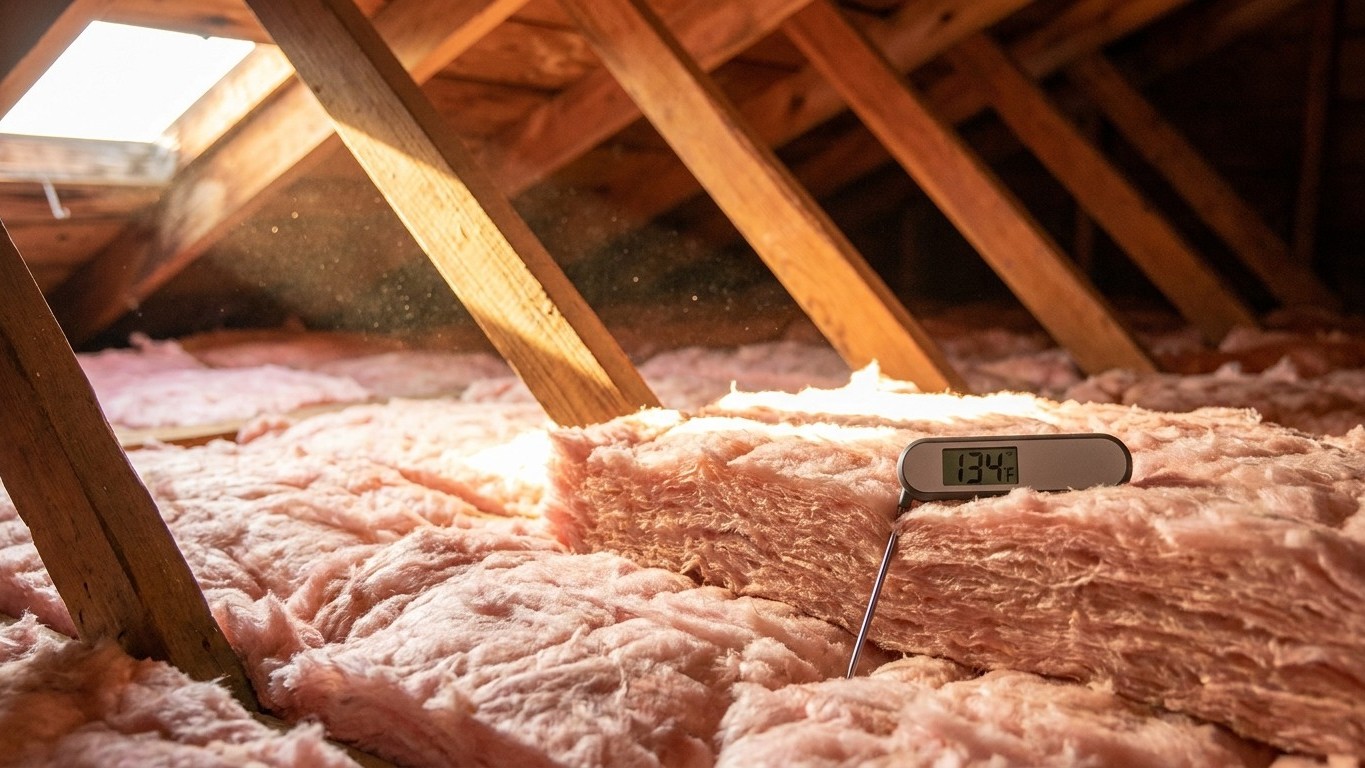
An attic under a summer sun doesn’t just get warm, it gets scorching. Roofing material absorbs solar radiation all day, and an unventilated or poorly ventilated attic can climb well past 120°F even when the outdoor air reads in the mid-80s. That superheated air sits directly above the ceiling of every room below it, above the ductwork if the system runs through the attic, and above anything stored up there, including any keepsakes in cardboard boxes.
Heat doesn’t stay put. It moves toward cooler space, and in a Ohio summer afternoon that means it moves downward, through the ceiling drywall, into the living space the air conditioner is working to cool. The insulation layer between the attic floor and the ceiling below is what slows that transfer. It’s the same material, doing the same job it does in January, just running in reverse. In winter it holds warm indoor air in; in July it holds hot attic air out. It isn’t a seasonal product swapped out twice a year. It’s a constant resistance to heat flow, and the direction of that flow just changes with the season.
What ENERGY STAR recommends for this state’s climate zones
Because Ohio spans two IECC zones, the retrofit target differs depending on which zone a county falls into. ENERGY STAR’s recommended insulation levels for retrofitting an existing wood-framed home, broken out by the relevant zones for this state, look like this:
| Zone | Attic if uninsulated | Attic if already 3-4 inches | Floor |
|---|---|---|---|
| Zones 4A and 4B | R60 | R49 | R19 |
| Zones 6, 5, and 4C | R60 | R49 | R30 |
Ohio’s 24 counties in zone 4A fall under the first row, and its 64 counties in zone 5A fall under the second, which is grouped with zones 6 and 4C in ENERGY STAR’s table. Note the difference isn’t in the attic target, which is R60 uninsulated or R49 on top of existing insulation in both cases, it’s in the floor recommendation, where zone 5A calls for R30 against zone 4A’s R19. These are retrofit levels for existing construction, not new-build code minimums, and they’re the same numbers whether a homeowner is chasing a lower winter heating bill or a cooler July living room. This site’s ENERGY STAR map link lets a reader confirm which zone a specific county falls into rather than guessing from a regional description.
What homes in Ohio cool with
Ohio households lean hard on mechanical cooling, and how that cooling is delivered changes what insulation can and can’t fix. Statewide, 94% of homes use some form of air-conditioning equipment, and 74% use a central air-conditioning unit specifically. The gap between those two figures, 20 percentage points, represents households cooling with something other than central air: window units, wall units, ductless mini-splits, or portable units, which together cover 26% of homes. Three-quarters of Ohio households, 75%, also run ceiling fans, which don’t cool the air but make a room feel more comfortable at a higher thermostat setting.
These figures describe households surveyed, not a share of the total housing stock, and a share reported as suppressed or too small to publish in the underlying survey is not the same as zero. Still, the split between central and individual cooling is the detail that matters for anyone thinking about insulation’s real-world payoff.
In a home with central air and ductwork running through the attic, that ductwork sits in the single hottest space in the building on a summer afternoon. Ceiling insulation between the attic floor and the room below does nothing to protect those ducts, because the ducts are above the insulation layer, not below it. A duct leaking cool air into 120-degree attic space loses that cooling before it ever reaches a vent, and no amount of ceiling insulation changes that. That’s a separate repair, covered in this site’s duct sealing and duct insulation guides, and it’s worth checking independently of anything done to the attic floor.
For the 26% of Ohio households cooling with a window unit, wall unit, or mini-split, the calculation is different. There’s no attic ductwork in the equation. What matters is the envelope of the specific room or zone being cooled, meaning wall insulation, window condition, and how much attic heat is pressing down on that room’s ceiling. This site’s room air conditioner and mini-split guides cover sizing and placement for that kind of setup in more depth.
What the heat asks for that the cold does not
Two products belong specifically to hot-climate homes, and Ohio’s moderate summer means the case for both is limited rather than automatic.
A radiant barrier is a reflective material, typically foil-faced, installed under the roof deck to bounce radiant heat back before it ever heats the attic air. It carries no R-value and isn’t insulation in the conductive sense, it works on a completely different mechanism. Radiant barriers earn their keep in climates with long, intense, sun-loaded summers, think the Deep South or the Southwest, where attic temperatures spike for months on end. Ohio’s 15.3 days above 90°F, and its split between zone 5A and zone 4A, doesn’t describe that kind of sustained radiant load. For most Ohio homes, particularly the 64 counties in zone 5A, a radiant barrier isn’t the tool the summer calls for. Adding attic insulation to the ENERGY STAR-recommended level does more for less, and does it in both seasons.
The second hot-climate consideration is vapor movement, and it runs in the opposite direction from what many homeowners expect. In a warm, humid climate, moisture-laden air sits outside the wall assembly in summer, pushing inward, which is why the model energy code doesn’t require an interior vapor retarder in its warmest zones. Ohio’s dual-zone status, split between 5A and 4A, means the vapor picture isn’t uniform across the state, and getting it wrong can trap moisture inside a wall rather than keep it out. That question deserves its own answer rather than a quick generalization here. This site’s vapor barrier guide for Ohio walks through which counties need which approach.
What the work is worth
ENERGY STAR puts a number on this kind of project: “EPA estimates that homeowners can save an average of 15% on heating and cooling costs (or an average of 11% on total energy costs) by air sealing their homes and adding insulation in attics, floors over crawl spaces, and accessible basement rim joists.” Both percentages matter, and they answer different questions. The 15% figure applies to the heating and cooling portion of a bill specifically. The 11% figure applies to total energy costs, a broader number that includes water heating, appliances, and lighting alongside HVAC.
Read that sentence closely and notice what it covers: attics, floors over crawl spaces, and accessible basement rim joists. It doesn’t include walls, windows, or doors, and stretching the figure to cover those upgrades would be a claim ENERGY STAR’s own modeling doesn’t support.
The number that matters most for this page is buried in plain sight: the estimate covers heating and cooling together, as one combined figure, not a winter saving with a footnote about summer. That’s the reason a page about Ohio summer heat and attic insulation exists in the first place. The saving isn’t a heating-season benefit that happens to carry over into July by coincidence. It’s modeled as a single package, and the summer half of it is exactly what shows up as a lower air-conditioning bill on the hottest stretch of an Ohio August.
These figures are averages drawn from energy modeling of a typical existing U.S. home, not a guarantee for any specific house on any specific street. A home already insulated close to ENERGY STAR levels will see less improvement than one with three inches of old fiberglass and daylight visible around the attic hatch. What the estimate does confirm is the direction: for a state that logs real summer heat without a Gulf Coast-length season, and that splits across two climate zones with different targets, insulation earns its cost back on both ends of the thermostat, not just the cold one.