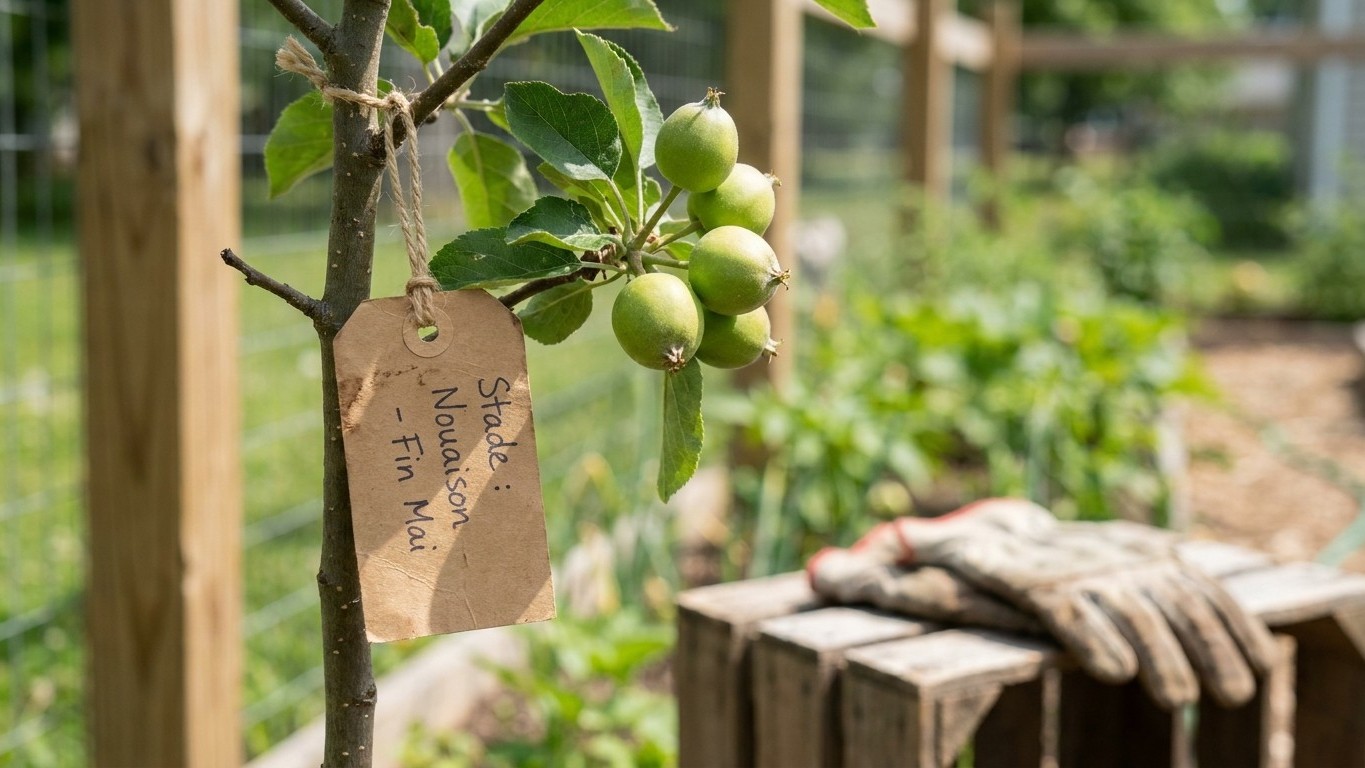

Ohio’s apple growers don’t lose sleep over the calendar — they lose sleep over what stage the buds are in. Near Columbus, the tree usually hits pink-to-bloom right when the last frost window is still open, and that overlap is the whole problem: a frost that a dormant tree shrugs off can wipe out an open bloom entirely. So skip the date on the wall tonight. Walk out to the tree, find the stage those buds are actually sitting at, and check tomorrow’s low against that stage before deciding whether to cover anything.
The short answer for Ohio
Near Columbus, an apple tree’s bloom typically arrives inside the frost-risk window that OSU Extension sets for zone 6a: a last spring frost of May 5 to May 15. That overlap is the entire reason Ohio apple growing has to be tracked by stage rather than by month. A tree sitting at green tip during a mild stretch in late March carries almost no frost exposure for its flowers, because there are no flowers yet. The same tree at open bloom on any day inside that May window is carrying its whole crop in tissue that has very little tolerance for cold.
The other boundary that matters is winter survival, and it is a separate question from bloom timing. NOAA’s 1991-2020 climate normals put the mean minimum temperature of the coldest month, measured at the Columbus reference station, at 22.6°F. That figure is a hardiness filter: it decides which rootstocks and scion varieties come through winter alive at all, before bloom timing ever becomes relevant. A tree can be perfectly hardy for a Columbus-area winter and still lose its entire crop to a late frost if it happens to bloom early, and a tree can bloom at exactly the right time and still be marginal if it isn’t hardy enough for the coldest month in the first place.
So the practical answer depends on three things: how early or late the cultivar blooms relative to others, how exposed the planting site is to cold air on a still night, and how far the local reference dates depart from Columbus, since OSU Extension is explicit that these dates shift across the state. A grower near Columbus working from the May 5 to May 15 window and a grower on a colder site should not use the same calendar date to decide when it’s safe to skip frost protection. They should use the same bud stage.
Working through it

Every stage of an apple tree’s year has a job attached to it, and the job is what should trigger the next step, not the date on a wall.
Dormancy through green tip


Dormant pruning gets done while the tree is fully asleep and the wood is easy to see, typically the stretch before any bud movement starts. Dormant oil for scale and mite eggs goes on before green tip, because it needs to smother eggs before they hatch and before foliage is present to be damaged by the oil. Green tip itself, when the bud splits and shows its first color, is the signal that the tree has woken up and that any remaining dormant work is now too late.
Pink through bloom


At pink, the flower is visible but still closed, and this is when most apple scab fungicide programs begin, because the fungus infects newly emerging tissue and a grower wants coverage down before petals open and pollinators arrive. Bloom itself, when petals are fully open, is the most frost-sensitive stage of the whole year. Open blossoms tolerate almost no freeze at all, while the same buds at tight cluster or pink withstand noticeably more cold. This is exactly why the OSU Extension frost window matters more at this stage than at any other: a frost that would do nothing to a dormant tree in February can wipe out the year’s crop if it lands during open bloom in May.
Petal fall through harvest

Petal fall marks the end of the pollination window and the point where insecticide and fungicide targets shift toward plum curculio and early scab lesions rather than protecting the flower itself. Fruit set, when the tiny green fruit is visible and the tree has decided how much of its bloom it will actually carry, is when hand thinning happens, both to size the remaining fruit and to prevent limb breakage later in the season. Harvest timing depends on the cultivar. An early-season type like ‘Yellow Transparent’ ripens well ahead of Ohio’s fall frost concerns, while a late type like ‘GoldRush’ or ‘Enterprise’ hangs on the tree much longer and is still ripening as OSU Extension’s fall frost window, October 5 to October 15 for zone 6a, approaches. Apple fruit itself tolerates a light frost far better than blossoms do, but a hard freeze on unharvested late fruit still costs quality and storage life.
| Stage | What’s happening | What to do | Frost sensitivity |
|---|---|---|---|
| Dormancy | No growth, buds closed | Prune, apply dormant oil | Very low |
| Green tip | Bud splits, first green shows | Last window for dormant oil | Low |
| Pink | Petals visible, still closed | Begin scab fungicide program | Moderate |
| Bloom | Petals fully open | Watch forecast against OSU Extension’s frost window | Highest |
| Petal fall | Petals dropping, ovary swelling | Shift spray target to curculio | Moderate |
| Fruit set | Small green fruit visible | Hand thin clusters | Low |
| Harvest | Fruit full size, colored per variety | Pick before hard freeze on late types | Low for fruit, matters for wood |
What changes across Ohio
The Columbus figures above are a reference point, not a statewide constant, and OSU Extension is clear that other parts of the state run on different dates. The Lake Erie shoreline counties in the northeast are the classic exception: the lake holds heat into fall and releases it slowly, which is the same effect that supports the long-established fruit belt in that part of the state. That lake moderation tends to delay spring bloom slightly and push the fall frost later than an inland site at the same latitude, which is part of why orchards cluster there rather than further south at the same distance from the equator.
Move away from the lake and elevation starts to matter more. Southeastern Ohio’s hillier, higher ground in the Appalachian foothills runs colder on average than the flatter land around Columbus, and cold air behaves the way it always does on sloped terrain: it drains downhill at night and pools in the low points. That means a valley bottom can register a harder frost than a slope only a short distance away and a little higher up, even on the same night, because the cold air has nowhere else to go once the sun sets. Anyone siting a new planting on hilly ground should treat a low, flat valley floor as the coldest spot available, not the most sheltered one.
None of this changes which stage does the deciding. It changes when each stage arrives locally. A grower on the Lake Erie plain and a grower in a southeastern Ohio valley are both watching for pink, bloom and petal fall, but the calendar date attached to each stage will differ, sometimes by more than a week, from what the Columbus-anchored OSU Extension window suggests.
The mistakes this climate punishes
A few specific errors show up again and again in Ohio orchards, and each one has a moment where it becomes visible rather than theoretical.
- Planting an early-blooming cultivar on an exposed site. An early bloomer like ‘Yellow Transparent’ can reach open bloom well before OSU Extension’s May 5 to May 15 frost window has closed, which shows up the first spring a late frost lands squarely on open flowers instead of on the tight buds a later-blooming tree would still be carrying.
- Feeding nitrogen too late in the season. A midsummer fertilizer push keeps shoot tips growing soft and green well into fall, which shows up the following winter as dieback on the newest wood, since soft, actively growing tissue is far less cold-tolerant than wood that has hardened off properly before the first fall frost, October 5 to October 15 near Columbus.
- Skipping thinning at fruit set. This one shows up two ways: undersized fruit at harvest, and limbs cracking under a heavy load once fruit reaches full size, both of which trace back to a decision made weeks earlier at the fruit-set stage.
- Assuming the fruit itself needs the same frost protection as the blossom. Growers who delay harvest on a late variety like ‘Enterprise’ sometimes protect the tree unnecessarily against a light frost that the fruit tolerates fine, while missing the bigger risk, which is a hard freeze arriving before the fruit is off the tree at all.
Every one of these is a timing error tied to a stage, not a month, which is the same pattern that runs through the whole Ohio apple calendar. Get the stage right and the calendar date mostly takes care of itself. For background on getting a tree to this point at all, Growing Apples in Ohio covers site selection and rootstock choice, and pairs well with a look at which cultivars actually suit this climate before you commit to one.
Checking this against your county
Every figure in this piece is anchored to the Columbus reference station, and OSU Extension states plainly that its frost dates and gardening calendar shift across the state’s counties. Before relying on the May 5 to May 15 or October 5 to October 15 windows for a planting decision, check the current guidance for your own county through OSU Extension, which maintains county offices that can confirm local frost expectations and current pest and disease pressure.
That same office is also the place to settle a variety choice, since bloom timing, chill requirement and disease resistance all have to line up with a specific site rather than a general one. If you haven’t picked a cultivar yet, The Best Apple Varieties for Ohio is the natural next stop before the calendar above becomes relevant to your own tree.
Common questions
What zone is Columbus for apples?
OSU Extension’s Ohio Gardening Calendar lists Columbus as zone 6a, based on the last spring frost falling between May 5 and May 15. That figure applies to the Columbus reference station specifically, and other parts of the state run a different date range.
How do I protect apple blossoms from a late frost?
The general options are overhead irrigation run continuously through the freeze, wind machines that mix warmer air down onto the orchard, and orchard heaters, all of which work by keeping blossom tissue from dropping to the temperature that kills it. None of that is something a home grower with one or two trees can usually deploy, so on a small planting the more realistic move is choosing a later-blooming cultivar for a frost-prone site in the first place.
Do I need two apple trees to get fruit?
Most apple cultivars need a different variety blooming nearby at the same time for pollination, since they don’t reliably set fruit from their own pollen. A neighbor’s tree or a nearby crabapple can sometimes cover this, but a self-fruitful cultivar removes the guesswork if you only have room for one tree.
Why did my tree bloom but not set any fruit?
The most common cause is a frost or hard cold spell during or right after bloom that killed the flowers internally without damaging the petals enough to notice, followed by poor pollination weather, a lack of a compatible bloom partner, or pollinator activity being too low during the short window flowers stay open. A tree can look fully bloomed from a distance and still have set almost nothing if the ovary inside each flower was already damaged.