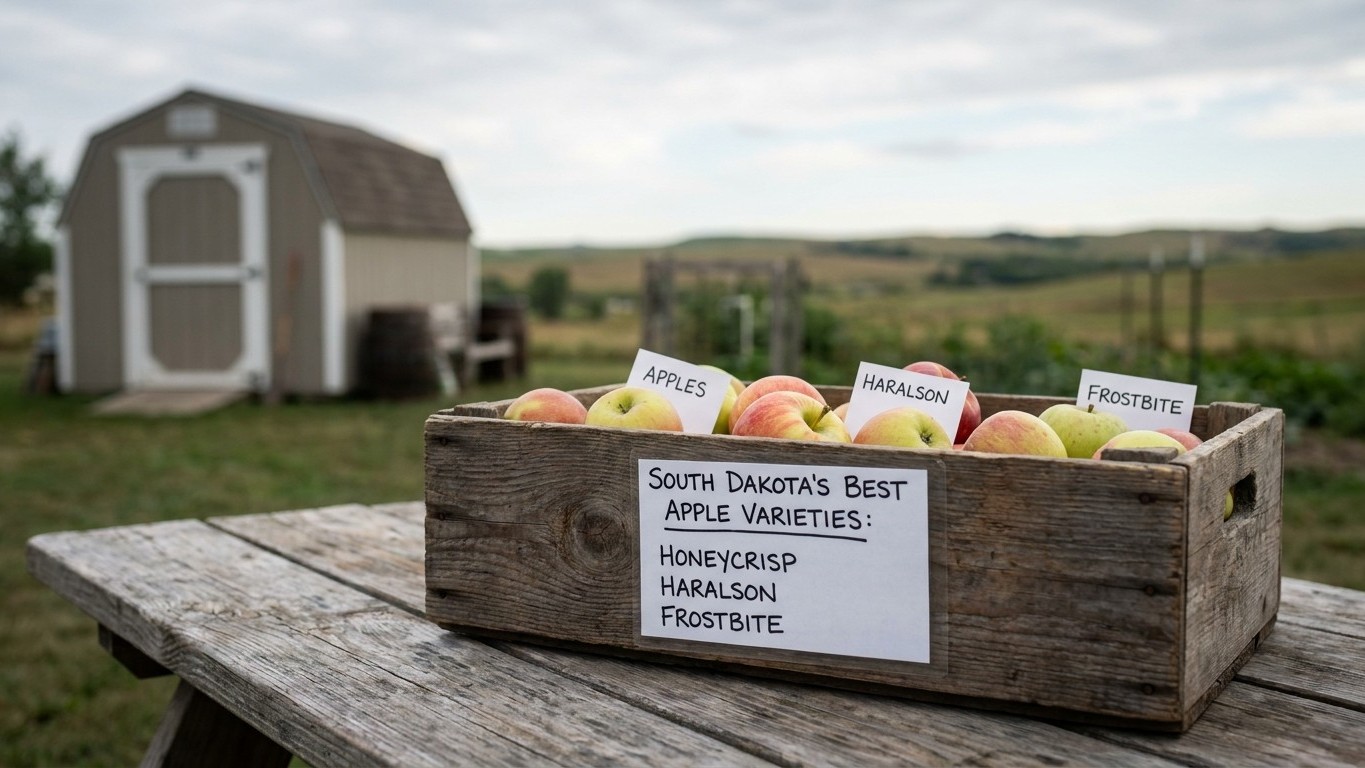

There’s no single “best” apple for South Dakota — the winner in your yard is decided by whether the tree’s wood can shrug off a cold snap and whether its blossoms open into a real spring rather than a late freeze. Everything else, taste, size, keeping quality, comes after that. So before you fall for a name on a tag, check the tree’s cold-hardiness rating and its bloom timing against your own county’s frost dates, not just the nursery’s description.
The short answer for South Dakota
The short answer is that cold hardiness decides which apple tree survives here, and bloom timing decides which one actually fruits. At the Sioux Falls reference station, NOAA’s NCEI 1991-2020 climate normals put the coldest month’s average daily low at 6.9°F, a threshold that rules out apple cultivars bred for zone 5 or milder without any argument about flavor or disease resistance. That same station’s NOAA NCEI 1991-2020 normals put the last spring freeze, in the 30 to 70 percent probability band, between April 29 and May 9, and the first fall freeze between September 24 and October 4. Those two windows set the frost-free season a tree has to work inside of, and they matter more to variety choice than most catalog descriptions let on.
What the answer depends on is where in the state you garden and how your particular site behaves in a hard winter. Sioux Falls sits in the southeastern corner of the state, and NOAA’s figures for that one station are not a guarantee for a yard forty miles away, let alone one near the Missouri River breaks or up toward the Black Hills. A cultivar’s published hardiness rating and its documented bloom date, matched against your own county’s frost record, are the two facts that matter before you plant. Everything else, fruit size, storage life, whether it makes a good pie, is a second-round decision once those two filters are satisfied.
This catalogue does not currently carry a sourced list of apple cultivars trialed specifically for South Dakota conditions. Rather than guess at names, treat the traits described below as the filter, and get the named recommendations from your county extension office, which tracks what has actually survived nearby winters.
Working through it

Ranking realistic choices for this climate starts with hardiness class, not variety name. Apple hardiness is usually described against USDA zone ratings, and a tree’s rated zone tells you whether the wood, not just the fruit buds, survives the coldest night of a typical winter. Given Sioux Falls’ 6.9°F average coldest-month low, as measured by NOAA’s NCEI 1991-2020 normals, only cultivars rated for zone 4 or colder should be considered reliable across most of the state, and even those need a favorable planting site to avoid cambium damage in a severe year.
Hardiness class and what it costs you
| Hardiness class | How it fares against Sioux Falls’ cold | Bloom timing risk | Trade-off |
|---|---|---|---|
| Very cold hardy (bred for zone 3-4 winters) | Wood survives NOAA’s 6.9°F coldest-month average without dieback in most years | Tends to bloom early, sometimes ahead of the historical last-frost window | Narrower selection, and some lines run to smaller fruit |
| Moderately hardy (zone 4-5) | Survives an average winter at this reference station but risks cambium injury in a severe one | Blooms nearer the middle of the frost window | Wider choice of fruit type, but a hard winter can cost the crop or the tree |
| Marginal (zone 5 and warmer) | Regularly damaged or killed outright at these winter minimums | Often moot, since the tree may not survive to bloom | Not a realistic planting outside a sheltered, south-facing microclimate |
Winter chill, the number of cold hours a tree needs to break dormancy properly in spring, is rarely the limiting factor in a climate this cold. A winter that regularly drops to a 6.9°F average low in its coldest month, per NOAA’s normals, accumulates far more chill than almost any apple cultivar needs to flower on schedule. The filter that actually eliminates candidates here is hardiness, not chill, which is the opposite of the calculation a grower in a mild-winter state has to make.
Bloom timing against the frost calendar is the second cost to weigh. A tree that blooms early, before the historical last-frost window of April 29 to May 9 at Sioux Falls closes, risks losing its flowers to a late freeze in years when spring comes in fits and starts. A tree that blooms later within that window trades some frost risk for a shorter run at the growing season before the first fall freeze arrives, which NOAA’s same normals put between September 24 and October 4 at that station. Every hardy cultivar sits somewhere on that trade-off, and no catalog page makes the decision for you.
If you have not yet settled your site, rootstock, and planting steps, Growing Apples in South Dakota covers that groundwork before you get to variety choice. Once a tree is in the ground, the pruning, bloom-watch, and frost-protection tasks that follow are keyed to the tree’s stage rather than the month, and The South Dakota Apple Calendar, Stage by Stage lines those stages up against these same frost windows.
What changes across South Dakota
The Sioux Falls figures above describe one station in the southeast corner of the state, and the rest of South Dakota does not share that station’s numbers. NOAA’s own caution with these normals is that suburban and rural sites typically see a later last spring frost and an earlier first fall frost than an airport station records, sometimes by one to two weeks, and more where elevation rises.
Elevation, rivers, and low ground
The Black Hills, in the far west, sit at a much higher elevation than Sioux Falls, and higher ground cools faster at night and holds frost longer into spring. A site in the Hills should expect a shorter frost-free window than the Sioux Falls figures suggest, even without a specific local number to cite here, and that alone can push a marginally hardy cultivar out of contention there.
The Missouri River corridor running through the middle of the state moderates temperatures somewhat along its immediate banks and bluffs, the way any large body of moving water does, though the size of that effect varies by exact site and no station-level figure for it appears in NOAA’s published normals used for this piece. Low ground away from the river, particularly narrow valleys along tributaries like the James River, can trap cold air on clear, calm nights and produce a frost pocket that runs colder than open, gently sloping ground nearby. A tree planted in a low spot can suffer a hard freeze that a tree fifty feet uphill escapes entirely, which matters as much as the cultivar chosen.
Eastern South Dakota, represented here by the Sioux Falls station, tends to run a touch milder and wetter than the western part of the state, which is more continental, with bigger day-to-night and winter-to-summer temperature swings. That difference does not change the underlying rule, hardiness first, bloom timing second, but it does mean a county in the west should lean toward the more conservative end of the hardiness classes described above, and confirm the assumption locally before planting.
The mistakes this climate punishes
The most expensive mistake is planting a cultivar rated for a milder zone than this climate delivers, on the strength of a nursery tag that lists a zone range without saying how it was tested. That mistake doesn’t show up the first winter, or even the second. It shows up the winter the coldest-month average finally runs well below the 6.9°F figure NOAA’s Sioux Falls normals report as typical, and the tree’s cambium tissue dies even though the bark looks fine into early spring.
Timing and site mistakes
Feeding a young tree nitrogen late in the season is the second common error, because it pushes soft new growth right when the tree should be hardening off for winter. That soft growth is the first tissue killed when the first fall freeze arrives, and at the Sioux Falls station that freeze lands between September 24 and October 4 under NOAA’s normals, earlier in many rural sites. A late-summer feeding schedule that made sense for a longer-season crop can cost an apple tree real wood.
A few other errors show up on a predictable schedule:
- Planting in a low spot or a valley bottom, where cold air pools and the effective frost date runs earlier than open ground nearby
- Skipping trunk protection going into the first two or three winters, which leaves young bark exposed to sunscald and splitting on cold, sunny days
- Pruning in late fall instead of while the tree is fully dormant, which opens fresh wounds right before the coldest stretch of the year
- Assuming a mild winter means a marginal cultivar is now safe, when one hard winter later erases several easy ones
The bloom-timing mistake is the one that costs a crop rather than a tree. A cultivar that blooms right at the front edge of the historical last-frost window, April 29 to May 9 at the Sioux Falls station per NOAA’s normals, loses its flowers outright in any year the freeze lands late in that window. The tree survives; the harvest doesn’t, and that distinction is easy to miss until it happens to you.
Checking this against your county
Everything above is built on one weather station and a set of general hardiness and bloom-timing rules, not a county-by-county survey. Before you commit to a cultivar or a planting site, check with SDSU Extension, the state’s land-grant extension service, for guidance specific to your county’s soil, elevation, and frost record. You can reach their office and published fact sheets at SDSU Extension.
Bring your county name, your rough elevation, and whether your site sits low or open when you call, since those three details change the answer more than any single cultivar name would.
Common questions
Do I need more than one apple tree for pollination?
Most apple cultivars are not reliably self-fertile, so you generally need a second apple tree, or a flowering crabapple nearby, blooming at the same time to get a good fruit set. Check the pollination note for the specific cultivar you’re considering before you plant just one and expect a full crop.
Can I grow apples in a container if my yard doesn’t have a good site?
Not easily in this climate. Apple roots are far less cold-hardy than the top of the tree, and a container sitting above ground exposes those roots to the full force of winter instead of the insulation soil provides, so a containerized tree usually has to be sunk into the ground or moved into an unheated structure for the coldest months.
Are crabapples hardier than regular apples, and can I eat the fruit?
Ornamental and edible crabapples are generally among the hardiest trees in the apple family, which is part of why they’re often planted as pollinator partners for less reliable bloomers. Most crabapple fruit is small and tart, and the trees are usually grown for bloom and pollination rather than for eating fresh.
If last winter was mild, does that mean a less hardy variety is safe now?
No. Choose a cultivar’s hardiness rating for the coldest winter your reference station’s record shows is possible, not for the mild one you just had, because a single severe winter years later can still kill wood that several easy winters let slide.