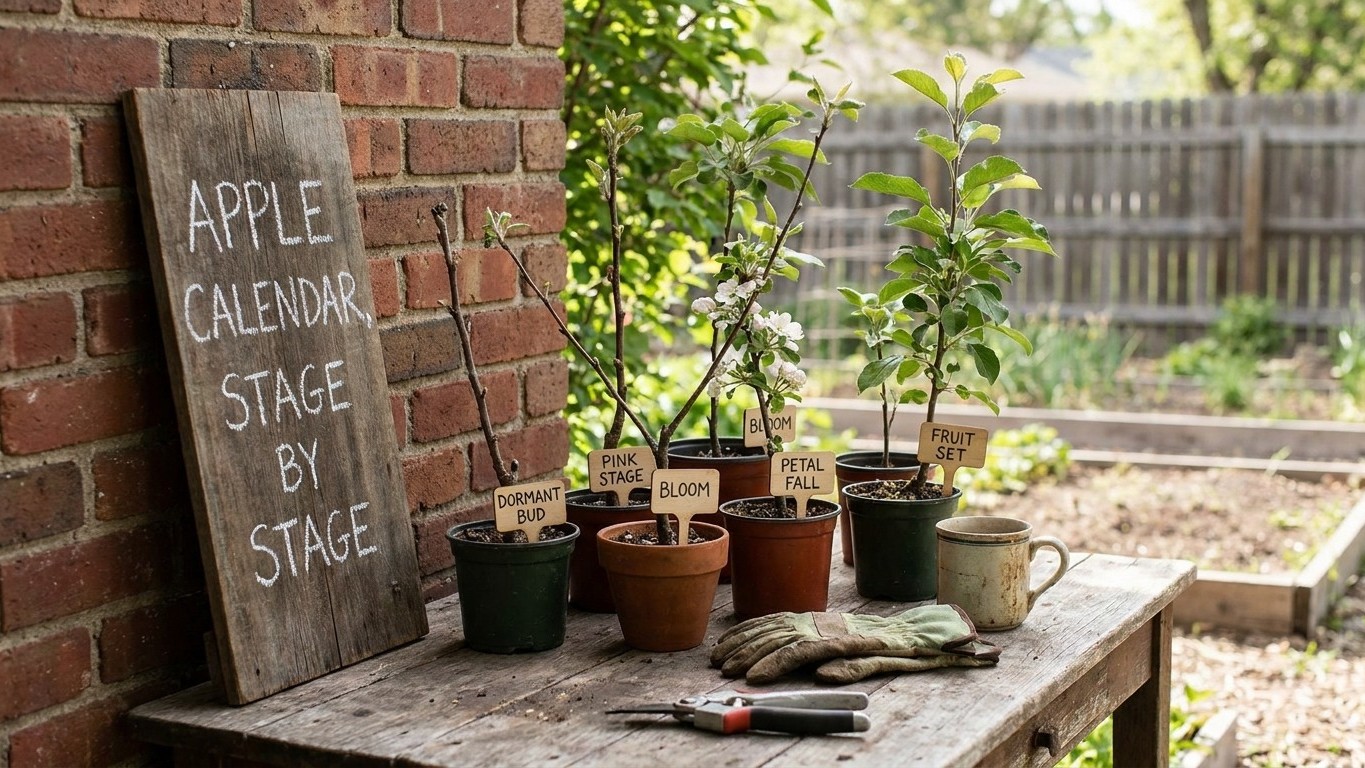

South Dakota’s apple calendar runs on the tree’s stage, not the date on the wall. Near Sioux Falls, green tip and pink arrive while a hard freeze is still a real possibility, since NOAA’s 1991-2020 climate normals put the last spring frost there between April 29 and May 9. Harvest for early and midseason apples needs to clear the tree before the first fall frost window of September 24 to October 4, from the same NOAA station. Check what stage your own tree is at before deciding whether to cover blossoms or start picking.
The short answer for South Dakota
Sioux Falls’ frost dates are the ones printed on every South Dakota apple calendar, and that’s exactly the problem. NOAA itself flags rural and low-lying sites as running one to two weeks behind that station, and a north slope or frost pocket will quietly ignore the printed date altogether. Add a cultivar that blooms early or late, and a spring that’s running warm or cold against the 30-year normal, and the calendar date stops meaning much. What matters is pink bud — the stage that starts the clock, whatever day it falls on.
That short answer depends on three things. It depends on which cultivar is in the ground, since bloom timing varies by a week or more between an early-flowering apple and a later one. It depends on how your own site holds cold air, since a low spot or a north-facing slope will run behind the Sioux Falls dates by a stretch that NOAA itself flags as commonly one to two weeks for rural and suburban sites away from the airport station. And it depends on how the current spring is actually running against the 30-year normal, which is an average, not a promise.
If you haven’t planted yet, the site selection and rootstock choices that this calendar assumes are already made are covered in Growing Apples in South Dakota.
Working through it

The stages below are anchored to Sioux Falls’ own frost data from NOAA, because a calendar date tells you less than the bud itself does. A cold spring pushes every stage later. A warm one pulls them earlier. The stage is what decides the risk, not the month printed on a feed store calendar.
Dormancy

The tree sits leafless from late fall through late winter. This is the window for structural pruning, since cuts made now heal before the growth surge and there’s no foliage in the way to hide bad angles. Sioux Falls’ coldest month averages a minimum of 6.9°F, according to NOAA’s 1991-2020 climate normals. That figure is what actually rules a cultivar in or out before bloom ever becomes a question. A tree that can’t shrug off that kind of cold every winter has no business in an eastern South Dakota orchard, regardless of how it flowers.
Green tip

Small green points push out of the bud scales. This stage typically opens well before the April 29 to May 9 last-frost window closes at Sioux Falls, which means the young tissue is still exposed to a hard freeze most years. Green tip tolerates cold better than any stage that follows it, but a severe late cold snap here can still set the tree back.
Pink

Buds swell and show color without opening. This is the most frost-sensitive stage before bloom itself, and it usually falls squarely inside the Sioux Falls frost window. A freeze at pink can abort a meaningful share of the year’s flower buds even though the tree itself comes through fine.
Bloom

White petals open fully and pollinators start working the flowers. A freeze during bloom is the single event that costs a South Dakota grower the most fruit, because it can wipe out the crop for the year while leaving the tree looking completely healthy afterward. Since bloom for many cultivars lands right at the tail end of the Sioux Falls last-frost window, watching the extended forecast in early May matters more than watching the calendar.
Petal fall

Petals brown and drop, and the tiny green fruitlet becomes visible at the base of each flower. Frost risk has usually dropped sharply by this stage in a normal year at Sioux Falls, but a late outlier freeze can still nip fruitlets that survived bloom itself.
Fruit set

Fruitlets swell and the tree naturally sheds a portion of them in what’s usually called June drop. By this point the Sioux Falls frost window has almost always closed, and the grower’s job shifts from frost-watching to thinning and pest scouting.
Harvest
Ripening runs from late summer into early fall depending on the cultivar, and it has to finish before the first-fall-frost window of September 24 to October 4 at Sioux Falls, per NOAA’s normals. Early apples clear this easily. Later, storage-type apples cut it closer, which is exactly why cultivar choice matters as much as the calendar. The Best Apple Varieties for South Dakota breaks down which cultivars ripen early enough to be a safe bet and which ones are pushing the season.
| Stage | Timing relative to Sioux Falls frost windows (NOAA) | Frost risk |
|---|---|---|
| Dormancy | Well before last frost (Apr 29-May 9) | None, tree is hardened off |
| Green tip | Usually before last frost | Moderate |
| Pink | Often within the last-frost window | High |
| Bloom | Often at the tail of the last-frost window | Highest, whole crop at stake |
| Petal fall / fruit set | After last frost in most years | Low, occasional outlier |
| Harvest | Before first frost (Sep 24-Oct 4) | None for early cultivars, tighter for late ones |
What changes across South Dakota
Elevation and geography shift both ends of the window
The Sioux Falls dates above come from a single airport station in the state’s southeast corner, and NOAA’s own normals note that rural and suburban gardens away from that station typically see the last spring frost later and the first fall frost earlier, often by one to two weeks, with the gap widening at elevation. That matters most in the Black Hills in the west, where higher ground routinely runs behind the eastern plains through spring and turns cold again sooner in fall.
Low-lying ground along river valleys, such as stretches of the James River valley and the Missouri River valley, tends to collect cold air on clear, still nights. That kind of frost pocket can see a hard freeze at pink or bloom stage even on a night when a garden a few miles away on higher ground stays clear. If your orchard sits in a low spot, treat the Sioux Falls frost window as the earliest possible date the risk clears, not the latest.
Open, wind-exposed ground on the eastern plains generally sees less frost pocketing than a sheltered valley, but it trades that for more wind stress on young trees and faster drying after bloom. None of this changes the underlying stages a tree moves through. It only shifts when each stage lands on the calendar, and by how much depends on your specific ground, not on which side of the state you’re on in general terms.
The mistakes this climate punishes
An early-blooming cultivar planted without accounting for a late Sioux Falls frost is the single most common way a South Dakota grower loses a crop. Old, early-flowering apples such as ‘Yellow Transparent’ and ‘Duchess of Oldenburg’ tend to bloom ahead of many modern cultivars, which puts their flowers at risk in exactly the window when NOAA’s normals still show a real chance of a 32°F freeze. This shows up as a tree that looks perfectly healthy all summer and simply carries little to no fruit.
Planting a cultivar that isn’t reliably hardy for the region is the second mistake, and it shows up differently: cambium and graft-union damage after a severe winter, sometimes not visible until the following spring when one side of the tree fails to leaf out. Sioux Falls’ coldest month averages a minimum of 6.9°F per NOAA’s 1991-2020 normals, and that’s an average, not the coldest night any given winter will produce. A cultivar bred for a milder climate can survive several winters here and then get taken out in the one winter that runs colder than normal.
Feeding and pruning timed wrong
Fertilizing late in summer pushes soft, sappy new growth right when the tree should be hardening off for winter. That soft growth is the first tissue damaged when the first fall frost arrives, and at Sioux Falls that frost typically lands between September 24 and October 4 per NOAA. Stop nitrogen feeding well ahead of that window rather than reacting to it after the fact. Pruning late in fall carries a similar risk, since fresh cuts don’t have time to callus before cold sets in, so structural pruning belongs in dormancy, not in the weeks before the first frost.
- Early-blooming cultivar + late Sioux Falls frost = lost bloom, healthy tree, no fruit
- Marginally hardy cultivar + an unusually cold winter = cambium or graft damage the following spring
- Late-season nitrogen + first fall frost = winter injury to soft new growth
- Late fall pruning + first frost = unhealed cuts entering winter
Checking this against your county
Before you commit to a spray schedule, a frost-cover date, or a picking date based on anything here, check it against your own county’s conditions with SDSU Extension, which tracks local growing conditions and pest and disease pressure specific to South Dakota orchards.
SDSU Extension is also the right first call if you’re trying to identify a disease or pest showing up at a particular stage, since timing of a spray matters as much as the product itself, and that timing is best confirmed locally rather than assumed from a statewide calendar.
Common questions
How do I tell if my tree survived winter or is just still dormant?
Scratch a small patch of bark on a young twig with your thumbnail. Green tissue underneath means the wood is alive. Brown, dry tissue on multiple branches, especially near the graft union, suggests winter injury rather than late dormancy.
Do I need two apple trees to get fruit in South Dakota?
Most apple cultivars need a different cultivar blooming nearby for pollination, since very few are reliably self-fruitful. Check the specific cultivar’s pollination needs before assuming one tree alone will set a crop.
What happens if frost hits my tree during bloom?
Damaged flowers usually turn brown or black at the center within a day or two and will not set fruit, even though the tree itself typically survives undamaged. A partial bloom that opens over several days can still set some fruit if only the earliest flowers were open when the freeze hit.
Do I need to spray at every stage every year?
No, spray timing should follow actual pest and disease pressure in your area rather than a fixed stage-by-stage routine. SDSU Extension is the right source to confirm what’s active locally before you spray at green tip, pink, or petal fall.