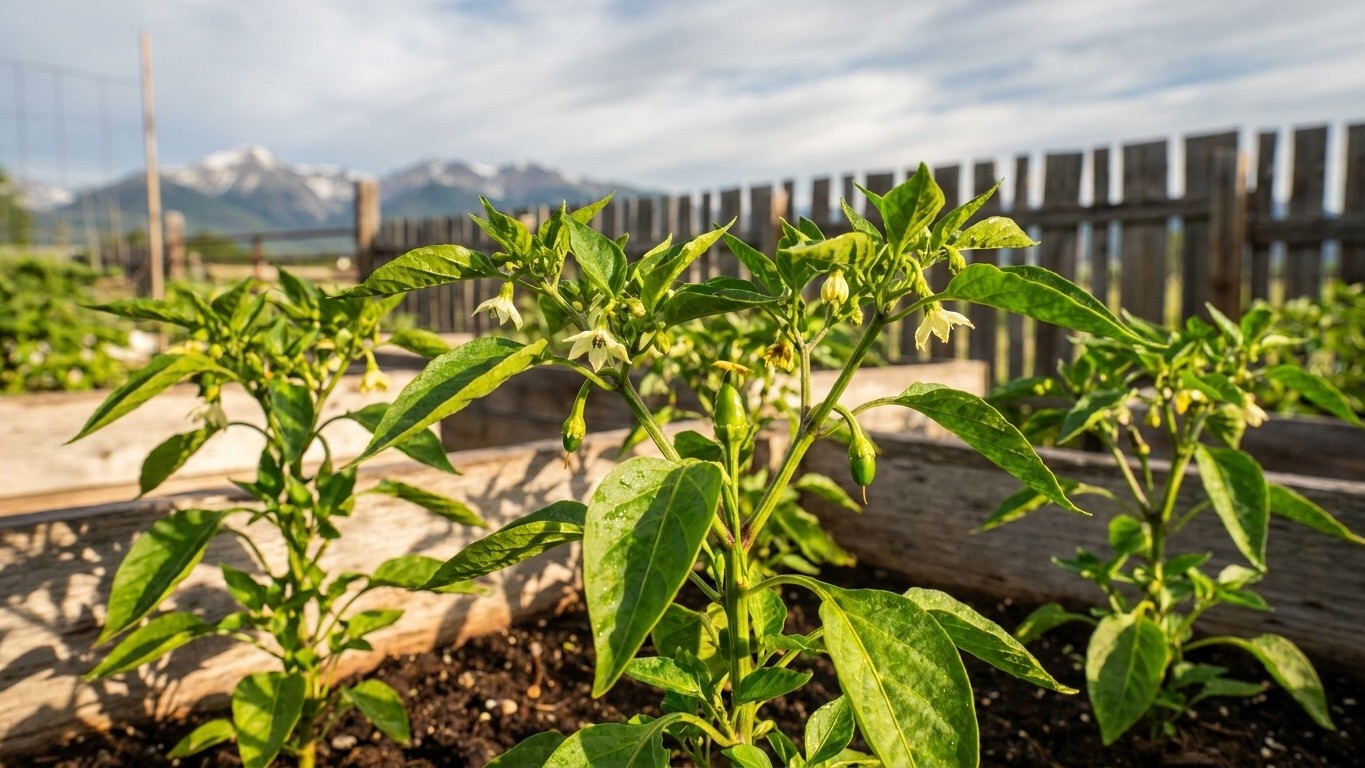

In Ohio, peppers are ready to pick once the fruit stops growing, the skin turns glossy and taut, and it holds firm under light pressure, whether it’s still green or has turned its mature color. That window usually opens in mid-summer and keeps producing into fall, right up until frost. Once picked, skip the refrigerator: peppers want a warmer, damper spot than a home fridge offers, and the cold shelf that keeps lettuce crisp will pit and soften a pepper within days.
When peppers are ready in Ohio
Forget the calendar for a second and look at the fruit itself. A pepper is ready when it has reached its full size for that variety, the skin is glossy and tight rather than dull or wrinkled, and it snaps or cuts away from the stem without much resistance. That’s the signal, and it applies whether you’re harvesting a bell pepper still green or letting it ride toward red, orange, or yellow. Color change is a bonus stage, not a requirement.
The rough window in Ohio is built backward from two dates. Ohio State University Extension puts the last spring frost for zone 6a between May 5 and May 15. Pepper transplants need to go in after that frost has passed and, per Utah State University Extension, once the soil itself has warmed to 60°F, since peppers started indoors need 8 to 10 weeks of growth before they’re ready for the garden. From there, Clemson Cooperative Extension notes peppers are typically ready for harvest 70 to 85 days after transplanting, which for most Ohio gardens lands the first real harvest somewhere in late July through August, with picking continuing steadily until frost cuts the season short.
Summer heat complicates that window from the inside. Utah State University Extension is blunt that pepper fruit set fails at both ends: nights below 55°F and days above 90°F. Columbus averages 15.3 days a year at or above 90°F, based on NOAA NCEI Climate Normals for 1991 to 2020, and that’s enough heat load to stall flowering during the hottest stretch of July and early August even while the plant looks healthy and loaded with blossoms. This site doesn’t track summer night minima, so for the cool end of that range, watch your own thermometer at night rather than guessing from the calendar or from how cold winter got.
Extension guidance names several pepper varieties suited to home gardens but attaches no days-to-maturity figure, no heat tolerance rating, and no size to any of them. Treat a seed catalog, not that source, as the word on how a specific variety behaves in your yard.
Keeping them, and for how long
Once peppers are off the plant, storage conditions decide how much of that harvest you actually get to eat. Clemson Cooperative Extension’s Home & Garden Information Center states it plainly: peppers hold best at 45 to 50°F and 80 to 90 percent relative humidity, and under those conditions they’ll keep for two to three weeks.
Read that as a ceiling, not a guarantee. Two to three weeks is what Clemson calls the outcome under optimal conditions, meaning the temperature holds steady in that band, the humidity stays high enough that the fruit doesn’t shrivel, and the peppers went into storage without bruises, cracks, or soft spots to start with. Drop any one of those variables and the timeline shrinks fast. A pepper stored at 60°F in a dry mudroom will soften and lose crispness well inside a week. One with a nick in the skin will start to rot from that point regardless of temperature.
This is also where the fridge problem becomes concrete. A standard home refrigerator is set to hold food at or below 40°F, which is exactly what’s recommended for most produce and dairy, but it’s well under the 45 to 50°F range peppers actually need. Below roughly 45°F, peppers suffer chilling injury: the flesh pits, softens, and develops water-soaked patches that show up within a few days, long before any mold appears. It’s not spoilage in the usual sense; it’s cold damage, and it’s close to irreversible once it starts. A pepper pulled straight from the crisper drawer after a week often looks fine on the outside and feels spongy the moment you press it.
So the fridge isn’t wrong for every vegetable in the drawer, it’s specifically wrong for peppers. The temperature that’s ideal for carrots and lettuce is a few degrees past the line where pepper flesh starts to break down.
Where in the house that actually is
Few Ohio homes have a room that sits naturally at 45 to 50°F with high humidity, but some spaces come closer than others. An unheated basement corner, away from the furnace and any heat ducts, tends to run cooler and more humid than the rest of the house, especially against an exterior wall built into the ground. A root cellar, if the house still has one, was built for exactly this range. A working entry, mudroom, or unheated back porch can work too, but only in the shoulder seasons; once fall temperatures start swinging widely, that spot can drop well below the target overnight.
A finished, heated room is too warm for anything close to two to three weeks of storage. Living spaces in an Ohio home typically sit in the high 60s to low 70s year-round, which will soften peppers on roughly the same schedule as a warm countertop: days, not weeks. A garage is the opposite problem. It tracks outdoor temperature closely, so a September garage might sit near 50°F overnight and climb into the 70s by afternoon, while a November garage can dip toward freezing, both of which are outside the safe window.
The only reliable way to know which spot in your house actually qualifies is to check it with a thermometer over a full 24-hour cycle, not to trust what the room feels like or how it performed for something else. A basement that stays cool in July can still swing 15 degrees between day and night once the furnace kicks on in October. Skip that check and you’re storing produce on a guess.
What goes wrong here
Ohio’s climate sets up a few specific failure points for stored peppers, and they’re worth naming rather than lumping into general advice. The first is an unheated cellar or garage that drops below freezing once autumn turns cold, which happens well before most people expect it. Peppers held at 45 to 50°F are fine; peppers held in a space that dips to 30°F overnight will freeze, and a frozen pepper turns to mush the moment it thaws. Checking the storage spot’s actual overnight low during a cold snap, not just its daytime reading, prevents that loss.
The second failure is dampness without airflow. A humid Ohio fall is good for the 80 to 90 percent humidity Clemson recommends, but a sealed container or a crowded bin traps that moisture against the fruit’s skin and encourages mold rather than simply keeping peppers from shriveling. Peppers stored loose, with some air movement around them, hold up better than peppers stacked tight in a closed drawer.
The third is timing rather than temperature: Ohio’s growing season compresses the harvest. Because fruit set stalls in the hottest stretch of summer and then frost ends the season abruptly, a lot of peppers ripen in a short window right before that first fall frost, producing more fruit at once than a household can realistically eat inside a two-to-three-week storage limit. Picking peppers a little early and often, rather than letting a full glut ripen on the vine at once, spreads that harvest out and avoids losing the excess to storage limits nobody can outrun.
Common questions
Will peppers picked green turn red on the counter?
Peppers don’t ripen further in any meaningful way once separated from the plant, unlike tomatoes. A pepper picked green will stay green; if you want red, orange, or yellow fruit, it needs to color while still attached to the plant.
Is it better to pick peppers green or wait for color?
Neither is objectively better; it’s a tradeoff. Green peppers are ready sooner and let the plant put energy into more fruit, while fully colored peppers are sweeter but take longer on the plant and are more exposed to late-season frost risk.
What ruins pepper texture the fastest?
Cold below roughly 45°F causes chilling injury, which shows up as pitting and softness within days. That’s a different failure than mold or rot, and it’s the one a home refrigerator is most likely to cause.
How long do peppers last on a kitchen counter compared to a cool storage spot?
Peppers stored at typical room temperature, in the high 60s to 70s common in an Ohio living space, soften noticeably within a few days. The 45 to 50°F range Clemson recommends can stretch that to two to three weeks, but only under otherwise optimal, steady conditions.