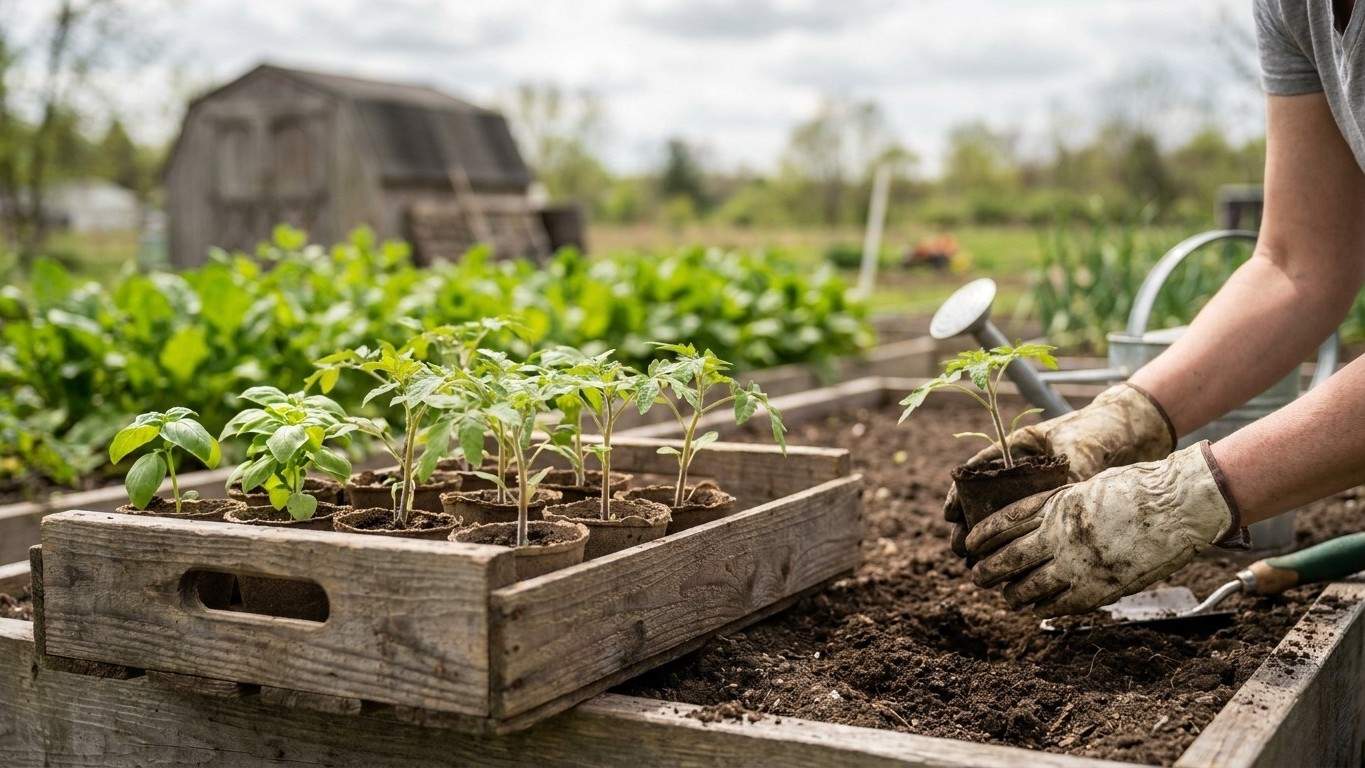

Ohio’s last frost date doesn’t fall before May, it falls inside it — anywhere from May 5 to May 15 depending on where you garden, which means the first two weeks of this month are still a gamble for anything tender. That’s why your onion sets, peas, and cabbage transplants can go in now regardless, while tomatoes and peppers sit on the porch a while longer. May isn’t one planting day, it’s a shifting line, and where you stand on it changes what’s safe to put in the ground this week.
What goes in the ground in May

Ohio’s frost window doesn’t finish before May starts, it sits inside the month. OSU Extension’s Ohio Gardening Calendar puts the average last spring frost for the Columbus area at May 5 to May 15, in USDA zone 6a, so what you can safely set outside changes from one week of May to the next. Treat the OSU frost window as the hard line for tender crops, not the calendar page. A run of warm afternoons in early May does not mean the frost risk has passed.
Cold-hardy crops don’t wait on that line. They tolerate a light frost and can go into workable soil any time in May:
- Onion sets and seed potatoes
- Peas, direct-sown
- Spinach and lettuce, direct-sown or transplanted
- Carrots and beets, direct-sown
- Cabbage, broccoli and other brassica transplants
If you already got the earliest of these into the ground following What to Plant in Ohio in April, May is mostly about succession sowing the same crops every week or two so the harvest doesn’t all land at once.
Warm-season crops are the ones that have to wait. Tomatoes, peppers, eggplant, basil, squash, cucumbers, beans and sweet corn should not go into the ground until the OSU frost window has closed and the soil itself has warmed, not just the air. Cold, wet soil rots bean and squash seed outright and stunts tomato and pepper transplants even when they survive. Mid to late May, once Columbus’s frost window has passed, is when transplants of these crops go in. Other parts of the state move later, so check the Ohio planting calendar for how far your county sits from the Columbus figure.
Counting tomato varieties against the frost window
Catalog days-to-maturity are counted from transplant, and they shift by a week or two either way depending on the season, so use them as a planning range rather than an exact date. Set transplants out mid May to late May, after the OSU frost window closes, and count forward from there against Columbus’s average first fall frost of October 5 to 15, from the same OSU Extension calendar.
| Variety | Type | Days to maturity | First ripe | Margin before fall frost |
|---|---|---|---|---|
| Sakura | Indeterminate cherry | 55 | Late July | 74 days |
| Sun Gold | Indeterminate cherry | 57 | Late July | 72 days |
| Supersweet 100 | Indeterminate cherry | 60 | Late July | 69 days |
| Juliet | Indeterminate grape | 60 | Late July | 69 days |
| Jasper | Indeterminate cherry | 60 | Late July | 69 days |
| Amalfi | Determinate paste | 68 | Early August | 61 days |
| Cherokee Purple | Indeterminate slicer | 72 | Early August | 57 days |
| Big Beef Plus | Indeterminate slicer | 72 | Early August | 57 days |
| Tiren | Indeterminate paste | 75 | Mid August | 54 days |
| Granadero | Indeterminate paste | 75 | Mid August | 54 days |
| San Marzano II | Indeterminate paste | 78 | Mid August | 51 days |
| Celebrity Plus | Determinate slicer | 78 | Mid August | 51 days |
| Brandywine | Indeterminate heirloom | 78 | Mid August | 51 days |
| Amish Paste | Indeterminate paste | 85 | Late August | 44 days |
What to start under cover
By May, the tomato and pepper seed-starting window most gardeners think of has already closed. Anything you still start indoors in May needs to reach transplant size in three to four weeks, not eight, because it’s going into the ground once the OSU frost window (May 5 to 15 at Columbus) has passed. That narrows the list to fast growers.
Cucumbers, summer squash, winter squash and melons fit that window. They germinate and grow quickly, resent having their roots disturbed, and transplant best at three to four weeks old, so starting them indoors in the first half of May lines up with setting them out once the frost risk has cleared. Basil behaves the same way: sow it under cover early in the month and it’s ready to go out alongside the tomatoes.
The two ways this goes wrong are opposite mistakes. Start too early and cucurbits sit in their pots past the three to four week mark, get rootbound, and stall for a week after transplant instead of taking off. Start too late, particularly with a long-season paste tomato like Amish Paste at 85 days from transplant, and there isn’t enough runway left before OSU Extension’s Columbus-area average first fall frost of October 5 to 15 to ripen a full crop. If seed is only going in now, lean toward the shorter varieties in the table above, or buy transplants instead of starting from seed for the long-season types. Crops that missed their indoor start entirely still have direct-sown options waiting in What to Plant in Ohio in June.
What is ready to pick
May is the first month that feels like harvest instead of just planting. Asparagus, if the bed is past its second or third season, sends up spears steadily through the month. Cut them at ground level while they’re still tight and straight, before the tips start to loosen and fern out, since a spear left too long turns woody fast.
Rhubarb stalks are ready to pull once they’ve reached a usable length and the leaf has fully unfurled. Take a few stalks from each plant rather than stripping it bare, and always leave at least a third of the stems so the crown keeps building strength for the following season.
Everything sown under cover or direct in April is also coming in: baby lettuce and spinach leaves, radishes, and green onions started from sets. Pick lettuce and spinach leaf by leaf while they’re young and mild. Radishes go pithy and hot fast once they size up, so pull them as soon as the shoulders push through the soil rather than waiting for them to get bigger.
Check overwintered storage crops at the same time. Onions, winter squash, and potatoes held from the previous season are due for a look. Any squash gone soft at the stem end, or a potato sprouting heavily, should be used or composted before it spreads rot to the rest of the bin.
The jobs that matter this month

Hardening off and staking
Hardening off is the job that gets skipped and costs the most. Any transplant raised indoors, tomatoes, peppers, cucurbits, needs seven to ten days outside in gradually longer stretches before it goes into open ground. Skip it and a plant that looked fine on the porch can scorch or stall within a day of transplanting.
Stake or cage tomatoes and trellis peas and cucumbers before they need it, not after. Sinking a stake next to a foot-tall tomato is easy. Doing it once the plant has sprawled and rooted where it touches the soil means broken stems and damaged roots.
Mulch, succession sowing, and pests
Mulch goes down once the soil has actually warmed, not before. Laying mulch too early keeps cold, wet soil from warming at all, which is exactly the condition that stalls tender transplants. Once the frost window has passed and the soil has warmed under a few sunny days, two to three inches of straw or shredded leaves around tomatoes, peppers, and squash holds moisture and keeps weeds down through the hottest months ahead.
Succession sowing is the job with the shortest fuse. Lettuce, spinach, radishes, and beans planted all in one week come ready all in one week. Sow a short row every seven to ten days through the month instead, so the kitchen gets a steady trickle rather than a glut followed by nothing.
Start scouting for pests as soon as transplants go in. Flea beetles riddle young eggplant and brassica leaves with small holes almost overnight, and Colorado potato beetle adults emerge from the soil to lay eggs on potato foliage right as the plants are at their most vulnerable. Check the undersides of leaves every few days rather than waiting for visible damage to spread.
What not to do in May
The biggest mistake is planting by the air temperature instead of the frost window. A stretch of warm days in early May feels like summer, but OSU Extension’s calendar still puts the last frost for the Columbus area as late as May 15, and a tender transplant set out on the strength of one warm week can be killed overnight. Wait for the OSU frost window to close, then check the soil, not the thermometer on the porch.
Uncovering too early after a mild spell is the same mistake in reverse. Row covers, cold frames, and cloches protecting early greens and transplants should stay on through the whole frost window, not come off the first time a warm afternoon shows up on the forecast. A single overnight dip after the covers are gone can undo weeks of head start.
Nitrogen timing trips up new tomato growers specifically. A heavy dose of high-nitrogen fertilizer right after transplanting pushes fast, leafy growth at the expense of the root system and flowers a plant needs to set fruit later. Hold off on nitrogen-heavy feeding until plants are established and flowering, and favor a balanced or phosphorus-leaning feed at transplant time instead.
Don’t work wet soil either. Tilling or digging a bed while it’s still saturated from spring rain compacts the structure for the whole season, and May in Ohio still brings enough rain to catch a gardener out. Squeeze a handful of soil before working it. If it forms a tight ball that doesn’t crumble back apart, it’s too wet to dig.
Checking this against your own county
Every figure here is measured at or near Columbus, and USDA’s 2023 hardiness zone map puts the state as a whole across zones 5b to 6b, a wide enough spread that a single statewide date is only a starting point. Lake Erie keeps the northern counties cooler in spring and delays the frost window there, while the Ohio River valley in the south often clears it earlier. Elevation shifts it further still, and a hilltop in Appalachian Ohio can run a full zone colder than a valley a few miles away.
Check OSU Extension for your county’s specific dates. Treat the Columbus figures as a starting point, not an instruction, since your local frost window may run a couple of weeks earlier or later.
Common questions
Can I plant tomatoes outside in Ohio in early May?
Not safely, in most years. OSU Extension’s frost window for the Columbus area runs May 5 to May 15, so early May still sits inside the risk period. Wait until that window has closed and check that the soil itself has warmed before setting tomato transplants out, especially if your county sits north of Columbus or at higher elevation.
What do I do if frost is forecast after I’ve already transplanted?
Cover the plants overnight with sheets, buckets, or row cover, anything that traps a little ground heat and keeps frost off the leaves, and pull the covers the next morning once temperatures rise. A single light frost often only damages exposed leaf tips, but a hard freeze can kill an unprotected transplant outright.
Is it too late to start seeds indoors in May?
For long-season tomatoes and peppers, yes, there isn’t enough time left to raise a full-size transplant before the OSU frost window closes. Fast growers like cucumbers, summer squash, and basil still work, since they only need three to four weeks under cover before they’re ready to go out.
Should I go by the calendar date or the soil temperature when deciding what to plant?
Soil temperature and the OSU frost window matter more than the date on the calendar. A warm stretch of air temperatures in early May doesn’t mean the ground has caught up, and cold, wet soil will rot seed or stunt transplants even on a day that feels like summer.