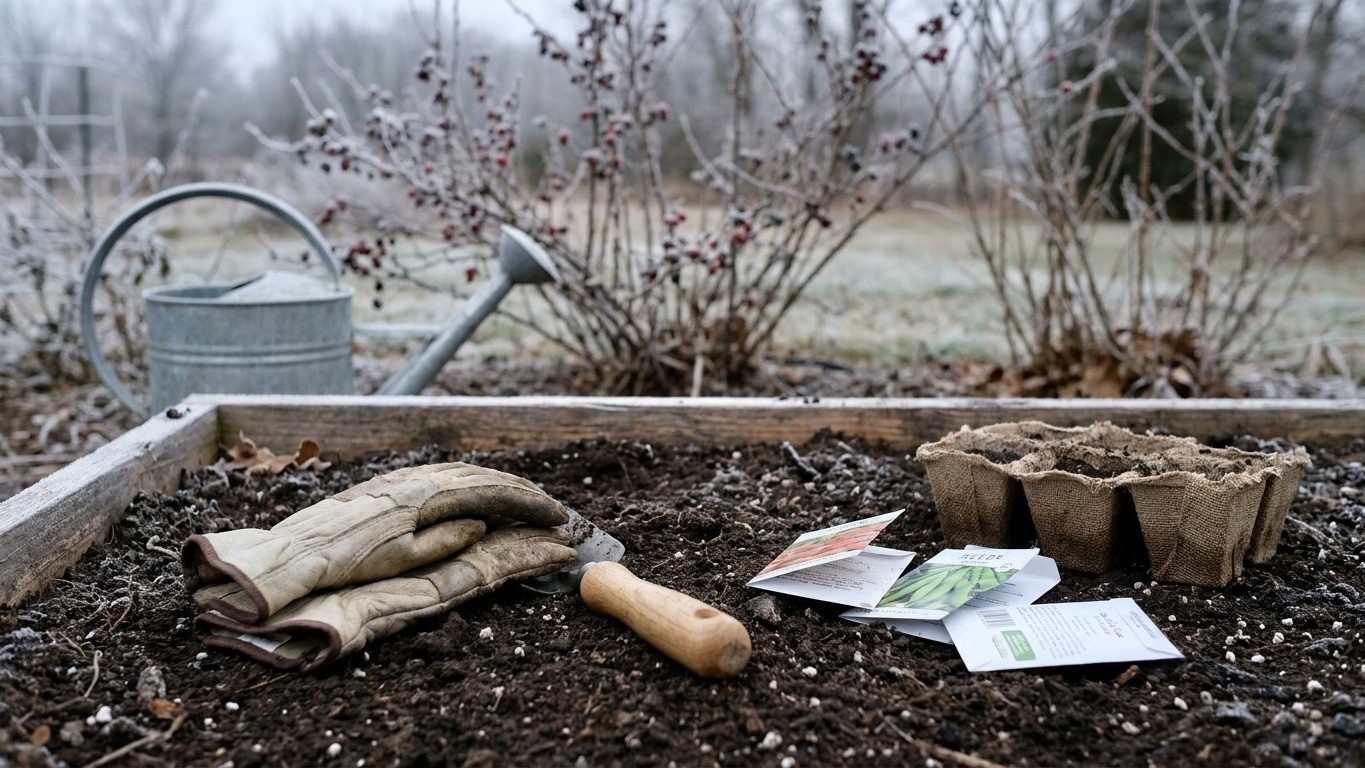

Nothing new goes into your open ground this month — the soil’s still too cold, and it will be for a while yet. The one real job is indoors: start onion and leek seed under lights now, because they need a longer head start than anything else you’ll grow this year. So today, skip the garden bed entirely and set up a seed tray by a window or grow light instead — that’s where February’s work actually happens.
What goes in the ground in February

For most of the state, the honest answer is nothing new goes into open soil this month. OSU Extension’s frost data puts the last spring freeze near Columbus at May 5 to May 15, which is roughly three months out, and soil temperature, not the calendar, is what determines whether a seed rots or germinates. A mild afternoon in February does not mean the ground has warmed.
Dormant and bare-root planting
Dormancy is the exception that makes February planting possible at all. Bare-root fruit trees, cane fruits and roses do not need warm soil the way seeds do. They can go into the ground on any day it is workable, meaning thawed and not sodden, because the plant is asleep and its roots simply need contact with soil, not active growth conditions. If you planted garlic or shallots in fall, they are already dormant underground and need nothing from you but a check that mulch has not blown off the row. A late planting of garlic can still go in if the ground is workable, but expect smaller bulbs than a fall-planted crop gets.
Cold frames and forcing indoors
Cold frames and low tunnels extend what “outdoors” means without breaking the frost rule. Hardy greens sown under cover weeks earlier, spinach and mache among them, can sit through February and start growing again as light returns, protected from the worst of the cold rather than exposed to it. Forcing is the other trick worth knowing this month. Rhubarb crowns covered with a bucket or forcing pot send up pale, tender stalks weeks ahead of the uncovered plant. Chicory roots dug and potted up in a dark, warm spot force into witloof heads in a few weeks, which is about the only fresh vegetable a February garden in Ohio can actually produce from scratch.
What to start under cover
Onions and leeks are the two crops worth starting from seed this month, because they need the longest head start of anything in the garden. Counting back 10 to 12 weeks from OSU Extension’s May 5 to May 15 last-frost window lands seed-starting in mid-to-late February, which is unusually early compared to almost everything else you’ll sow. Celery and celeriac run on a similar clock and can go in alongside them.
Tomatoes are a different story, and this is where the arithmetic actually matters. Every cultivar in the catalogue, whether it’s the 55-day Sakura or the 85-day Amish Paste, gets set out mid-May to late May here, because that date is set by frost risk, not by the variety. Counting back the usual 6 to 8 weeks for seed-starting from that transplant window lands in late March to early April, not February.
| Cultivar | Days to maturity | Set-out window | Seed-start count-back |
|---|---|---|---|
| Sakura | 55 days | mid May to late May | late March to early April |
| Sun Gold | 57 days | mid May to late May | late March to early April |
| Cherokee Purple | 72 days | mid May to late May | late March to early April |
| Amish Paste | 85 days | mid May to late May | late March to early April |
Notice the count-back column doesn’t change with days to maturity. That number affects when the fruit ripens, not when the seed goes into a tray. Start tomato seed in February and you’ll be nursing leggy, rootbound plants on a windowsill for six extra weeks before the ground is anywhere near ready for them. Wait until May to start them from seed instead, and there won’t be enough season left before the first fall frost lands October 5 to October 15 per OSU Extension. Onions and leeks are the exception that earns a February seed tray. Tomatoes are not.
What is ready to pick
Outdoors, there is little to nothing to harvest in most of the state this month. What’s available comes from crops that were already in the ground going into winter or from stores put up in fall.
Checking stored crops
- Winter squash: press near the stem end for soft spots and use any that have started to give.
- Potatoes: sort out ones that have sprouted, gone soft, or show green skin and use them first.
- Onions: squeeze the neck just above the bulb; a soft neck means it needs using now, not later.
- Overwintered kale and leeks: dig or cut whenever the ground is workable, even under snow cover, since both hold their quality in cold soil far better than in a refrigerator.
Cold-frame greens sown the previous fall, spinach, mache and similar hardy leaves, can still be cut a few leaves at a time as long as the frame keeps them above freezing during the day. Indoors, sprouts and microgreens are the most reliable fresh food a February kitchen garden produces, ready in as little as a week to ten days from sowing on a windowsill or under a light, with no soil temperature or frost window to worry about at all.
The jobs that matter this month

In a month when almost nothing gets planted outdoors, the work that happens now is what makes the rest of the season possible.
Pruning and planning
Dormant pruning of fruit trees, grapevines and cane fruits belongs in this window, done before buds swell and sap starts moving. Cuts made now heal faster and cost the plant nothing, because it isn’t actively pushing growth into the wood you’re removing. Seed ordering has its own deadline: popular cultivars sell out earliest, and if you want a specific tomato like Brandywine or a paste type like San Marzano II, ordering now beats finding it gone in April. This is also the month to sketch out crop rotation, moving tomatoes and peppers away from where nightshades grew, before the plan gets lost once spring work starts.
Soil and tools
A soil test sent to OSU Extension’s lab now gives results back in time to amend beds before anything goes in the ground, which a test sent in April usually does not. Turning compost, cleaning and sharpening tools, and repairing raised beds or fencing are all jobs that take twice as long once the garden is actively growing and competing for your time. None of this is filler work. Skipped in February, it becomes a scramble in April and May, right when transplants and direct-sowing are demanding the same hours.
What not to do in February
The biggest mistake this month is trusting air temperature over soil temperature. A run of 50-degree afternoons feels like spring, but the ground several inches down is still cold, and any warm-season seed sown into it will rot before it germinates rather than get a head start. Save direct-sowing of anything tender for the window OSU Extension’s frost data actually supports.
Uncovering cold frames or pulling mulch off perennial beds after one mild stretch is the second classic error. Ohio’s late winter weather swings hard, and a hard freeze after exposure can undo a season’s worth of overwintered greens or damage crowns that had just started to break dormancy. Leave protection in place until the mild stretch has held for more than a day or two.
Fertilizing early is the third trap. Nitrogen applied to dormant fruit trees or perennials before real growth starts pushes soft new tissue that a late frost then kills outright. Hold off on feeding until the plant is actually moving, and don’t work wet soil in the meantime either. Digging or tilling saturated ground compacts the structure you’ll be relying on all season, and it takes far longer to fix than to avoid.
Checking this against your own county
Every figure above comes from data centered near Columbus, and OSU Extension is explicit that a statewide month is a starting point, not an instruction. Elevation, lake effect off Lake Erie, and the general north-south divide across Ohio can shift these windows by two or three weeks in either direction. A garden in the Ohio River valley often runs warmer and earlier than one on the Lake Erie shoreline at the same time. Check your own timing against OSU Extension and against the Ohio planting calendar before committing seed or transplants to a date built for someone else’s county.
Common questions
Can I still plant garlic in February in Ohio?
Yes, if the ground is workable and not frozen or waterlogged, though fall planting is the standard recommendation and gives bigger bulbs. A February-planted clove has less time to establish roots before the plant needs to bulk up top growth.
Is February too late to start onions from seed?
No, mid-to-late February is actually the target window, counting back 10 to 12 weeks from OSU Extension’s May 5 to May 15 last-frost date. Starting later than that risks small bulbs at harvest because onions need a long juvenile period before they’ll size up.
Why are my seedlings already leggy in February?
Usually it means they were started too early for the amount of light available, or the light source is too far from the leaves. Seedlings stretch toward whatever light they can find, and a windowsill in February rarely provides enough of it compared to a grow light kept just a few inches above the plants.
When can I actually direct-sow something outdoors in Ohio?
That depends on the crop and how it survives frost, and it’s worth reading What to Plant in Ohio in March for the earliest hardy options, since none of them belong in the ground quite yet in February. If you’re catching up on what should have already gone in over winter, What to Plant in Ohio in January covers the month just before this one.