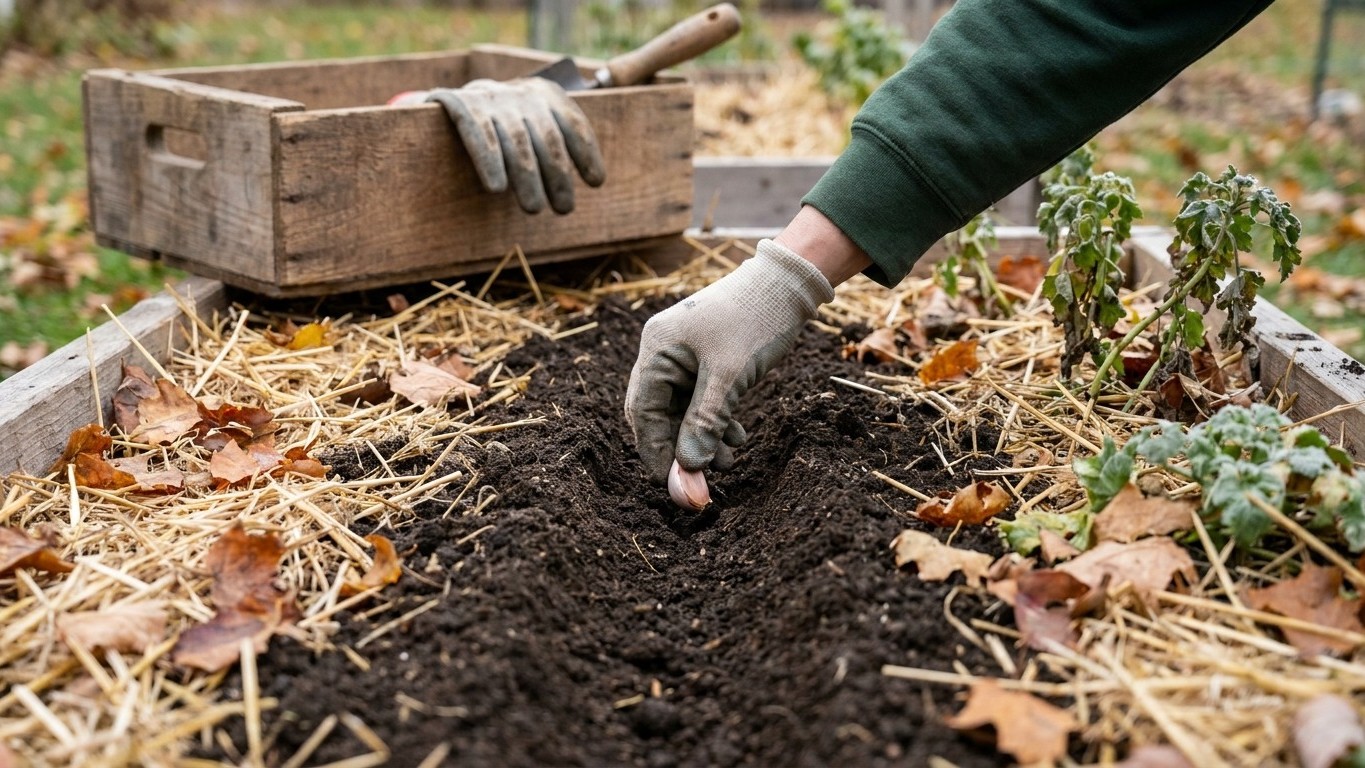

Not much, honestly — garlic and shallots are the one thing still worth planting, and this week is your window before the ground locks up. Almost everything else has already missed its moment; the soil’s too cold for new roots to catch hold. So get cloves and sets in the ground now, root-down, a couple inches deep, then bury the bed under four to six inches of straw or shredded leaves before a hard freeze sets in.
What goes in the ground in November

Almost nothing new goes into open soil this month in most of the state. OSU Extension’s Ohio Gardening Calendar places the average first fall frost near Columbus between October 5 and October 15, and by November that date has already passed across nearly every county. Soil temperature, not the calendar, is what decides whether a planting has any chance, and by November it has usually dropped too far for germination or root establishment of anything tender.
Garlic and shallots are the exception. Both go in as cloves or sets while the soil can still be worked with a trowel, not frozen and not waterlogged from late fall rain. Set cloves root-down about two inches deep, space them by variety, and cover the bed with a four to six inch layer of straw or shredded leaves once temperatures start dropping hard. That mulch layer matters more than the planting itself: it buffers the freeze-thaw cycles that heave cloves out of loose soil before they’ve rooted.
Cold frames, low tunnels, and dormant plantings
A cold frame or low tunnel extends the picture slightly. Hardy greens already established from earlier plantings, spinach, mâche, and claytonia among them, will keep growing slowly under cover even as outdoor beds shut down. This isn’t a month to start new seed under those covers so much as to protect what’s already there.
Bare-root fruit trees, brambles, and roses can still be planted while they’re fully dormant and the ground hasn’t frozen, since they aren’t trying to grow and don’t need warm soil the way a vegetable seedling does. It’s also the month to force chicory roots or rhubarb crowns indoors in a dark, cool space for a harvest of blanched shoots that has nothing to do with the frozen garden outside. For a fuller picture of what led into this point in the season, What to Plant in Ohio in October covers the last window before frost closed most options down.
What to start under cover
Work backward from OSU Extension’s last spring frost window of May 5 to May 15 near Columbus and November falls a long way outside the range where most indoor seed-starting makes sense. Onions and leeks, which typically want ten to twelve weeks indoors before transplanting after that last frost, would need to be started in February at the earliest, not now. Starting them in November means five or six extra months on a windowsill or under lights, and that almost always ends in leggy, rootbound seedlings that never recover once they finally go outside.
What actually makes sense this month
The exceptions are things that don’t run on that spring-transplant clock. Winter sowing, packing perennial and native wildflower seed into vented milk jugs and leaving them outdoors through the cold months, uses the season’s natural freeze-thaw cycle to break seed dormancy rather than counting weeks to a frost date. Forcing bulbs indoors, amaryllis and paperwhite narcissus in particular, gives a bloom in a matter of weeks regardless of what the outdoor frost window is doing. A windowsill pot of chives or parsley started from a root division rather than seed also skips the whole timing problem.
The two failure modes worth naming plainly: starting a spring vegetable too early leaves it outgrowing its pot long before the ground is ready, and starting one too late means it never reaches transplant size before the frost window closes in May. November sits closer to the “too early” end for almost every vegetable crop, which is exactly why so little indoor sowing happens this month.
What is ready to pick
Outdoors, there is little left standing in most Ohio gardens by November, and what remains is almost entirely crops built to take a hit of cold. Kale, collards, and Brussels sprouts left in the ground actually improve after frost, since the cold converts starches to sugars and takes some of the bitterness out of the leaves. Leeks can stay in the ground under a heavy mulch and be dug as needed through much of the winter rather than pulled all at once.
A cold frame with established greens, spinach, mâche, or a hardy lettuce, will keep producing small pickings through the month even as the open garden goes quiet. Indoors, sprouts and microgreens on a windowsill or under a grow light are the one crop that ignores the outdoor frost window entirely and can be started and harvested on a two to three week cycle all winter.
Checking the storage pile
Most of the household’s food from the garden this month comes out of storage rather than off a plant. Go through winter squash, potatoes, and onions on a regular basis and pull anything showing:
- A soft or sunken spot on winter squash, which usually spreads within days
- Sprouting eyes on potatoes stored somewhere too warm or too light
- A soft neck or mold at the top of a stored onion
Use the questionable ones first rather than letting them sit next to sound stock, since rot spreads fast in a crowded storage bin.
The jobs that matter this month

This is the month where garden work shifts from growing to maintenance, and the jobs that get skipped now tend to show up as problems by spring. Dormant pruning of fruit trees and brambles can begin once the leaves have fully dropped and the plant is genuinely dormant, not just slowing down. Cutting live wood too early, while the tree is still moving sap, invites dieback at the cut.
Ordering seed before the good varieties sell out
Seed catalogs sell out of the most reliable disease-resistant cultivars earlier every season, and November is not too early to place an order for spring. Comparing a few tomato options side by side while the beds are quiet helps decide what actually fits a given garden’s disease pressure and season length, keeping in mind that catalogue days-to-maturity figures are counted from transplant and shift by a week or two with the weather.
| Variety | Days from transplant | Habit | Disease resistance |
|---|---|---|---|
| Sun Gold | 57 | Indeterminate | Tobacco Mosaic Virus (High), Fusarium Wilt race 1 (High) |
| Celebrity Plus | 78 | Determinate | Nematodes (Intermediate), Gray Leaf Spot (High), Tomato Mosaic Virus (High) |
| Cherokee Purple | 72 | Indeterminate | None listed |
| Amish Paste | 85 | Indeterminate | None listed |
A variety like Amish Paste, at 85 days from transplant, leaves the narrowest margin against an early fall frost, which is exactly the kind of detail worth weighing while ordering rather than discovering in September.
Soil, tools, and infrastructure
- Test soil pH and fertility now so lime or sulfur amendments have the winter to work into the root zone
- Turn the compost pile once more before it freezes into a solid block
- Clean soil off tools, sharpen blades, and oil metal parts before they sit unused for months
- Repair raised bed corners, fencing, and trellis hardware while there’s no crop in the way
What not to do in November
The most common mistake is planting anything warm-season because a stretch of mild air made the soil feel ready. Air temperature swings fast and soil temperature doesn’t, so a 60-degree afternoon can sit on top of soil that’s still barely above freezing a few inches down. Anything tender put into that ground either rots before it germinates or dies at the next cold night.
A second mistake is pulling covers off a cold frame or low tunnel too early after a warm spell. Hardy greens tolerate steady cold far better than a sudden swing from mild and exposed back to a hard freeze, so it’s worth managing vents rather than removing covers outright, and watching the forecast rather than the thermometer on a single afternoon.
The third is feeding nitrogen at the wrong point in the season. Nitrogen pushes new, tender growth, and on perennials, shrubs, or a lawn, that new growth has no time to harden off before a freeze kills it back. Hold off on nitrogen until the plant is fully dormant or wait for spring, and use this month instead for the soil test and amendment work that pays off without forcing new growth into the cold.
Checking this against your own county
Every figure above comes from OSU Extension’s data near Columbus, and the USDA’s 2023 Plant Hardiness Zone Map puts Ohio across a range from zone 5b to 6b, which means a single statewide month is a starting point and not an instruction. Elevation in the Appalachian foothills, lake effect near Lake Erie, and the general gap between the state’s north and south can shift a frost window by weeks in either direction.
Always check local conditions against OSU Extension and against the Ohio planting calendar before treating any date in this piece as fixed for a specific county. For what comes after this month, What to Plant in Ohio in December picks up where the ground finally locks up for the season.
Common questions
Can I still plant garlic this late in the fall?
Yes, as long as the ground is still workable and hasn’t frozen solid. Get cloves in and mulch heavily right after planting, since the mulch matters as much as the timing for keeping cloves from heaving out over winter.
Is it too late to start onion or leek seeds indoors?
For this cycle, yes. Counting Back From OSU Extension’s last spring frost window of May 5 to May 15 puts the proper indoor start in late winter, not November, and seedlings started this early just get leggy and rootbound long before it’s time to transplant.
Do I need to cover my cold frame every single night?
Not necessarily. Venting on mild days prevents the frame from overheating and keeps moisture from building up and rotting the greens inside. Close it up fully only when a hard freeze is actually forecast.
What if my area already froze weeks before the dates given here?
That’s common in northern counties near Lake Erie or at higher elevation, where frost windows shift earlier or later than the Columbus-based figures used here. Check OSU Extension’s own data for the closest reporting station to a specific county before relying on any statewide range.