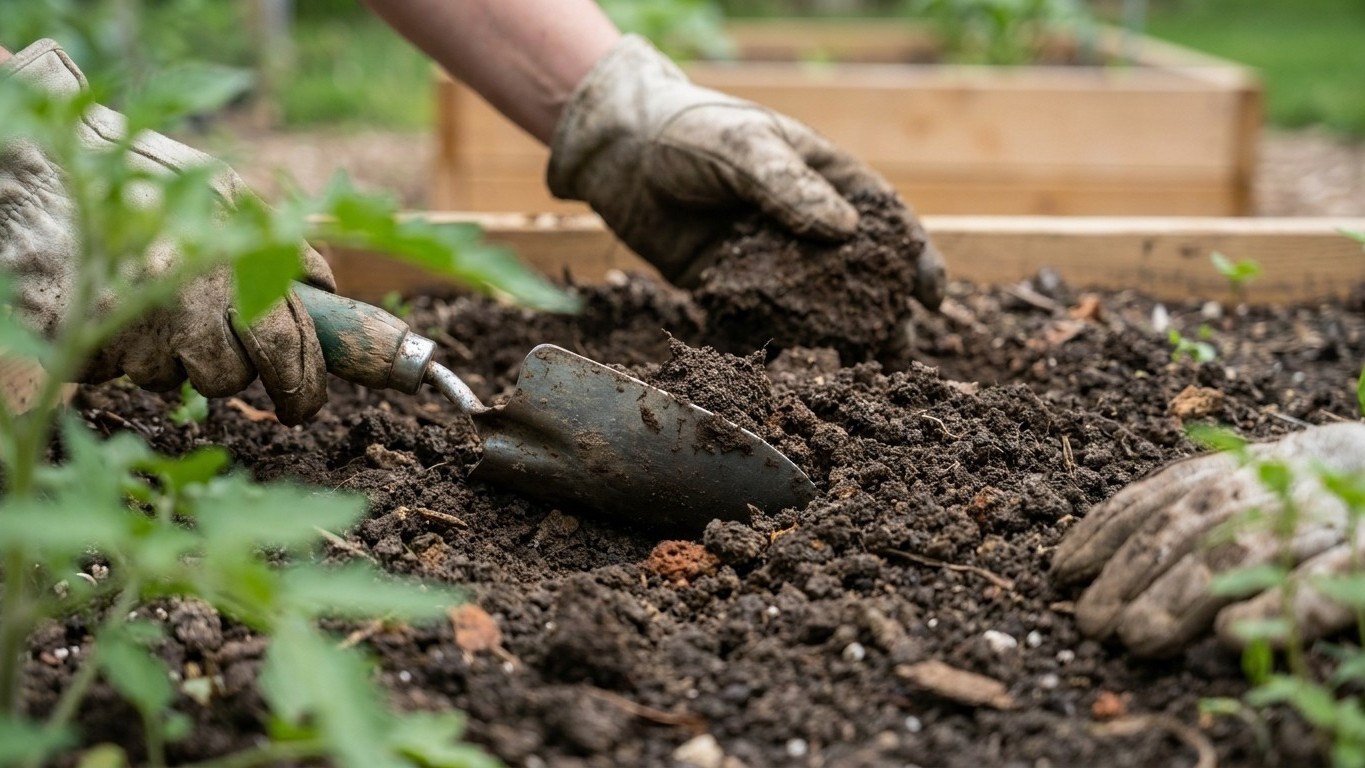

Ohio soil is not one kind of dirt. Walk a few miles in almost any county and you can go from sticky clay to loose sand to something in between, because glaciers, rivers and bedrock left their mark differently across the state. The only way to know what is actually under your own garden is to test it, and OSU Extension runs the lab most Ohio gardeners send samples to. Before you spend money on lime, sulfur or compost, pull a sample and find out what you are actually correcting.
What is under your garden

Much of Ohio was shaped by glaciers that ground rock into fine particles as they moved and melted, which is one reason clay is such a common complaint among gardeners in the glaciated two-thirds of the state. The unglaciated southeastern hills tend toward thinner ground over sandstone and shale instead. None of that tells you what is actually in your own yard, though, since even a single glaciated county can have a pocket of sand along a former streambed or a patch of heavy clay where a pond used to sit.
Clay holds onto water and nutrients longer than any other soil type, which sounds like an advantage until you are trying to dig it after rain, when it behaves closer to modeling clay than garden bed. Sandy soil does the opposite: water and dissolved nutrients drain through it fast, which makes it easier to work but means you are watering and feeding more often. Most garden soil in the state falls somewhere between the two, described as loam, and the exact ratio of sand, silt and clay in your own yard is worth knowing before you plan a bed.
Reading your own soil
You do not need a lab to get a rough answer. The jar test tells you roughly what you are working with in about a day, using nothing but a clear jar, water and a spoonful of dish soap.
- Fill a straight-sided jar about a third full with soil from six inches down, away from mulch and roots.
- Add water to near the top, along with a drop of dish soap, and shake it hard for a minute.
- Set it somewhere it will not be disturbed and let it settle for at least a full day.
- Sand drops first and forms the bottom layer, silt settles next, and clay forms the finest layer on top.
The thickness of each layer, measured against the total, gives you a rough percentage of sand, silt and clay. It will not tell you pH or nutrient levels, but it tells you whether you are working with heavy clay, quick-draining sand or something more forgiving, and that shapes every amendment decision that follows.
Testing before you amend
Adding lime to soil that is already alkaline, or piling nitrogen onto ground that already has plenty, does not just waste the price of the bag. It can push pH further from where your plants want it and cause nutrient lockout, where a plant cannot take up what is already there because something else in the soil is out of balance. A soil test is the only way to know what you are correcting before you correct it, and it costs far less than a season of underperforming vegetables.
Take samples from several spots in the bed, not just one, since even a small yard can have pockets that differ from each other. Dig a small hole about six to eight inches deep at each spot, take a slice from the side of the hole rather than scraping the surface, and mix all the slices together in a clean bucket. Let the mixed soil air dry, then send the amount the testing lab actually requests rather than the whole bucket.
A standard test reports pH, organic matter percentage, and levels of phosphorus, potassium and other major nutrients, and many labs add a recommendation for lime, sulfur or fertilizer based on what you tell them you are growing. pH matters more than most gardeners expect, because it determines how available nutrients are to plant roots regardless of how much you have added. Soil that tests high in phosphorus but sits at the wrong pH will keep showing deficiency symptoms until the pH itself is corrected.
OSU Extension operates the soil testing lab most home gardeners in the state use for exactly this purpose. Retesting after you start amending lets you see whether the changes are actually working, rather than adding more of something and hoping.
Amending it

What your test comes back with determines which of four common problems you are actually dealing with: soil that is too heavy, too sandy, too acidic or alkaline, or compacted from years of foot traffic and machinery. Each has a fix, and the fixes differ enormously in how long they take to show results.
Matching the fix to the problem
| Problem | What helps | Timeframe |
|---|---|---|
| Heavy clay | Coarse compost worked into the top several inches, added every season | Improvement over several seasons, not one |
| Sand that drains too fast | Compost and other organic matter to add water-holding capacity | Often noticeable within a single season |
| pH too low (acidic) | Agricultural lime, applied at the rate your soil test recommends | Months to shift meaningfully, longer in clay |
| pH too high (alkaline) | Elemental sulfur, applied at the rate your soil test recommends | Slow; often a full season or more |
| Compaction | Core aeration, deep-rooted cover crops, keeping traffic off wet soil | Ongoing, rarely fixed in one pass |
Compost is the one amendment that helps almost every problem on that list, because organic matter loosens clay’s structure and gives sand something to hold onto. It will not correct a badly off pH by itself, and it works slowly, which is why a dramatic before-and-after photo is usually not showing what three seasons of adding an inch of compost a year actually looks like.
Lime and sulfur are exact tools, not general ones. Applying either without a test result to work from means guessing at a rate, and overshooting is easy to do and hard to undo within a single season. Follow the rate your soil test lab actually recommends for what you are growing, since the same soil can call for a different lime rate under blueberries than under tomatoes.
Drainage and compaction
Water moves through soil at a rate set largely by pore size, which is why clay and sand behave so differently in the same rainstorm. Clay particles pack tightly with tiny pores, so water has to squeeze through slowly and often pools on the surface or sits a few inches down. Sandy soil has large pores that let water run straight through, which is why a sandy bed can look dry again within a day of heavy rain while a clay bed nearby is still soggy.
The percolation test
You can measure this yourself with a percolation test, which tells you in plain terms whether a spot drains well enough to plant without raising the bed.
- Dig a hole about a foot deep and a foot wide wherever you are considering a new bed.
- Fill it completely with water and let it drain once, to saturate the surrounding soil.
- Fill it a second time and time how long it takes to drain fully.
- A hole that drains within a few hours is workable ground. Standing water after most of a day points to a drainage problem worth solving before you plant.
A slow-draining hole does not necessarily mean you need to regrade the whole yard. It often means that one spot has a compacted layer, a high clay content, or both, and a raised bed filled with purchased soil sidesteps that problem entirely rather than asking you to fix native ground that may take years to improve.
Compaction comes from repeated weight on the same ground, whether that is foot traffic along a path you walk every day, a mower crossing the same line, or equipment driven across a yard before a house was even finished. Compacted soil has fewer pore spaces for water, air and roots, which is why plants in a compacted bed often look stunted even when the nutrient numbers on a soil test look fine.
Double digging, the old practice of turning soil two spade-depths deep, has fallen out of favor because it destroys the soil structure and microbial life it is supposed to fix, and the compaction often returns within a season or two once the loosened soil settles and traffic resumes. Core aeration, added organic matter, and simply keeping traffic off wet soil do more for compacted ground over time than one aggressive dig ever does.
For ground that is both compacted and slow-draining, a raised bed is often the more honest answer than years of amendment, especially if you want to plant this season rather than wait for improvement that may take years to show. Filling it with a purchased blend sidesteps the native clay or compaction underneath entirely, though the roots of larger perennials and shrubs will eventually reach the soil below regardless.
Local help
OSU Extension runs the soil testing lab most Ohio home gardeners use, and its county offices can help interpret a report if the recommendations do not make sense on their own. Start with a test before you start with a bag of anything, since every fix described above depends on knowing where your soil actually stands. Find your county office and current sampling instructions at OSU Extension. If you garden in more than one Ohio county, our broader Ohio guides cover the other conditions, from frost timing to hardiness, that shape what you can grow on whatever soil you end up with.
Common questions
How do I know if I have clay or sandy soil without a test?
The jar test described above gives a rough answer in about a day. A simple hand test helps too: wet clay soil forms a ribbon when squeezed between your fingers, while sandy soil falls apart and won’t hold a shape at all.
Can I just buy topsoil instead of fixing what I have?
You can, and it’s often the fastest fix for a single new bed, but bagged or bulk topsoil varies a lot in quality and sometimes brings weed seed with it. For an existing lawn or a large area, improving what’s already there with organic matter usually costs less than replacing it.
Is compost enough to fix bad soil on its own?
It helps almost everything but won’t correct a pH that’s badly off in either direction, and it works slowly. Pair it with a lime or sulfur application based on an actual test result if pH is the main issue.
How often should I retest my soil?
There’s no single number that fits every garden, since it depends on how much you’re amending and how the soil responds. A reasonable habit is to retest whenever you’re making a major change, like converting a stretch of lawn to a garden bed, rather than sticking to a fixed yearly schedule.