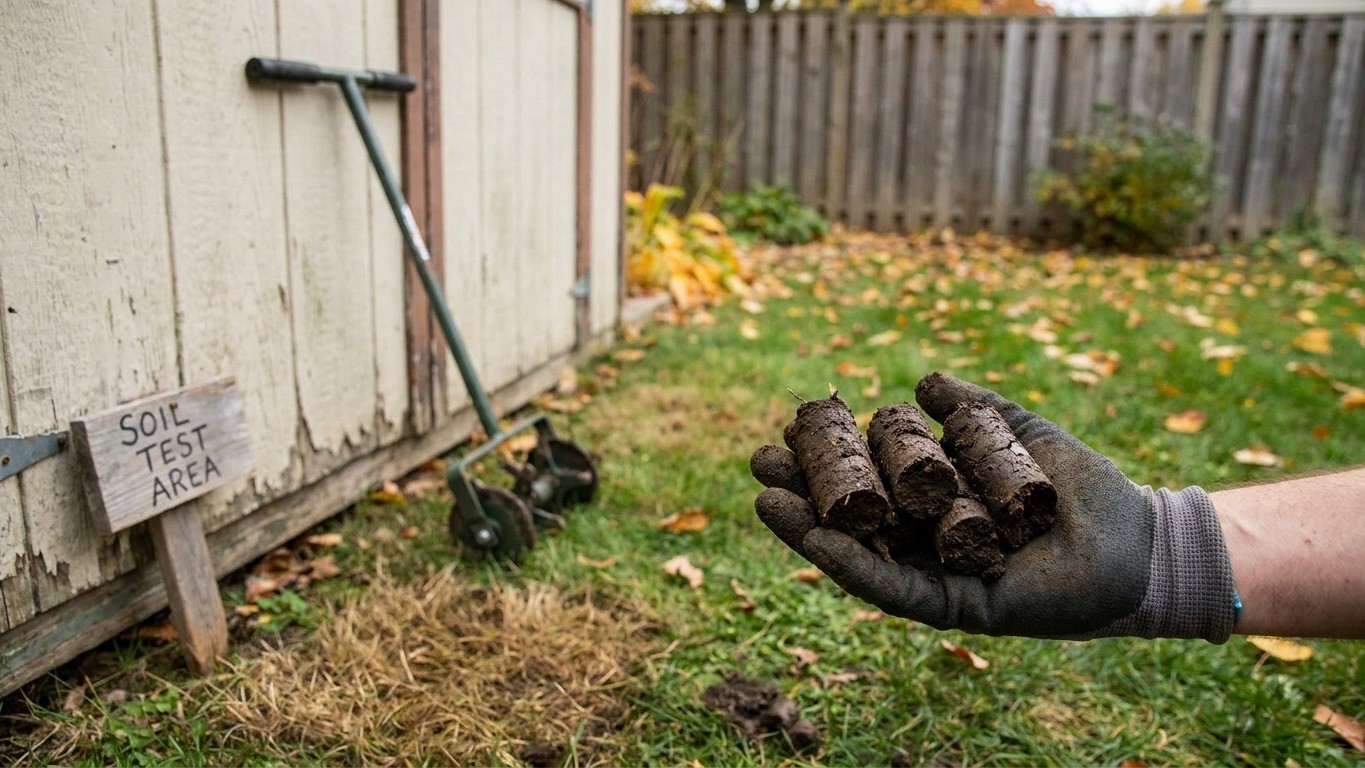

Core aeration helps a lawn when the soil beneath it has become compacted or buried under a thick layer of thatch, not on a fixed yearly schedule. Dig up a small plug of turf in a heavily used spot: if the roots stop short and the soil underneath feels dense and dry, that lawn is compacted and will answer to aeration. Do that check now, in the part of the yard that gets the most foot traffic, before you rent a machine or hire anyone.
Why this matters
Skip aeration on a compacted lawn and the grass does not fail the day you mow past it. It fails weeks later, when a hot, dry stretch hits and the roots that never had room to spread cannot reach enough water. Compacted soil blocks the air, water and fertilizer a lawn needs from ever reaching the root zone, so every other input you spend money on, from feeding to overseeding, works at a fraction of its potential.
The lag between cause and symptom
A lawn that needed aeration in spring often does not show it until midsummer heat stress, when thin, yellowing patches spread across the areas that get walked on hardest: the path to the garden shed, the strip along a driveway, the spot where the kids’ trampoline used to sit. By the time those patches are obvious, the grass has already spent a season fighting compacted soil instead of growing. The fix at that point takes a full growing season to show results, not a week, because roots have to rebuild depth before the grass above them can recover fully.
This is also where a lawn’s overall care routine matters. A mower set too low, or a fertilizing schedule that skips the parts of the yard under the most stress, compounds the same compaction problem. Get the basics of lawn care right first, because aeration on a lawn that is underfed or scalped just opens holes in soil that still cannot support strong roots.
When to do it
Timing follows the grass’s growing season, and that season runs in opposite halves of the year depending on which kind of grass is in the ground. Cool-season grasses, including Fine Fescues, Kentucky Bluegrass, Perennial Ryegrass, Rough Bluegrass and Tall Fescue, do their growing in spring and fall, according to Penn State Extension’s Lawn Establishment guidance and Clemson Cooperative Extension’s HGIC 1214. Aerate a cool-season lawn while it is actively putting on new growth, so the turf can knit back over the holes and thicken up before the stress of summer heat or winter cold arrives.
Warm-season grasses run on the opposite calendar
Bahiagrass, Bermudagrass, Carpetgrass, Centipedegrass, Seashore Paspalum, St. Augustinegrass and Zoysiagrass are warm-season species, per Clemson Cooperative Extension’s HGIC 1214, and they grow through the warm months while sitting dormant, not dead, over winter. Aerate a warm-season lawn during its active growing period, the same months it is putting out new runners and filling in bare patches, rather than while it is brown and dormant. Pulling plugs out of a dormant warm-season lawn just leaves open wounds with no active growth to close them.
Because the exact weeks of active growth shift with local climate, check the maintenance calendar published for the specific species growing in your yard, such as HGIC 1217 for Zoysiagrass or HGIC 1219 for Tall Fescue, both from Clemson Cooperative Extension, for the fuller seasonal task list. If aeration season overlaps with the broader tidy-up most lawns need after winter, tackle that spring lawn cleanup first so the aerator is not dragging matted leaves and debris across the surface.
How to do it

A core aerator pulls small plugs of soil and thatch out of the lawn and drops them on the surface, opening channels that let air, water and fertilizer reach the root zone directly instead of pooling on top of compacted ground. Rent or hire a hollow-tine core aerator, not a spike aerator: spike tines just punch holes and press soil sideways, which adds to compaction instead of relieving it.
Before you run the machine
- Mow the lawn to the low end of its normal range a day or two before aerating, using the height Clemson Cooperative Extension’s HGIC 1205 sets for the species in the ground, so the aerator can reach soil instead of dragging through long grass.
- Water the day before if the soil is dry and hard. Damp, not soaked, soil lets the tines punch full plugs instead of bouncing off the surface or clogging with mud.
- Mark sprinkler heads, shallow irrigation lines and any cable or utility markers before the first pass.
Running the aerator and what to do with the plugs
Run the machine in two directions, one pass north to south and a second east to west, so the holes cover the lawn in a crosshatch rather than straight lines. Leave the plugs where they fall. They look messy for a week or two, but they break down with rain and mowing and return organic matter and the microbes already living in that soil back to the surface, rather than being hauled off as waste.
Aeration is also the best moment to overseed a thin cool-season lawn, since the holes give seed direct soil contact instead of sitting on top of existing turf. Match the seed to the site: Fine Fescues for a shaded spot that will not carry much foot traffic, given their excellent shade tolerance and poor wear tolerance under Penn State Extension’s ratings, or Kentucky Bluegrass and Perennial Ryegrass where the lawn needs to hold up to wear, since both carry a good wear rating from the same source. After seeding, keep the mower at the higher end of the new grass’s mowing range, 2.5 to 3.5 inches for Fine Fescues or 2 to 3 inches for Kentucky Bluegrass and Perennial Ryegrass, so the young stand keeps enough leaf to photosynthesize while roots establish.
Warm-season lawns being aerated to fill in bare or thin turf answer to the same logic with a different plant list. Zoysiagrass and Bermudagrass both carry a very good to excellent wear rating and excellent drought tolerance under Clemson Cooperative Extension’s HGIC 1214, which is why they show up on athletic fields and driveway strips, while St. Augustinegrass has excellent shade tolerance for a lawn under mature trees. None of that matters if the plugs sit in soil that never gets the follow-up water and fertilizer a newly opened lawn needs to make use of the extra root room aeration just created.
What goes wrong
The most common mistake is aerating a lawn that is dormant rather than actively growing, on both ends of the seasonal divide: a cool-season lawn aerated during summer heat, or a warm-season lawn aerated while it is still brown from winter. The holes just sit open with no root growth to close them, which invites weed seed to germinate in bare soil that would otherwise have been covered by turf.
Thatch that never gets addressed
Aeration helps with a moderate thatch layer, since some of the plugs pulled up break through it, but it is not a substitute for dethatching a lawn where thatch has built past what aeration alone can fix. If mower blades bounce on a spongy surface and a probe into the turf meets a dense mat before it ever reaches soil, that is a job for dethatching first, measured properly rather than guessed at, with aeration to follow once the thatch layer is back to a manageable depth.
Skipping the crosshatch pattern and running the aerator in one direction only is the second common shortcut. It halves the number of holes per square foot without the operator realizing it, because the lawn still looks like it was aerated. The tell shows up the following season: a lawn aerated in one pass recovers less evenly than one aerated in two, with lower-density stretches showing between the lines the machine ran.
The last failure is timing the follow-up watering wrong. A freshly aerated lawn with exposed holes and, often, new seed in them dries out faster than an intact lawn, because there is more exposed soil surface for the sun to reach. A lawn that goes without water for the first couple of weeks after aeration and overseeding loses much of the benefit the holes were supposed to provide, since seed that dries out after germinating does not get a second chance the way un-sprouted seed does.
How this changes across the country
A lawn care service in a cool-season state and one in a warm-season state are not doing the same job when they talk about aeration, because the grass under their tines is built for entirely different tolerances. Pennsylvania, where Penn State Extension’s Lawn Establishment guidance covers Fine Fescues, Kentucky Bluegrass, Perennial Ryegrass and Rough Bluegrass, sits solidly in cool-season territory: these species grow in spring and fall and go dormant in the hottest weeks of summer, the opposite pattern from a warm-season lawn. South Carolina, covered by Clemson Cooperative Extension’s HGIC 1214, runs mostly on warm-season species such as Bermudagrass, Centipedegrass, St. Augustinegrass and Zoysiagrass, which grow through the warm months and sit dormant over winter.
The transition zone answers to neither calendar cleanly
A yard that sits in the band between clearly cool-season and clearly warm-season territory often carries Tall Fescue, which Clemson Cooperative Extension’s HGIC 1214 rates with good shade tolerance and fair drought and wear tolerance, a middle profile that reflects a grass built to tolerate both a cold winter and a hot summer rather than to excel at either. A lawn like that needs its aeration timed to whichever stretch of active growth it actually gets locally, which is why Clemson publishes a dedicated Tall Fescue Maintenance Calendar, HGIC 1219, rather than folding it into either the cool-season or warm-season schedule.
The table below lines up tolerance ratings that matter most when deciding whether a compacted, heavily used lawn is even carrying the right grass for the job, aeration aside.
| Grass | Season | Mowing height | Wear tolerance | Drought tolerance |
|---|---|---|---|---|
| Kentucky Bluegrass | Cool-season | 2 to 3 in | Good | Fair |
| Tall Fescue | Cool-season | 2.5 to 3.5 in | Fair | Fair |
| Bermudagrass | Warm-season | 0.75 to 1.5 in | Excellent | Excellent |
| Zoysiagrass | Warm-season | 0.75 to 2 in | Very good | Good |
A lawn carrying Bermudagrass or Zoysiagrass under heavy foot traffic may need aeration less often than a Fine Fescue lawn in the same use pattern, since Fine Fescues carry only a poor wear rating under Penn State Extension’s classification and compact faster under the same load.
Common questions
Can I aerate a lawn that’s dormant right now?
You can run the machine over it, but it will not do much good. A dormant lawn, cool-season in summer heat or warm-season in winter cold, has no active root growth to take advantage of the extra air and water reaching the soil, so the holes just sit there until growth resumes.
Do I need to aerate every single year?
Not if the soil is not compacted and thatch stays thin. A lawn with light foot traffic and no yellowing, thinning patches during summer stress may go several seasons between aerations. Check with the plug test each year rather than aerating on autopilot.
Should I aerate before or after fertilizing?
Aerate first, then fertilize. The open holes let fertilizer reach the root zone directly instead of sitting on the surface, and Clemson Cooperative Extension’s HGIC 1201 Fertilizing Lawns guidance is a good reference for getting the rate right for whichever species is in the ground.
Is it a problem if I see grubs or worm castings when I pull plugs?
Worm castings are a sign of healthy soil biology, not a problem to fix. Grubs are a different matter and worth identifying properly before treating, since a pest problem calls for a different response than compaction does, and the two are sometimes mistaken for each other when a lawn is thinning.