
Oklahoma State University Extension documents ten insect pests on Oklahoma’s summer garden crops, but only about seven of them regularly show up on summer squash. The rest belong to other plants entirely. Knowing which ones actually target squash, and when they arrive relative to the state’s frost-free window, is what separates a useful diagnosis from a guess.
Which pests attack summer squash in Oklahoma

Oklahoma State University Extension documents ten pests relevant to home vegetable gardens in the state: Blister beetles, Colorado potato beetle, Corn earworm, Cucumber beetles, Grasshoppers, Green peach aphid, Harlequin bug, Spider mites, Squash bug, and Stink bugs and leaffooted bugs. Not all of them belong on a summer squash page.
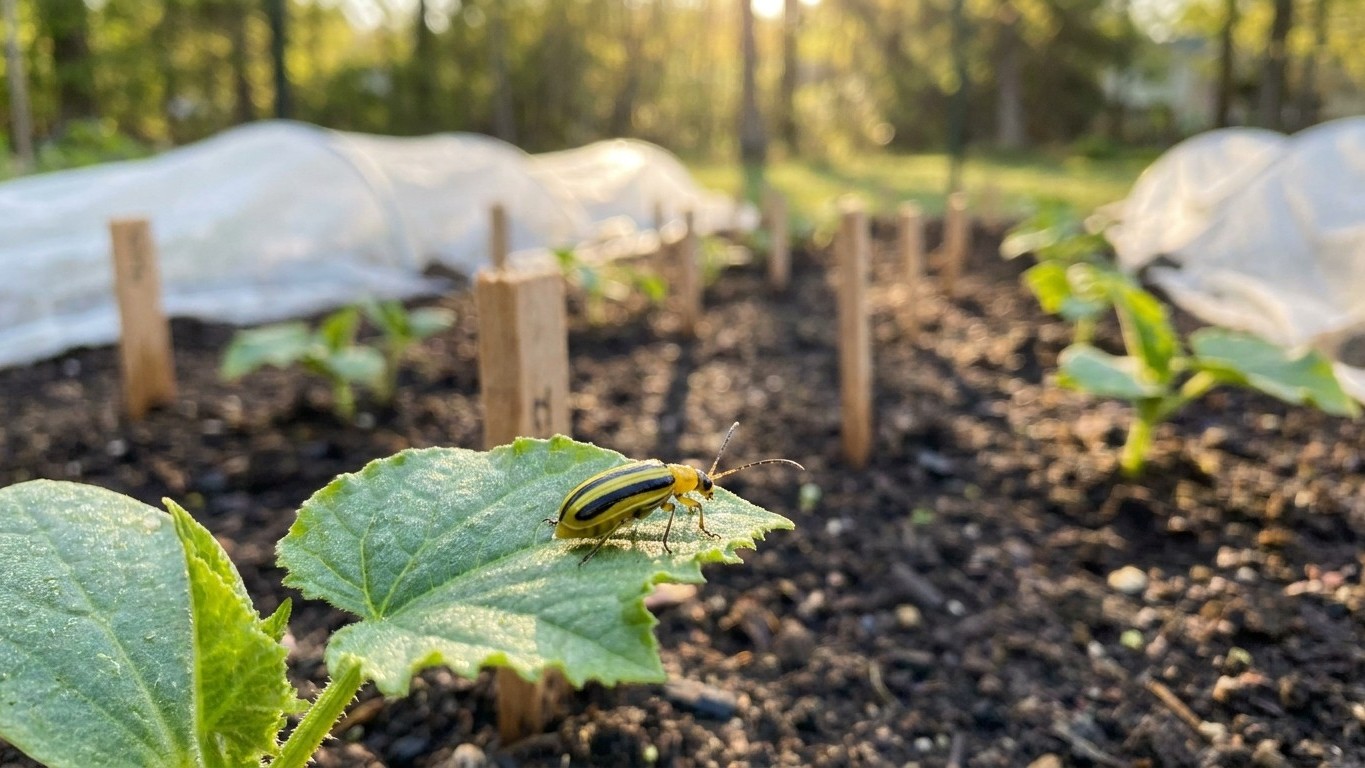
Squash bug is the one most tied to this crop specifically. It feeds almost exclusively on cucurbits, and it’s usually the first insect a squash grower learns to recognize on sight. Cucumber beetles, both the striped and spotted forms found in Oklahoma gardens, feed on cucurbit leaves, blossoms, and fruit, and they also carry bacterial wilt, which can kill a squash plant faster than the feeding damage itself. Stink bugs and leaffooted bugs puncture developing fruit and leave the scarring and pithy patches that show up later on squash flesh. Spider mites thrive on squash foliage especially once dry, hot weather sets in. Grasshoppers are generalist feeders that chew through squash leaves along with nearly everything else in a garden bed. Blister beetles feed in groups on foliage and can strip a squash plant’s leaves in a short window. Green peach aphid clusters on new growth and undersides of squash leaves, weakening plants and excreting the sticky honeydew that leads to sooty mold.
Three pests on the Oklahoma State University Extension list don’t belong here. Colorado potato beetle targets potatoes, eggplant, and other nightshades, not cucurbits, so it has no reason to be on a squash plant. Corn earworm is built around corn ears and tomato fruit; it isn’t a squash-fruit feeder in the way it is for those two crops. Harlequin bug is a brassica specialist, drawn to cabbage, broccoli, and related plants, and it largely ignores cucurbits. A gardener who finds any of these three on squash should look again at what’s actually happening, because the identification is probably off.
When each one shows up, and what it does first
Oklahoma’s last spring frost falls somewhere between March 28 and April 10 at the reference station, and the first fall frost lands between October 29 and November 8. Squash pest activity tracks that frost-free stretch rather than the calendar month, since planting dates shift from one part of the state to another.
Cucumber beetles are usually the earliest arrivals, often showing up within the first couple of weeks after squash seedlings go in the ground or seeds germinate. The first sign is small, ragged holes in the seed leaves and early true leaves, sometimes with wilting that spreads faster than feeding alone would explain, which is the bacterial wilt connection at work. Squash bugs tend to follow a few weeks later, once plants are Established and vining. Their first clue is usually a cluster of small, bronze-colored eggs laid in neat rows on the underside of a leaf, followed by wilting on individual leaves that spreads outward from where the bugs are feeding at the base of the plant.
Aphids build up steadily through the early and middle part of the season, and the first sign is curled or puckered new growth rather than obvious insects, since the aphids cluster where leaves are still unfurling. Spider mites become more of a concern as the season pushes into its hottest stretch, and Oklahoma averages 70.7 days a year at or above 90°F, which is exactly the kind of stress that favors mite populations. Their first sign is a fine stippling or bronzing on leaves, often mistaken at first for drought stress. Grasshoppers and blister beetles tend to move in from field edges and can appear at almost any point in the season, with chewed leaf margins as the first visible clue. Stink bugs and leaffooted bugs typically show up once fruit is forming, and the first sign is often a small, sunken scar or discolored spot on the young fruit itself rather than anything visible on the leaves.
Telling the damage apart from everything else
Squash plants show stress in ways that look similar whether the cause is an insect, a watering problem, or a disease, and guessing wrong means treating the wrong issue. The single biggest tell is where the damage starts: insect feeding tends to concentrate on specific leaves or leaf edges, while water and nutrient problems tend to show up evenly across the whole plant.
| Symptom | Possible cause | What distinguishes it |
|---|---|---|
| Sudden wilting of one or two leaves, plant otherwise green | Squash bug feeding or squash vine borer | Check the leaf underside and stem base for insects, eggs, or a small entry hole with sawdust-like frass |
| Whole-plant wilting despite moist soil | Bacterial wilt spread by cucumber beetles | Cut the stem and look for a milky, stringy sap; wilting from drought doesn’t do this |
| Yellowing between leaf veins | Nutrient deficiency | Pattern is uniform across older leaves, with no holes or insects present |
| Fine speckled or bronzed leaves | Spider mites or heat/drought stress | Tap a leaf over white paper; moving specks confirm mites |
| Scarred or dimpled fruit | Stink bug or leaffooted bug feeding | Scars are sunken and localized, unlike the sunscald that affects the whole exposed side of a fruit |
Mechanical damage from hail, garden tools, or animals tends to be sharp-edged and random in placement, while disease symptoms usually spread gradually over days rather than appearing overnight. When the cause still isn’t clear after checking these signs, the local Oklahoma State University Extension county office can look at a sample or a photo and settle it rather than guessing further.
What actually works here, and what is a waste of time
Oklahoma’s short window between last spring frost and the arrival of 90°F days means timing matters more than any single control method. A physical barrier placed over young squash plants right after planting, and removed once flowers open for pollination, blocks the earliest wave of cucumber beetles and squash bugs without any need to identify the pest first. Waiting until damage is visible to act is the most common misstep, since squash bug eggs and young nymphs are far easier to manage than adults hiding at the base of a mature plant.
Rotating squash to a different bed each year, rather than replanting cucurbits in the same spot, reduces the overwintering population of squash bugs and cucumber beetles that would otherwise emerge right next to the new crop. Removing old squash debris at the end of the season does the same thing, since squash bugs overwinter in plant litter and garden edges. Checking leaf undersides for egg clusters every few days during the early weeks after planting catches squash bug populations before they establish.
What tends not to work: spraying on a fixed schedule regardless of what’s actually present, since it wastes effort on weeks when pest pressure is low and misses the narrow window when young nymphs are most vulnerable. Relying on a single control method for the whole season is another common mistake, since cucumber beetles, squash bugs, and mites respond to different tactics and different timing. Any treatment decision that goes beyond covers, rotation, and sanitation is a question for Oklahoma State University Extension, since they know what’s labeled and legal for use in the state.
Where to check this for your own county
Oklahoma State University Extension maintains the pest documentation cited throughout this page, and their statewide resources are available at extension.okstate.edu. The single most useful next step is contacting the local county extension office, since pest pressure inside Oklahoma varies by region, soil, and even by neighborhood, and a statewide list doesn’t say what’s active in one particular garden.
Oklahoma spans USDA hardiness zones 6a through 8a, and a squash bed in the state’s cooler northern counties won’t necessarily see the same pest timeline as one in the warmer south. The frost-free window used throughout this page reflects a single reference station, and gardens away from that station, especially rural ones, often see the last spring frost arrive later and the first fall frost arrive earlier, sometimes by one to two weeks. That shift changes when pests show up relative to a specific garden’s own planting date.
A county extension office can confirm whether a particular insect found on a squash plant matches what’s documented for that area, and can identify a sample when the symptoms overlap between causes, as they often do early in an infestation. That’s a more reliable next step than trying to match a photo online, and it’s the resource this page keeps pointing back toward.