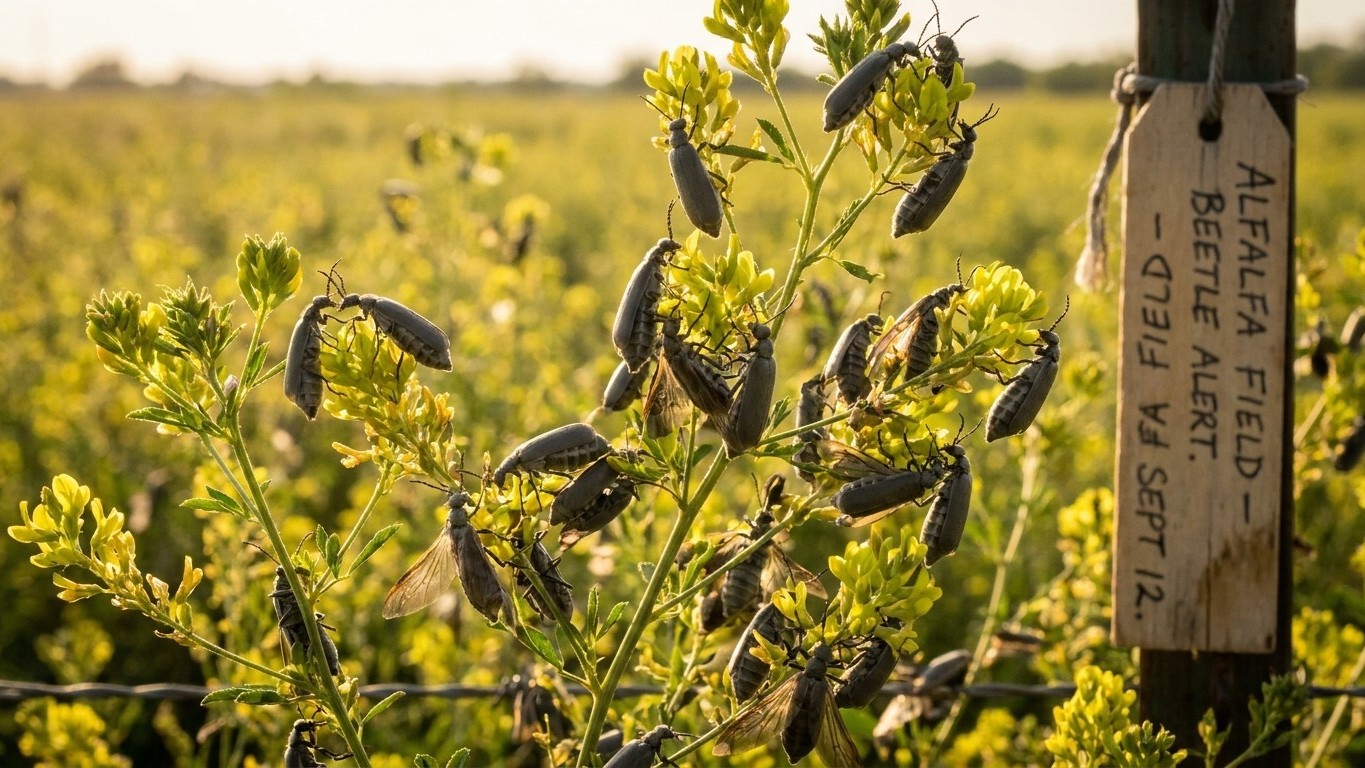

Late July through September is peak season for blister beetles in Oklahoma, and the trigger is almost always alfalfa in bloom. These narrow-bodied beetles swarm fields in tight clusters, chew through flowering crops and garden plants, and carry a toxin called cantharidin that blisters skin on contact. Stopping an infestation depends on where you’re dealing with it: a hayfield calls for cutting timing and inspection, a backyard garden calls for gloves, row covers, and targeted insecticide.
When Blister Beetles Show Up in Oklahoma

The life cycle starts underground and mostly out of sight. Blister beetle larvae spend their early months hunting grasshopper egg pods in the soil, which actually makes them useful to farmers battling grasshopper outbreaks. That changes once they mature. Adults emerge from late June into September, right as summer heat pushes flowering plants into full bloom, and they head straight for pollen-rich foliage.
Alfalfa is the magnet. Oklahoma’s growing season typically produces three to four cuttings of alfalfa hay, and blister beetles tend to concentrate in the second and third cuttings, when the crop is flowering and grasshopper populations (their larval food source) have already built up from a hot, dry early summer. A field can look clean one week and be crawling with beetles the next, since adults move in dense, fast-moving swarms rather than spreading out gradually.
The striped blister beetle is the species most associated with Oklahoma hay problems, largely because it swarms in far larger numbers than the solid black or gray varieties. Homeowners are more likely to run into the smaller, scattered groups that show up on tomatoes, potatoes, beans, and flowering weeds like ragweed along fence lines. Both situations trace back to the same insect, just different scales.
Why Oklahoma Hay Buyers Worry About Blister Beetles
Cantharidin doesn’t need a live beetle to cause harm. Once a beetle is crushed, dried, and baled into hay, the toxin stays active and gets ingested along with the forage. Horses are extraordinarily sensitive to it, far more than cattle or sheep, and even a small number of beetle bodies mixed into a flake of hay has been enough to sicken or kill a horse in documented cases across the region.
Hay conditioning equipment makes the problem worse, not better. Modern crimpers and conditioners crush the stems for faster drying, and if beetles are present in the field during cutting, that same equipment crushes them directly into the hay instead of letting them escape ahead of the machinery. This is part of why later cuttings carry more risk than the first cutting of the season, which happens before alfalfa blooms and before beetle populations have built up.
What Actually Reduces the Risk
Oklahoma State University’s Extension service, along with equine health programs at other land-grant universities, points buyers toward a short list of practical steps rather than any single fix:
- Favor first-cutting alfalfa hay whenever horses are involved, since it’s typically harvested before beetles swarm
- Inspect flakes visually for beetle bodies, especially along field edges where swarms concentrate
- Ask growers whether hay was cut with a crimper/conditioner during a known beetle year
- Avoid hay sourced from fields with heavy weed bloom bordering the alfalfa, since beetles migrate in from those edges
None of these guarantee a beetle-free bale. Cantharidin poisoning is serious enough that horse owners who suspect contaminated hay should contact a veterinarian promptly rather than waiting to see if symptoms appear, since the toxin affects the digestive tract and urinary system quickly.
Controlling Blister Beetles Around Your Home and Garden
Backyard encounters look nothing like a hayfield swarm, but the caution around handling still applies. Adults run about half an inch to three-quarters of an inch long, with a narrow, soft body and a head that’s noticeably wider than the thorax behind it. Color varies by species, some are solid black or gray, others show the yellow-and-black stripes that give the most common Oklahoma species its name.
Gardens draw them in through the same mechanism as alfalfa fields: flowering foliage. Tomatoes, potatoes, beans, and other legumes are frequent targets, along with flowering weeds nearby that act as a staging area before beetles move onto cultivated plants. A patch of foliage that goes from green to skeletonized over a couple of days is a common first sign, often noticed before the beetles themselves are spotted.
Bare-handed removal is the one thing to avoid. Cantharidin causes a chemical burn that raises blisters on skin within hours, and the reaction happens whether the beetle is alive, dead, or already dried out. Gloves are non-negotiable for hand-picking, and beetles knocked into a bucket of soapy water die quickly without needing to be crushed by hand.
Signs You’re Dealing With a Swarm, Not a Few Stragglers
Isolated beetles show up as scattered chewing damage over a week or two. A true swarm behaves differently, moving through a garden row or field edge in a dense band and leaving a visible line between untouched and stripped foliage within a day or two. That distinction matters for treatment, since a handful of beetles is manageable by hand, while a swarm usually needs a broader response.
For larger infestations, insecticides labeled for blister beetles, including products containing carbaryl or permethrin, give faster control than hand removal alone. Timing the application to early morning or evening, when beetles are less active and pollinators are less likely to be foraging, cuts down on unintended harm to bees working the same flowering plants. Row covers during the peak emergence window in July and August can also keep beetles off high-value vegetable rows without any chemical application at all.
Removing flowering weeds along fence lines and garden borders before beetles arrive reduces the staging ground that draws swarms in from adjacent fields in the first place. It’s a smaller-scale version of the same logic hay growers use when they manage weedy field margins.
A Beneficial Insect With a Bad Reputation Locally
The larval stage of the blister beetle spends months underground eating grasshopper egg pods, one of the more effective natural checks on grasshopper populations in Oklahoma pastures and rangeland. Wiping out blister beetles entirely, even if it were practical, would likely mean more grasshopper damage the following season. The goal for most homeowners and hay producers isn’t eliminating the species, it’s timing and handling choices that keep the adult stage away from horses, garden crops, and bare skin during the few weeks each summer when swarms are actually a problem.