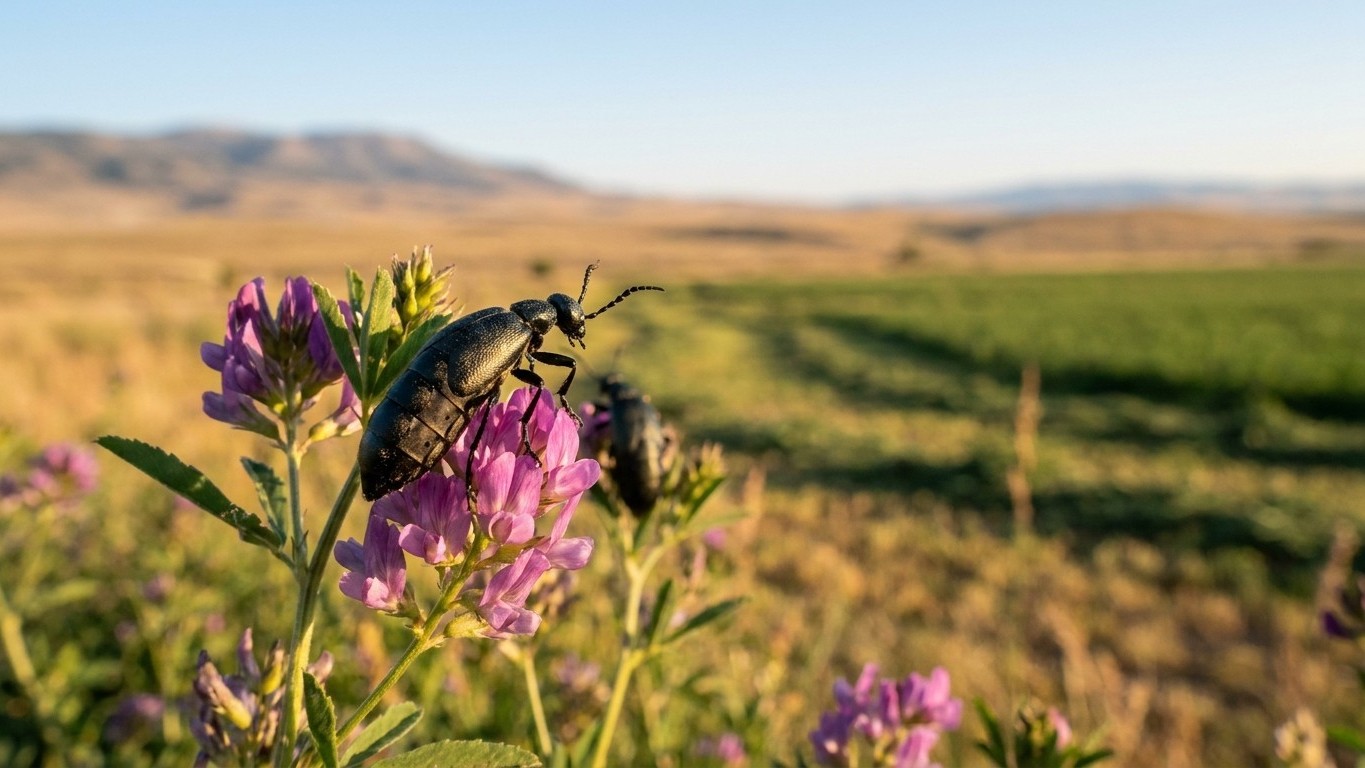

Blister beetles show up in Wyoming from late June through August, typically after a run of warm, dry weather following alfalfa’s first cutting. The real danger isn’t the beetle biting you (it barely does), it’s cantharidin, a chemical in their bodies that blisters skin on contact and can kill a horse that eats even a handful of crushed beetles baled into hay. Stopping them means managing hay cutting schedules, scouting fields before baling, and keeping bare skin away from swarms during peak activity.
When Blister Beetles Appear in Wyoming

Wyoming’s blister beetle activity tracks closely with alfalfa growth cycles. Adults emerge from the soil in early summer, usually between mid-June and early July depending on elevation and spring temperatures. In the Bighorn Basin and lower-elevation irrigated valleys around Worland or Powell, beetles tend to show up earlier than in higher, cooler counties like Sublette or Park.
Populations peak during the second alfalfa cutting, which lands in most of Wyoming sometime in late July or August. That timing is not a coincidence. Blister beetles feed on the flowers of blooming alfalfa and other flowering plants, so a field left to bloom before cutting draws them in like a dinner bell. Fields cut on a tight schedule, before bloom, see far fewer beetles because there’s nothing there to attract them yet.
Heat and drought push beetle activity higher. A dry summer with several 90-degree days in a row, common across the Wind River and North Platte drainages, tends to concentrate beetles in irrigated fields where the vegetation stays green while everything around it browns out. That contrast makes irrigated hay ground the single biggest hot spot for blister beetle encounters in the state.
Why Ranchers Take This Pest Seriously
Cantharidin is the reason blister beetles get more attention in Wyoming than almost any other insect on the hay ground. The compound is stable, meaning it doesn’t break down when a beetle gets crushed and baled into dry hay. A horse can be poisoned months after the hay was cut, just by eating a flake that happens to contain beetle remains.
Horses are far more sensitive to cantharidin than cattle or sheep. According to Colorado State University Extension research on the topic (widely referenced across the Rocky Mountain region because blister beetle biology doesn’t stop at state lines), as few as several dozen beetles of the more toxic species can be a lethal dose for an adult horse. Symptoms include colic, oral blistering, and in severe cases, kidney damage that shows up within hours of ingestion.
This is why alfalfa hay grown for horse owners gets scrutinized more closely than hay destined for cattle feedlots. Buyers in Wyoming’s horse country, think Sheridan, Big Horn, or the Jackson Hole valley, often ask sellers directly whether a field was cut before bloom and whether it was crimped or conditioned with equipment that crushes stems (and any beetles riding along) into the windrow.
Species Found in Wyoming Hay Ground
Several species turn up in Wyoming, and they don’t all carry the same risk. The striped blister beetle (Epicauta occidentalis and related species) is one of the more commonly reported types in the region, often moving in dense swarms that strip alfalfa blooms in a matter of days. Black blister beetles show up too, usually in smaller, more scattered numbers.
Swarming behavior matters more than species identification for most hay producers. A field with a few scattered beetles poses far less risk than one hit by a migrating swarm that can number in the thousands, feeding shoulder to shoulder along a windrow edge.
What Actually Stops Blister Beetles
Timing the cut is the single most effective tool available. Cutting alfalfa before it blooms removes the food source that draws beetles into the field in the first place. Producers who manage a strict pre-bloom cutting schedule report dramatically fewer beetle problems than those who let fields flower, even by just a few days, before mowing.
Scouting before cutting catches what timing alone misses. Walking field edges and low spots, where beetles tend to concentrate, in the days before a planned cutting gives a grower a real read on whether a swarm has moved in. If beetles are present in numbers, delaying the cut by even a few days, or mowing around a heavily infested patch, can keep contaminated material out of the bale.
Equipment choice changes the outcome too. Older hay conditioners crush and crimp the stem as it’s cut, and that same crushing action kills any beetles caught in the windrow, driving cantharidin directly into the hay. Some producers switch to non-conditioning mowers or adjust conditioner rollers during high-risk cutting windows specifically to reduce this crushing effect, since a beetle that’s simply raked into a windrow (rather than crushed) is far less likely to release its toxin into the forage.
Border and ditch management around fields reduces the food sources that draw beetles in before alfalfa even blooms. Blister beetles feed on a range of flowering weeds, so keeping field margins, irrigation ditches, and fence lines mowed or treated cuts down on the staging areas where populations build before moving into the crop.
Insecticide treatments exist but come with real trade-offs. Because blister beetles often move as swarms and can arrive with little warning, a treatment applied too early or too late does little good. Pyrethroid-based products labeled for use on alfalfa can knock down an active swarm, but timing has to be tight, and pre-harvest interval restrictions on the label still apply. Most Wyoming extension guidance treats insecticide as a backup option behind cutting-time management, not a first-line solution, since killing beetles in the field after they’ve already fed doesn’t undo the contamination risk if the timing was off to begin with.
Handling Hay After the Cut
Visual inspection of baled hay only catches the worst cases. Beetles that were crushed during conditioning leave no obvious trace, so a bale can look completely normal and still carry a dangerous dose of cantharidin. This is one reason hay grown specifically for horses often commands a premium when the grower can document pre-bloom cutting and a scouting record.
Storage and sourcing habits matter for horse owners buying hay rather than growing it. Asking a seller directly about cutting timing, requesting hay that wasn’t grown near a known beetle hot spot, and inspecting a sample of flakes for any beetle fragments (even though this only catches obvious contamination) are the practical steps most Wyoming equine operations rely on. Some horse owners also stagger feeding across multiple hay sources rather than relying on a single field, on the theory that spreading risk across different lots limits how much damage a single contaminated batch can do.
For people simply working around hay fields rather than raising horses, the concern shifts from cantharidin poisoning to skin contact. Handling live beetles with bare hands, or brushing against a swarm while walking through a field, can raise painful blisters within hours. Gloves and long sleeves during scouting or hand-raking in beetle season are a simple, low-cost precaution that avoids the whole issue.
A Detail Worth Knowing
Blister beetle risk isn’t evenly spread across a single field. Swarms tend to cluster along field edges bordering weedy ditches or fence lines, since that’s often where the flowering plants that first attract them are growing before the alfalfa itself blooms. A producer who scouts only the interior of a field, and skips the margins, can walk right past the exact spot where a swarm is building.