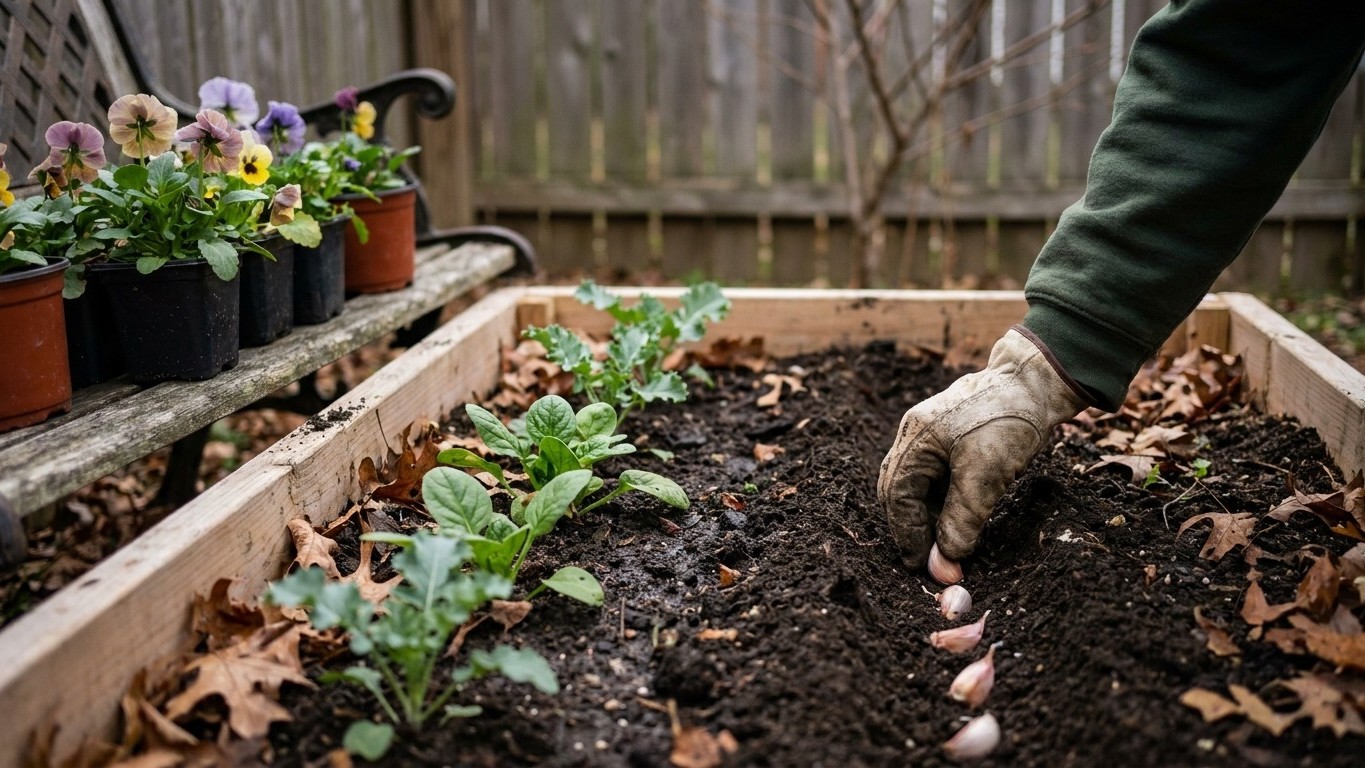

October in Ontario means garlic and shallots go in the ground, spring bulbs get their last window before the soil locks up, and cover crops can still be broadcast in the first half of the month. Almost nothing tender survives past the average first fall frost of October 16, so the real work this month is planting what’s frost-hardy and protecting or lifting what isn’t.
What goes in the ground in October

Soil temperature and the shortening days decide what still goes outdoors, not the date on the calendar. The average first fall frost for the region, taken from the Toronto Pearson station, falls on October 16, but that’s a mean from a thirty-year record, not a boundary line. In roughly half of all years frost arrives later than that, and in the other half it arrives earlier. A warm first week of October tells you nothing certain about week three.
Garlic is the anchor crop of the month. Cloves want six to eight weeks of cool, unfrozen soil to root before the ground freezes solid, without pushing top growth that a hard freeze would kill. Shallot sets follow the same logic. Spring-flowering bulbs, tulips, daffodils, crocus, need a similar cool-soil window and go in any time before the ground becomes unworkable. Cover crops like winter rye or hairy vetch can still be broadcast into cleared beds early in the month in the milder south of the province; further north or at elevation, that window closes sooner.
| Crop or task | Plant in October? | Notes |
|---|---|---|
| Garlic, shallots | Yes | Six to eight weeks before ground freeze |
| Spring bulbs | Yes | Needs cool soil, not frozen soil |
| Winter rye, hairy vetch | Early month, south only | Later sowing risks poor establishment |
| Bare-root trees, shrubs | Yes, if dormant | Water in well before freeze-up |
| Tender annuals, tomatoes, peppers | No | Won’t survive first frost |
Bare-root fruit trees and dormant shrubs can also go in once they’ve dropped their leaves, provided the roots get a thorough watering before the ground closes. Skip anything tender: tomatoes, peppers, squash, basil, all of it is finished for the season the moment a real frost lands, and planting them now is planting for the compost pile.
What to start under cover
October isn’t a month for starting next spring’s vegetable seedlings, not in this climate. But two kinds of “starting” still make sense, and both work backward from a date rather than forward from today.
The first is forcing bulbs for indoor bloom. Hyacinths and paperwhites need roughly ten to thirteen weeks of cold treatment before they’ll flower; tulips need closer to twelve to sixteen. Pot them now in an unheated garage, cold frame, or a fridge kept clear of fruit, and count forward: a pot started in early October is ready to bring into warmth and light in mid-to-late December or January. Start too late and the bulbs simply won’t have banked enough cold hours to bloom on schedule.
The second is cold stratification for native perennial and wildflower seed, milkweed, coneflower, many prairie natives that germinate poorly without a real winter. Sow them into pots or flats, leave them outdoors or in an unheated space, and let the season do the work. The failure mode here runs the other direction from spring sowing: start too late, after the ground has frozen hard, and the seed doesn’t get the sustained cold it needs before spring warm-up triggers germination. There’s also no upside to sowing these too early in warm soil, they can rot before cold sets in, so the window really is October, not September.
What is ready to pick
This is a genuine harvest month. Winter squash and pumpkins should already be cured or coming off the vine before a hard frost damages the skin, look for a stem that’s dried and a rind that resists a fingernail. Apples and pears in the mid-to-late varieties are ready through the month depending on cultivar. Root crops, carrots, parsnips, and beets left in the ground actually improve after a light frost, as the plant converts starches to sugars.
Brussels sprouts follow the same pattern, sweetening noticeably once nighttime temperatures dip. Leeks, kale, and late cabbage can stand in the garden well past the first frosts and are often better for it. Dry beans destined for storage should come off the vine once the pods rattle and the shells have hardened.
Anything already in storage, summer’s squash, potatoes, onions, deserves a check-through this month. Pull anything with a soft spot, a sprouting eye, or a sour smell before it spreads to the rest of the bin. One rotting potato in a dark storage box will take out its neighbors faster than most gardeners expect.
The jobs that matter this month

Several tasks have a real deadline attached to them in October, and missing it costs more than a few days.
Tender bulbs, dahlias, gladiolus, cannas, need to come out of the ground before a hard freeze kills the foliage and starts rot working down into the tuber. Cure them in a dry spot for a few days, then store in slightly damp peat or vermiculite somewhere cool and dark. Garlic beds, once planted, want a two-to-four-inch mulch of straw once the soil has cooled but before it freezes, enough to buffer temperature swings without smothering the sprouting clove.
Seed catalogs for spring-flowering bulbs and garlic seed stock start selling out of popular varieties early, ordering now rather than in late winter avoids the disappointment of a sold-out list. Soil testing is worth doing this month too, results come back in time to plan amendments for spring rather than scrambling once planting season is already underway.
Clean-up matters more than it looks like it should. Diseased leaves and fruit left on the ground overwinter fungal spores and insect eggs right where next year’s plants will grow; pulling and disposing of that debris now, rather than tilling it under, breaks that cycle. Compost piles benefit from one more turn before cold weather slows the microbes down. Tools deserve a real cleaning and a sharpening before they go into winter storage, a dull hoe or pruner is a spring problem you’re creating right now. Hoses and irrigation lines should be drained before the first hard freeze cracks a fitting.
What not to do in October
The most common mistake is treating a mild stretch of weather as proof the season has more life in it than it does. A run of warm afternoons doesn’t cancel the frost risk sitting in the average; it just delays it. Tender plants left uncovered on the strength of a nice week are gambling against a date that, historically, lands mid-month on average and sometimes earlier.
Fertilizing with nitrogen this late works against the plant rather than for it. Nitrogen pushes soft new growth, and soft new growth is exactly what a frost kills first. If anything needs feeding this month, it should be a low-nitrogen, root-focused amendment, not the all-purpose blend used in June.
Pruning spring-flowering shrubs, lilac, forsythia, hydrangea in most cases, now is a mistake gardeners make almost every year. Those shrubs have already set next year’s flower buds on this year’s wood; a fall pruning session removes the very growth that was supposed to bloom. Save the pruning saw for genuinely dead, diseased, or damaged wood only, and leave the rest until the plant is fully dormant or has finished flowering next season.
Finally, don’t leave winter squash or pumpkins in the field past their prime hoping for a few more days of size. Once a hard frost hits the vine, the fruit’s storage life drops fast even if the fruit itself looks fine at first glance.
Checking this against your own county
A province-wide October is a starting point, not an instruction. Ontario stretches from the Windsor-Essex peninsula, one of the mildest corners of the country, to northern districts where frost risk runs weeks ahead of the Toronto-area average used here. Lake effect from the Great Lakes moderates shoreline gardens noticeably compared to inland spots just a short drive away, and elevation in areas like Haliburton or Dufferin can push frost dates earlier still.
For local guidance layered on top of this general picture, the Ontario Ministry of Agriculture, Food and Rural Affairs is the place to check county-specific advice before committing a bed to any of the above.
Common questions
Is it too late to plant garlic in Ontario in October?
No. October is the standard planting window across most of the province, provided the soil is still workable and cloves get six to eight weeks of cool soil before hard freeze locks the ground.
What’s the average first frost date in Ontario?
Based on the Toronto Pearson station’s 1981-2010 climate normals, the average first fall frost falls on October 16. That’s a midpoint, not a guaranteed safe date, frost has historically arrived earlier or later than that in any given year.
Can I still start a vegetable garden in October in Ontario?
Not for warm-season crops, and not for most vegetables from seed outdoors. Garlic and shallots are the exception, along with cold frame greens in protected settings.
What hardiness zone is Ontario?
The reference city used for this page sits in Canadian hardiness zone 7a, based on Natural Resources Canada’s 1991-2020 normals. That’s the Canadian system, built on seven climate variables, and it does not convert directly to a USDA zone number.
Gardeners who plant by the Moon can check the October 2026 moon planting calendar, a tradition rather than a proven method.
Related guides
- What to Plant in Ontario in January
- What to Plant in Ontario in July
- What to Plant in Ontario in December
- What to Plant in Ontario in September
- What to Plant in Ontario in November
Elsewhere? See what to plant in October in every state and province.