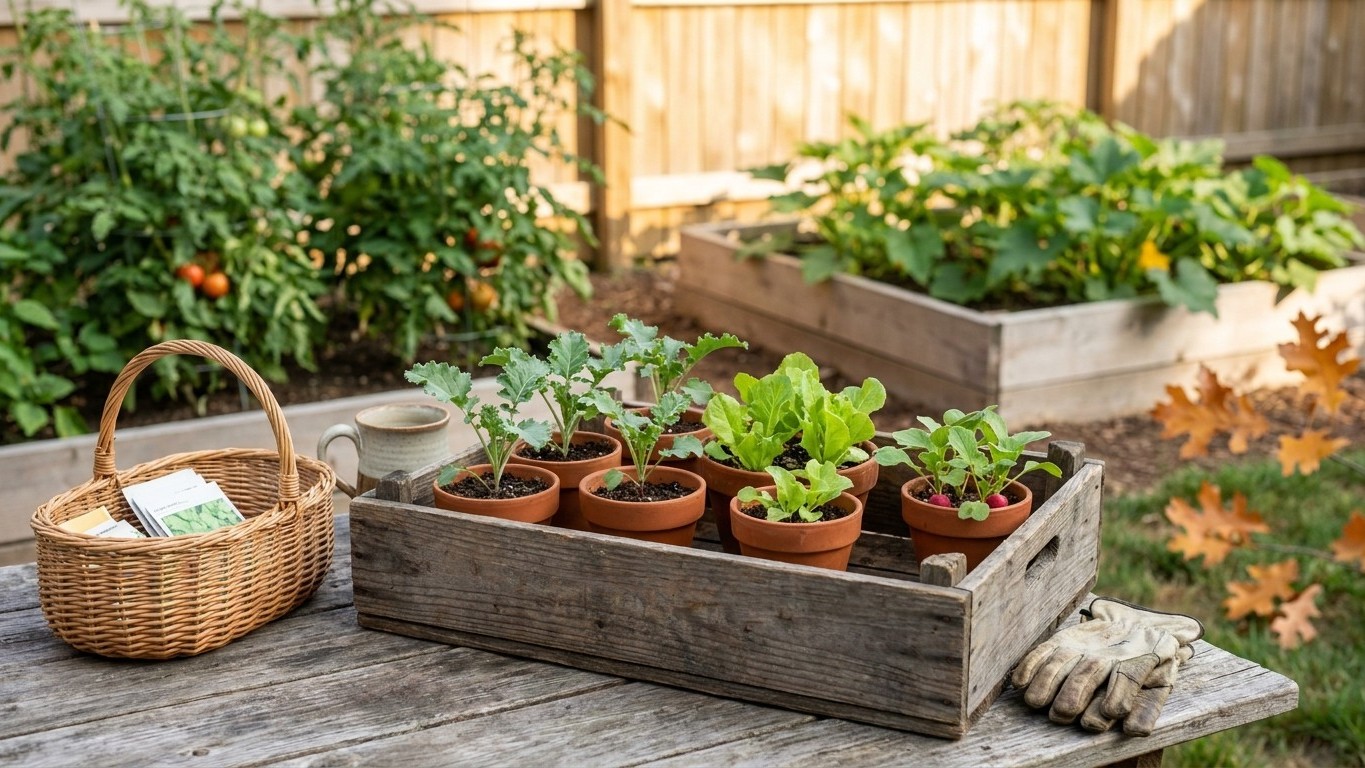

In Ontario, August sits deep in the growing season: roughly fourteen weeks after the mean last spring frost of April 30, and about ten weeks before the mean first fall frost of October 16. That window still leaves room for quick-maturing greens and roots, a last round of fall brassica transplants, and cold-frame starts for late-season harvest, while the rest of the garden is busy ripening.
What goes in the ground in August

The calendar says summer, but the number that actually decides what you can still plant is the gap to the mean first fall frost, October 16. Count backward from that date, not forward from today, and remember it is a mean: in one year out of two, frost arrives later, but in the other half it arrives sooner, sometimes by a couple of weeks. Treat October 16 as the middle of a window, not a guarantee.
Early August still allows crops that need 60 to 75 days to finish: bush beans for a final harvest, a second round of snap peas, beets, carrots sown now for fall pulling, and Swiss chard. Transplants of fall broccoli, cabbage, and cauliflower that were started under cover in early or mid summer should go into the ground now if they have not already, since they need every remaining week of warm soil to size up before the days shorten.
By mid to late August, the safe list narrows to fast crops: lettuce, spinach, arugula, mustard greens, radish, turnip, pak choi, and scallions. These finish in three to six weeks and can still mature before growth slows with the shorter days, even if a light frost arrives ahead of the mean date. Soil is still warm from summer, so germination is fast, often a day or two quicker than a spring sowing in the same soil temperature.
What is a gamble at this point: anything that needs more than 75 days from seed, including winter squash, pumpkins, and full-season carrots sown from scratch. Garlic and shallots are not an August crop here; they go in later, once the soil has cooled toward fall, so hold that planting for a different month rather than rushing it now.
What to start under cover
Starting seed under cover in August is less about protecting from cold and more about buying the extra two or three weeks a fast crop needs to reach transplant size before light levels drop. Sow lettuce, spinach, mizuna, and claytonia into cell trays or flats now, and plan to move them into a cold frame or low tunnel in early to mid September for a harvest that stretches well past the point the open garden has shut down.
Do the arithmetic in reverse: pick the crop’s days-to-maturity, add one to two weeks for the slower growth typical once daylight shortens, then count that total backward from October 16. A lettuce that needs 45 days plus a 10-day cushion needs to go into the ground, under cover, no later than roughly eight weeks before that date, which lands the seed-starting step in early to mid August for most gardens near the reference station.
The two ways this goes wrong are familiar to anyone who has done it before. Start too early under cover, in the heat of high summer, and transplants get leggy and rootbound waiting for cooler weather to go outside, wasting the head start they were meant to give. Start too late, and the plants never bulk up before the light drops enough to stall growth, leaving small, disappointing heads even under protection. Splitting a sowing into two batches roughly ten days apart hedges against getting the timing wrong either way.
What is ready to pick
August is the month the garden pays back the spring’s work. Tomatoes, peppers, summer squash, zucchini, and cucumbers are all producing steadily, and the rule with all of them is the same: pick often. Zucchini left two extra days turns from a tender vegetable into a watery baseball bat; cucumbers left on the vine go bitter and seedy; beans left to mature past the pod stage turn stringy and signal the plant to stop flowering.
Sweet corn is ready when the silks have browned and dried and a kernel, pressed with a thumbnail, releases a milky rather than clear liquid. Blueberries and raspberries ripen in waves through the month, so a planting checked every two to three days yields more than one checked weekly, since birds and heat both move fast once fruit colors up.
Garlic and onions planted earlier in the season should be curing by now if they were pulled in midsummer; check that cure by twisting the neck gently. If it still feels soft and green, give it more time in a dry, airy, shaded spot before storing. Early potatoes can be dug as new potatoes once the plants flower, and the first apples on early-season varieties often color up by late August, though a taste test beats a calendar guess every time.
The jobs that matter this month

Heat and growth both peak in August, and the jobs that matter now are the ones that keep plants producing rather than shutting down early. Watering rhythm matters more than volume: a deep soak two or three times a week beats a light daily sprinkle, since shallow watering trains roots to stay near the surface where they dry out fastest. Mulch that has thinned since spring should get topped up now, both to hold that moisture and to keep soil temperature from spiking around root zones.
Staking, scouting and succession
Indeterminate tomatoes and anything sprawling from a heavy fruit set need staking or tying up before the weight of the crop snaps a stem, and this is easier to do before the plant is fully loaded than after. Pest scouting pays off directly this month: Japanese beetles, squash vine borer, and tomato hornworm are all active, and catching an infestation in its first week is the difference between hand-picking a few pests and losing a plant.
Succession sowing is the other job with a real deadline attached. Every week a fast crop like lettuce or radish is not resown is a week of harvest lost in September, since the plants started now are the ones that will be filling the table once the summer crops wind down. As early plantings of peas, beans, or garlic finish, clear the bed, work in compost, and get the next round of seed in rather than leaving the space idle.
Humid August weather also brings fungal pressure, so watering at the base rather than overhead, and giving plants enough spacing for airflow, cuts down on blight and powdery mildew before they take hold. A once-a-week walk through the rows checking undersides of leaves catches most problems while they are still small enough to manage by hand.
What not to do in August
The most common mistake this month is starting warm-season crops from seed as though there were still a full season ahead. Melons, winter squash, and pumpkins sown now in most of Ontario will not have enough days left before the mean October 16 frost to size up and ripen, and a warm stretch of weather does not change that math, since it is day length as much as temperature that slows things down late in the season.
Heavy nitrogen feeding is the second trap. A fruiting tomato or pepper plant fed a strong nitrogen boost in August responds with lush new leaf growth instead of ripening the fruit already on the vine, which is the opposite of what the plant needs with roughly two months of season left. If a feed is needed at all this late, a lower-nitrogen, higher-potassium option supports ripening rather than delaying it.
Letting harvest slide is the quieter mistake. Squash, beans, and cucumbers left on the plant even a few days past ready don’t just waste that fruit, they signal the plant to slow down flowering, which cuts total yield for the rest of the season. And treating October 16 as a hard deadline rather than a mean is its own risk: since frost falls later than that date about half the time and earlier the other half, a fall planting timed right up against it is planting on a coin flip rather than a safe margin.
Checking this against your own county
Every date and figure here comes from one weather station, near Toronto Pearson International Airport, and Ontario is not one climate. Elevation, distance from the Great Lakes, and simple latitude shift these windows by two to three weeks in either direction: the Niagara Peninsula and the shoreline counties, moderated by lake effect, typically see a later fall frost and a longer season than inland or northern districts, which can see real frost weeks ahead of the provincial mean.
The Canadian hardiness zone of 7a cited for the reference station is also specific to that location and to the Canadian system, which weighs seven climate variables rather than the single minimum-temperature figure the US system uses, so it should never be read as a stand-in for a USDA zone. For local planting dates and season-specific advice, the Ontario Ministry of Agriculture, Food and Rural Affairs is the starting point worth checking against anything read here.
Common questions
Is it too late to plant tomatoes or peppers from seed in August?
Yes, for most of Ontario. Both need well over 75 days to fruit and ripen, and with the mean first fall frost falling October 16, seed started in August rarely has enough season left, even allowing for a mild fall.
Can I still direct-sow carrots in August?
Only in the first half of the month, and only for a fast-maturing type. Full-season carrots need more time than the gap to the mean fall frost reliably allows once August is underway.
What is the single most useful job in the garden this month?
Succession sowing of fast greens. Every week without a new sowing of lettuce, spinach, or radish is a week of harvest that will not exist in September, since these are the crops carrying the garden once summer vegetables slow down.
Should I trust October 16 as the date frost will hit?
No. It is a mean from the Toronto Pearson station over a multi-decade record, not a promise. Frost arrives later than that date in roughly half the years tracked, and earlier in the rest, so it should guide planning as a midpoint, not a deadline.
Gardeners who plant by the Moon can check the August 2027 moon planting calendar, a tradition rather than a proven method.