
Squash vine borer moths start flying in Ontario gardens from late June through mid-July, with egg-laying and stem tunneling peaking in the following few weeks. That single window matters more than almost anything else in this state’s vegetable patches, because Ontario typically sees only one generation per year, unlike warmer regions further south that deal with two waves of damage.
Miss that window and you’ll likely lose a healthy-looking zucchini plant almost overnight. Catch it early enough with row covers or the right variety choice, and the whole problem becomes manageable.
The Squash Vine Borer Life Cycle in Ontario’s Climate

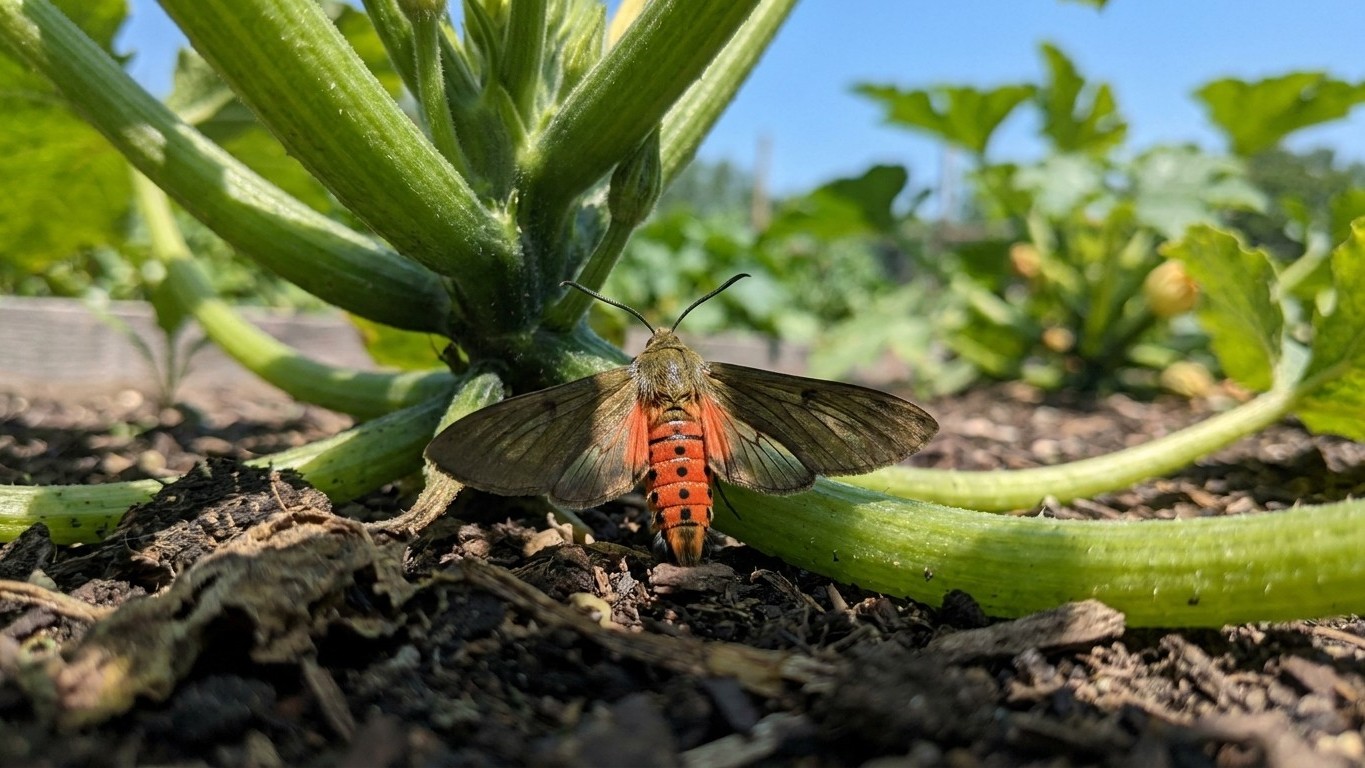
Melittia cucurbitae spends the winter as a larva or pupa tucked inside a silk cocoon one to two inches below the soil surface, right where last year’s squash plants stood. When soil temperatures warm enough in late spring, the moth emerges. It’s a striking insect, day-flying and often mistaken for a wasp: dark olive-brown front wings, clear hind wings, and a fat orange-red abdomen dotted with black spots. Homeowners who spot one hovering near their squash bed in early summer are seeing the adult stage, and that sighting should trigger immediate action, not a wait-and-see approach.
Females lay small reddish-brown eggs singly at the base of stems, usually right at or just below the soil line. Each egg hatches in about a week to ten days. The newly hatched larva immediately bores into the stem and starts feeding inside the plant tissue, hidden from view for four to six weeks. That hidden feeding period is exactly why so many gardeners never see the culprit until the damage is already severe.
Because Ontario’s growing season runs cooler and shorter than states like Kentucky or Georgia, entomologists at extension programs across the northern tier, including University of Minnesota Extension, note that gardens at similar latitudes typically get just one generation annually rather than the two seen further south. That single-generation pattern actually works in the gardener’s favor. It means there’s one clear high-risk period to defend against each season, not a rolling series of threats from June through September.
Recognizing Damage Before the Whole Vine Collapses
The first visible sign is rarely the insect itself. It’s a sudden wilt on one runner of an otherwise healthy plant, often on a hot afternoon when the rest of the garden looks fine. That selective wilting, one vine down while its neighbors thrive, is the calling card of a larva already established inside the stem.
Look near the base of the affected vine for small holes surrounded by a moist, sawdust-like material that’s greenish-yellow or orange-brown in color. That’s frass, essentially larval excrement pushed out of the feeding tunnel, and it’s the most reliable field diagnostic available to a home gardener. A slit made lengthwise along the stem near an entry hole, using a sharp knife, will often reveal a fat, cream-colored caterpillar with a dark head, sometimes more than one per stem in a bad infestation.
Not every squash relative faces equal risk. Zucchini, yellow summer squash, pumpkins, and acorn or buttercup types (Cucurbita pepo and Cucurbita maxima) have hollow, relatively soft stems that larvae tunnel through with ease. Butternut squash, a Cucurbita moschata variety, has denser, more solid stem tissue and roots readily at leaf nodes along the vine, which makes it noticeably more tolerant of borer feeding even when eggs are laid on it. Cucumbers, melons, and watermelons are rarely bothered at all.
Timing Controls to Ontario’s Actual Flight Window
Prevention beats treatment with this pest, mostly because once a larva is inside the stem, insecticide sprays applied to foliage can’t reach it. The strategy that works focuses almost entirely on the three to four weeks before and during adult flight.
Floating row covers, placed over young plants at transplanting and left in place until flowering begins, physically block egg-laying females from reaching the stems. Because squash plants need pollinators once flowers open, covers have to come off at bloom time, which means the timing has to line up with when moths are actually active in a given Ontario region. Gardeners farther south in the province, around the Niagara area or Windsor-Essex, tend to see moths a bit earlier than those in cooler zones near Ottawa or the northern shore of Lake Superior, since soil warms faster in those milder pockets.
A few other tactics have solid track records among vegetable growers dealing with this insect:
- Wrapping the base of each stem in aluminum foil or a nylon stocking piece creates a physical barrier against egg-laying at the most vulnerable point on the plant.
- Mounding soil over stem nodes encourages secondary rooting, so a plant that does get bored into higher up can still survive on roots established lower down.
- Delaying planting by two to three weeks past the usual date can sometimes push germination past peak moth activity, though this trades borer risk for a shorter harvest window.
- Removing and destroying vines immediately after the final harvest, rather than leaving them to decompose in place, cuts down on the overwintering population available to emerge the following year.
For gardeners who already have larvae established in a stem, a surgical approach sometimes saves the plant. Slitting the stem lengthwise near the entry hole, extracting the larva with a needle or knife tip, then mounding moist soil over the wound, gives the plant a chance to reroot and recover. It’s messy and not guaranteed, but it’s often the only option once tunneling has started.
Choosing Varieties That Shrug Off Ontario’s Borer Pressure
Plant breeding offers a shortcut that a lot of home gardeners overlook. Butternut squash and other Cucurbita moschata types resist damage far better than the pepo group, largely because of that solid stem structure mentioned earlier. Gardeners who’ve struggled year after year with zucchini losses often find that switching a portion of their squash bed over to butternut, or to moschata hybrids bred for similar traits, cuts losses substantially without changing any spray schedule at all.
Succession planting adds another layer of insurance. Starting a second round of summer squash seed in early July, timed to germinate after the main moth flight has tapered off, gives a backup crop that sidesteps the worst of the pressure entirely. This works particularly well in Ontario given the single-generation pattern; a late-planted crop isn’t likely to face a second wave of egg-laying the way it might in a warmer, multi-generation region.
Bacillus thuringiensis (Bt), applied as an injection directly into the stem or as a spray targeted at the base of the plant during the egg-hatch period, can kill young larvae before they tunnel deep enough to escape contact. Timing this treatment to coincide with the local flight window, rather than applying it on a fixed calendar date, makes the difference between a treatment that works and one that’s too early or too late to matter. Watching for the first adult moths in the garden, or setting a simple yellow sticky trap near the squash bed in late June, gives a practical signal for when to start.
Related guides
- Squash vine borer in Manitoba: When It Shows Up and What Stops It
- Squash vine borer in Quebec: When It Shows Up and What Stops It
- Squash vine borer in Pennsylvania: When It Shows Up and What Stops It
- Squash vine borer in Prince Edward Island: When It Shows Up and What Stops It
- Squash vine borer in Maine: When It Shows Up and What Stops It
- Squash vine borer in Kansas: When It Shows Up and What Stops It