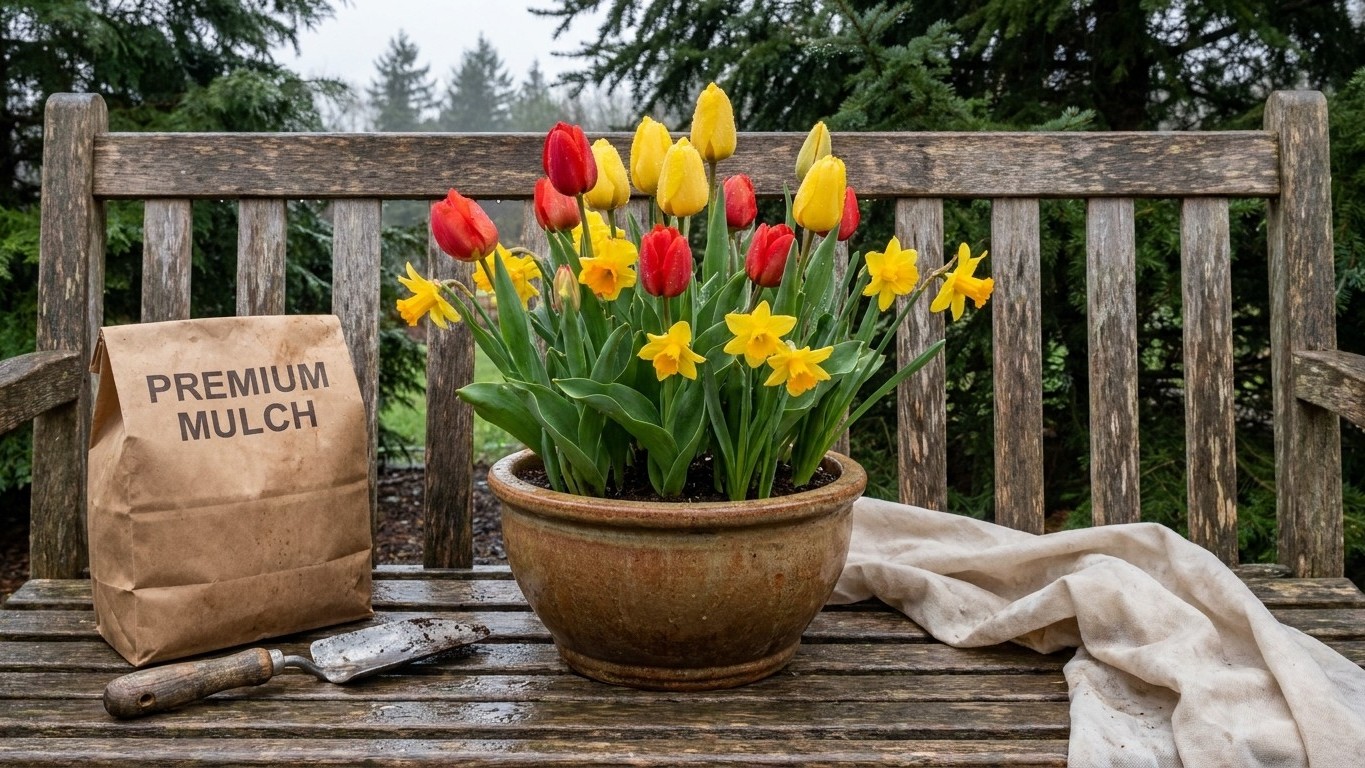

A pot of tulips or daffodils makes it through an Oregon winter only if the container gets the protection the ground gives for free: mass and insulation. Grow spring bulbs in Containers here by picking varieties with a short chilling need, sizing the pot at least two USDA zones hardier than the bulb calls for, and moving or mulching it before a hard freeze. Forcing bulbs indoors solves a different problem, one this state mostly doesn’t have.
Why this matters in Oregon

The mean daily minimum temperature during Oregon’s coldest month, measured at the Portland reference station, sits at 36.2°F, according to NOAA NCEI Climate Normals for 1991-2020. That single figure decides which of two very different bulb problems applies to a given garden here.
Forcing is the fix when winter doesn’t deliver twelve to fourteen weeks below 45°F on its own, so the gardener has to supply that cold artificially in a fridge or an unheated space. At 36.2°F, the typical overnight low in Portland’s coldest month already sits well under that 45°F ceiling, which means a bulb planted directly in the ground in the milder parts of the state usually banks enough chilling hours from the winter itself. Forcing, is optional insurance here more than a necessity for garden-planted bulbs.
Containers change the math entirely. A bulb bed in open ground is surrounded by a huge volume of earth that buffers temperature swings, so the soil a few inches down rarely freezes solid even when the air does. A container has no such buffer. Its whole soil mass tracks the air temperature almost directly, which means a pot can freeze through, roots and all, on a night when the same bulb planted in a bed nearby stays untouched. That’s a threshold failure, not a slow one: the bulb is fine right up until it isn’t.
The USDA Plant Hardiness Zone Map, built on 1991-2020 normals, places Oregon anywhere from zone 4a to 9b, one of the widest spreads of any state in the country. Portland sits toward the milder end of that range, but a container left outside in a Willamette Valley yard is not facing the same winter as one in the Cascades or the high desert further east, even though both are technically “Oregon.” The zone printed on a bulb’s tag has to be checked against where the pot actually sits, not against a statewide average that spans five and a half zones.
For most container growers clustered around the state’s milder valleys, the practical work is protecting the pot from the occasional hard freeze, not manufacturing cold the winter already supplies to bulbs in the ground.
How to do it here
- Locate the pot on the zone map, not the state average. If the container sits in the Willamette Valley near the milder end of Oregon’s 4a-9b range, hard freezes are occasional. If it sits at elevation or east of the Cascades, treat it as a colder pocket and plan accordingly.
- Buy or size the container two USDA zones hardier than the bulb’s tag calls for. If the tag lists a bulb as hardy to zone 6, the potted version needs the equivalent of zone 4 protection, since the pot loses the ground’s insulating mass.
- Confirm the bulb’s chilling requirement, usually twelve to fourteen weeks below 45°F. Check the source that came with the bulb; requirements vary by species and this isn’t published for every variety in one place.
- If that chill isn’t happening where the pot sits, supply it yourself. An unheated garage that still stays above freezing works. So does a refrigerator drawer, kept away from ripening fruit, since the ethylene gas fruit gives off can kill the flower bud forming inside the bulb.
- Plant in a well-draining potting mix, not garden soil, at the depth listed for that bulb. Garden soil compacts in a container and holds too much water around the base of the bulb.
- Insulate or relocate the pot once nights consistently threaten a freeze. Group pots against a wall, wrap them in bubble insulation, or move them into an unheated garage until the coldest stretch passes, then bring them back out.
Which bulbs are worth it
Not every bulb rewards the effort of a container. A short chilling requirement forces faster and finishes bloom before a tall stem has time to develop, which is exactly the trait that makes some species reliable in a pot and others a disappointment.
- Crocus, short chill and a short stem that never has room to topple
- Paperwhite narcissus, needs no chilling period at all and blooms fast
- Hyacinth, short chill requirement and a sturdy, low stem
- Dwarf iris (Iris reticulata), small enough to suit a pot’s limited root run
- Snowdrops, short chill and low growth habit
Bulbs that are already a one-season purchase, like most forced paperwhites and forced hyacinths, cost nothing in the long run when forced, since they were never going to return and rebloom regardless.
- Tall tulips, need fourteen to sixteen weeks of chill and a stem that flops in a container’s confined soil
- Tall trumpet daffodils, top-heavy once in bloom and prone to tipping a pot
- Fritillaria imperialis, height and weight work against it in anything but a large, heavy planter
- Allium giganteum, wants more root room than a container gives and a longer chill than most gardeners plan for
Perennial natives bought for years of return, like camassia, are the ones to skip forcing on entirely. They sulk when rushed because the whole reason for planting them was the long game, not one season of bloom.
What goes wrong, and when you can still fix it
Leaves but no flower
The bulb put out foliage but skipped the bloom entirely. This almost always means the chilling period ran short of the twelve to fourteen weeks below 45°F the bulb needed to form a flower bud in the first place. There’s no fixing this season’s bulb; give it a full, uninterrupted chilling cycle next winter and it will usually flower the following year, provided it wasn’t already too weak to try again.
A flower on a stem too short to see
The bloom opened but the stem never had a chance to elongate. This happens when a chilled bulb gets warmed up too fast, skipping the gradual transition it needs to stretch before flowering. This season’s bloom can’t be corrected once it’s underway. Next time, warm the bulb gradually over a week or two rather than moving it straight from cold storage into a warm room.
Rot in the pot
The bulb turns soft, discolored, or moldy before it ever blooms. This is a drainage failure, water pooling around the base because the pot lacked drainage holes or the mix was too dense. A bulb that has already gone soft is done for the season and should be discarded. The fix is for the next planting: drill drainage holes, use a loose potting mix, and never let the pot sit in a saucer of standing water.