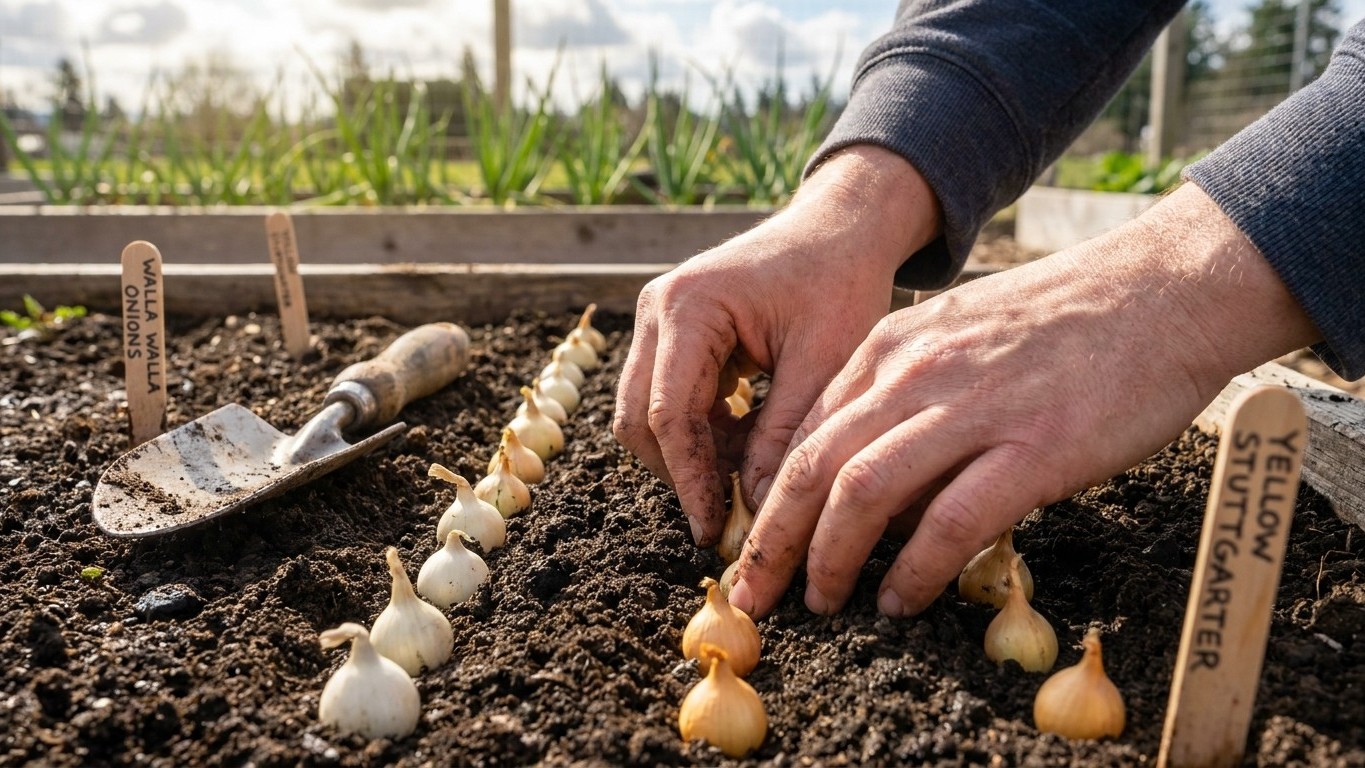

In most of Oregon, long-day onions go into the ground from late February through April, as transplants or sets, timed so the plants have several weeks of leaf growth before the June solstice. Portland sits at 45.59 degrees north and gets 15 hours 30 minutes of daylight on the longest day, well past the 12-hour trigger that starts bulbing in short-day types. That single fact rules out an entire category of onion for this state and sets the whole planting calendar around it.
The short answer for Oregon

Onions do not bulb because the weather warms up. They bulb when day length crosses a threshold specific to the variety, and that threshold is fixed regardless of temperature. Portland’s 15 hours 30 minutes of daylight on the longest day places the state firmly in long-day onion territory, alongside northern states like Washington, Idaho, and the Dakotas.
That changes the whole planting logic compared to states south of about the 36th parallel, where growers Plant Onions in fall. In mild-winter climates, short-day varieties go into the ground in October or November, spend the cool season building leaves, and bulb in early spring when day length reaches only 10 to 12 hours. There is no equivalent fall window in Oregon. Winters here are wet and cold enough to stall or kill young onion plants outright, and even if they survived, a short-day onion would start bulbing under Oregon’s spring daylight while still small.
The Oregon calendar instead runs forward from spring. Long-day (and some intermediate-day) varieties are started from seed indoors in January or February, or bought as bare-root transplants, and set out in the garden from late February in the mildest valleys through mid-April at higher elevations. The plant then has roughly four months to build leaf mass before daylight climbs past 14 hours in early June and pushes the plant into bulbing.
The gap between Oregon’s calendar and a Georgia or Texas calendar is not a matter of one region being more careful. It’s two different day-length groups running on two different clocks. Nothing about planting an Oregon garden three weeks later “to be safe” changes that clock, which is exactly the trap covered next.
What will not work here
Planting later than the recommended window does not push the harvest back. It shrinks the harvest, because the size of the bulb is locked in by however much leaf growth the plant managed before day length crossed the bulbing threshold. An onion that has produced six leaves by the time daylight hits its trigger point makes a small bulb. An onion that has produced twelve leaves by that same date makes a large one. Planting three weeks late does not give the plant three more weeks at the end. It takes three weeks away from the front, and that time is gone for good.
The bigger mistake is choosing a short-day variety at all. Several onions sold widely and grown successfully in the South simply cannot finish a bulb at Oregon’s latitude:
- Candy (intermediate-day, rated 33-40N): sits south of Oregon’s range and bulbs too early to size up.
- Red Sensation (short-day, 25-35N): daylight in Oregon never drops low enough, early enough, to match its trigger.
- Texas Grano 1015Y (short-day, 25-35N): bred for Gulf Coast and Texas daylight patterns, not Pacific Northwest ones.
- Vidora (short-day, 25-35N): same short-day ceiling, will start bulbing while still leafy and small.
- Red Rock (short-day, 30-36N, no page of its own on this site): too far south in its published range for Oregon daylight.
- White Castle (short-day, 30-38N, no page of its own on this site): still below Oregon’s 45.59N reference latitude.
- Gabriella (short-day, 20-35N, no page of its own on this site): a deep-South variety, badly mismatched here.
- Madalyn (short-day, 20-35N, no page of its own on this site): the same story as Gabriella.
Plant any of these in Oregon and the pattern is consistent: healthy green tops all summer, a bulb that never swells past marbling size, and rot setting in once the plant senses it should be dying back with nothing stored to show for it. A handful of intermediate-day varieties, including Cabernet, Calibra, Elsye, Expression, Red Carpet, and Sierra Blanca, sit close enough to the edge of their published range that they may bulb here, but a gardener planting them is working at the margin, not with a sure thing.
What changes across Oregon
Oregon runs roughly four degrees of latitude from its southern border near Ashland to the Columbia River in the north, and Portland’s 45.59 degrees north sits well toward the northern half of that span. A gardener in Medford or Ashland, closer to 42 degrees north, gets noticeably less daylight on the summer solstice than Portland does, while a gardener up near the Washington line gets slightly more.
| Region | Approximate latitude | What it changes |
|---|---|---|
| Southern Oregon (Medford, Ashland) | ~42N | Shorter summer daylight than Portland; slightly reduces the margin for long-day types, but spring soil warms sooner, which can offset it |
| Portland (reference city) | 45.59N | 15h30 on the longest day; solid long-day territory, calendar as described above |
| Northern Willamette Valley / Columbia River area | ~46N | Slightly more daylight than Portland; long-day varieties bulb with a bit more margin, but spring can arrive a week or two later |
None of this moves Oregon out of long-day territory. It shifts the timing at the margins. A gardener near the California line can often start transplants a week or two earlier than one near the Columbia River, since the growing season begins sooner in the south of the state even though the day-length trigger arrives at roughly the same point on the calendar everywhere. The coast adds its own wrinkle, with cooler, slower springs that push transplanting later regardless of latitude.
Sweet now, or onions that last
Every Oregon gardener eventually runs into the same trade-off, and it isn’t about luck or variety fashion. It’s chemistry. The volatile sulfur compounds that give an onion its bite are the same compounds that protect it from breaking down in storage. A variety bred to be mild and sweet has fewer of these compounds, which makes it excellent sliced raw on a burger in July and nearly useless by January. A variety bred sharp has more of them, tastes harsher fresh, and can sit in a cool, dark pantry until spring without going soft.
Walla Walla Sweet (long-day, rated 35-55N) is the clearest example growing right at Oregon’s doorstep. It’s a long-day onion, so it bulbs fine here, but it’s also famously sweet, and sweetness in an onion is a storage liability rather than a bonus. Growers who plant it are choosing flavor for the next few weeks over onions that last through winter.
Varieties on the sharper end of the spectrum, such as Redwing (long-day, rated 43-65N, a range that fits Oregon comfortably), trade some of that raw sweetness for months of shelf life. A gardener who wants onions in the pantry come March does better planting a firm, pungent long-day type and saving the sweet varieties for eating fresh through late summer. Growing both, in separate rows, is the simplest way to get both a summer onion and a winter one without compromising either.
Checking this against your own garden
The 45.59 degrees north and 15 hours 30 minutes used above describe Portland specifically, not every backyard in the state. A garden near Ashland, Astoria, or the high desert around Bend sits under different daylight and frost conditions, and the calendar shifts accordingly. Before locking in a planting date, it’s worth confirming a few things close to home:
- Look up your own latitude if you’re more than an hour’s drive from Portland, since even one or two degrees changes how much daylight your onions get on the solstice.
- Check your local last spring frost date, since transplants set out too early into wet, cold soil can stall rather than grow.
- Contact your county’s OSU Extension Service office for planting dates calibrated to your specific valley, coastal, or high-desert microclimate.
- Confirm the day-length rating printed on any onion seed packet or transplant tag against the groups discussed here before buying.
- Track your soil temperature at planting depth. Onion roots develop poorly in cold, saturated soil even when the calendar says it’s time.