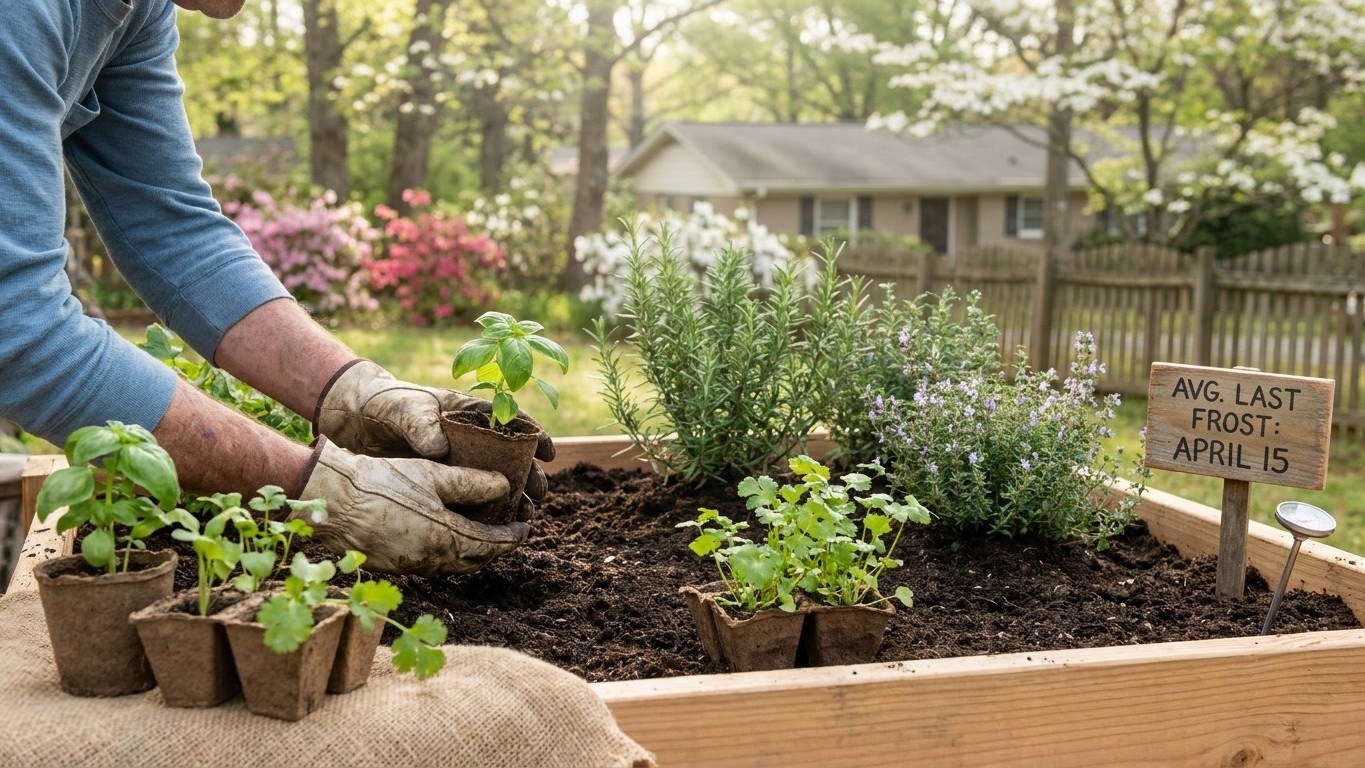

Pennsylvania gardeners can start hardy herbs like parsley, cilantro, and chives as soon as soil can be worked in late March, but tender herbs such as basil, and cuttings-grown rosemary need to wait until after the last spring frost, which falls between March 29 and April 6 around Philadelphia. That date is not a promise. It is a probability line, and what it means for your garden depends on where in the state you’re standing.
The short answer for Pennsylvania
The frost window of March 29 to April 6 comes from NOAA’s 1991-2020 climate normals for the Philadelphia reference station, and it marks the band where the odds of a 32°F freeze run between 30% and 70%. That’s a coin flip skewed slightly toward frost, not a hard cutoff. Gardeners who plant basil or other frost-tender herbs on March 30 are betting against odds that still favor a freeze more often than not.
For hardy herbs, the calculus changes. Parsley, chives, cilantro, and dill tolerate a light frost and can go into the ground two to three weeks before that window closes, once the soil has thawed and dried enough to crumble rather than clump in your hand. These are the herbs that reward gardeners who get impatient in March.
Tender herbs are a different story. Basil, in particular, sulks and yellows if soil temperatures sit below 50°F, which usually means waiting until well into the back half of that frost window, sometimes into mid-April, before transplanting outdoors with any confidence. Rosemary and other tender perennials grown as annuals here follow the same logic: wait for the warm side of the window, not the early edge.
On the fall side, the first frost arrives between November 5 and November 16, again a 30-70% probability band. That gives most of the state a working season of roughly seven months for hardy herbs and closer to six for anything that needs consistent warmth to establish and produce before cold shuts things down. Basil in particular tends to blacken at the first real cold snap, so harvesting hard before that November window opens is the safer play than hoping for a mild exception.
None of these dates are unique to one county. They come from a single reference station in Philadelphia, and that matters more than it might seem, because Philadelphia sits at the mild end of Pennsylvania’s climate spread. Anyone gardening outside the southeastern corner needs to treat these dates as a starting point, not a schedule.
What will not work here

The coldest month in Philadelphia averages a daily minimum of 26.0°F. That single number explains why so many Mediterranean herbs that garden centers sell as perennials behave like annuals almost everywhere in Pennsylvania. Rosemary, bay laurel, and many lavender varieties are bred for winters that rarely dip much below freezing overnight. A mean daily low of 26°F in the coldest month, which is itself an average and not the season’s worst night, is cold enough to kill the roots of these plants left outdoors without protection in most of the state.
This is not a case where you can simply mulch heavier and expect survival. The 26°F figure is the mean minimum for the coldest month at the mildest station Pennsylvania has to offer. Away from that reference point, especially at elevation in the Alleghenies or across the northern tier, winter lows run colder and longer, which pushes the odds against overwintering these herbs outdoors even further. Gardeners who want rosemary or bay as a permanent fixture are better off treating them as container plants that move indoors for winter, rather than fighting the ground’s cold.
Short-season herbs and the northern tier problem
Pennsylvania’s frost-free season, bookended by that spring window in late March or early April and the fall window in early to mid-November, gives the mildest parts of the state something like 210 to 230 days without freezing. That sounds generous until you remember the caution attached to these dates: the northern tier and the Alleghenies run two to four weeks later in spring, and by the same logic, likely earlier in fall, since colder air pools at elevation and lingers longer into the season.
Shave three or four weeks off each end of the season and the math changes fast. Herbs that need a long, unbroken stretch of warmth to bulk up, tender basil varieties among them, are the ones that get squeezed hardest by a shortened window. A gardener near the New York border working with a season closer to five months rather than seven is not gardening in the same climate as a plot in Chester County, even though both are technically “Pennsylvania.”
What changes across Pennsylvania
The USDA Plant Hardiness Zone Map places Pennsylvania across a span from 5a to 7b, built on the single measure of average annual extreme minimum temperature. That range is wide enough to cover the difference between the coastal Northeast and the Upper Midwest, all inside one state’s borders. There is no single hardiness answer for Pennsylvania, and any resource that gives you one number for the whole state is glossing over a real gap.
Zone 5a, at the cold end, describes conditions in the state’s northern counties and its highest elevations, where extreme minimum temperatures can fall into the negative teens in a hard winter. Zone 7b, at the warm end, describes pockets in the immediate Philadelphia area and parts of the southeast, where extreme minimums rarely drop much below 5°F. That’s roughly a 20-degree spread in the coldest nights a garden is expected to survive, and it directly affects which herbs can be treated as reliable perennials versus which need to be replanted or brought indoors every year.
The frost dates carry the same kind of spread, even though the NOAA figures cited here come from one station. A last-frost date in early April at the Philadelphia reference point is a reasonable stand-in for the mildest corner of the state, but the stated caution is direct: the northern tier and the Alleghenies run two to four weeks later in spring. A gardener at higher elevation planting on the Philadelphia calendar is planting into a frost risk that the calendar never accounted for.
What it can say is that “Pennsylvania” is really several distinct growing climates layered together, and the honest move is to check the USDA hardiness zone map directly for a specific address rather than borrowing a zone from a city on the other side of the state.
Where to check this for your own county
Penn State Extension is Pennsylvania’s land-grant university extension service, and its site at extension.psu.edu is the resource built for exactly this problem: turning a statewide range into a county-specific answer. A county-level extension office works from local trial data and local frost records, which is a different, more useful thing.
Two items are worth hunting for specifically. The first is a local planting calendar, if the county office publishes one, which will translate the general frost-date logic used here into dates anchored to that county’s own climate station rather than Philadelphia’s. The second is a list of herb varieties actually trialled in that county or region, since not every basil or parsley cultivar performs the same way across a 20-degree hardiness spread. Extension trials exist to catch that kind of regional difference before a gardener has to learn it the hard way over a lost season.
It’s also worth calling or emailing the local office directly if the website doesn’t have county-specific herb information posted. Extension offices field these questions constantly, and a five-minute phone call can surface information that never made it onto a public page, particularly for herbs, which get far less attention from extension programs than row crops or turfgrass.
A county recommendation will always beat a state one, because it accounts for elevation, local frost pooling, and soil type in ways a statewide figure cannot. Treat it as the wide-angle view, and treat the county extension office as the answer that actually applies to a specific plot of ground.
Checking this against your own garden
Every date here is a probability drawn from decades of averages. Your own garden is a single, specific place, and it will often disagree with the averages in small but important ways. Three signals are worth checking by hand before trusting a calendar date over your own soil.
- Soil warmth by feel: dig down two or three inches and grab a handful. Cold, clammy soil that clumps tightly means the ground hasn’t caught up to the calendar yet, no matter what the frost date says. Warm, crumbly soil that falls apart in your hand is soil that’s ready for tender herb transplants.
- The first flush of new growth on hardy herbs already in the ground: chives pushing new green shoots, or perennial oregano and thyme breaking dormancy, are a better local signal of true spring arrival than any date on a chart, since they’re responding to the same soil and air conditions your new plantings will face.
- The first true leaves on anything started from seed indoors: if seedlings are slow to push past their first true leaves under otherwise normal care, it often means the air or soil they’ll be transplanted into is still running cooler than the calendar assumes, and a week’s delay outdoors will cost less than transplant shock.
These three checks won’t replace the frost data, but they’ll tell you whether your particular yard is running ahead of or behind the averages this particular year, which is a question no regional calendar can answer for you.
Some gardeners also time this by the Moon: when to plant herbs by the moon, as almanac tradition rather than fact.